Four centuries on, Jan Steen's paintings still reveal the best and worst of human nature
National Gallery of Ireland marks Jan Steen's 400th birthday with seven paintings exploring chaos, morality and human nature. Free exhibition opens 21 November 2026.
Few artists have captured the contradictions of everyday life quite like the Dutch Golden Age painter Jan Steen. His canvases are filled with laughter, disorder, indulgence and affection, yet beneath their lively surfaces lies a sharp understanding of morality and human behaviour. Four hundred years after his birth, his work remains remarkably contemporary, reminding viewers that while fashions change, people rarely do.
This winter, the National Gallery of Ireland will mark the 400th anniversary of Steen's birth with Jan Steen: Sacred and Profane, a focused exhibition bringing together seven paintings that explore the extraordinary breadth of one of the seventeenth century's most accomplished artists. Running from 21 November 2026 to 25 April 2027, the free exhibition draws on the Gallery's own collection alongside major loans from the Rijksmuseum, Museum Boijmans Van Beuningen, the Bredius Collection, the Bute Collection and the National Gallery, London.
Although Steen is perhaps best known for bustling domestic interiors so chaotic that his name became shorthand in Dutch for a disorderly household, the exhibition demonstrates that his artistic ambitions extended far beyond comic family scenes. Religious narratives, theatrical compositions, portraits and finely observed studies of daily life all reveal an artist equally fascinated by humour, drama and the complexity of the human condition.
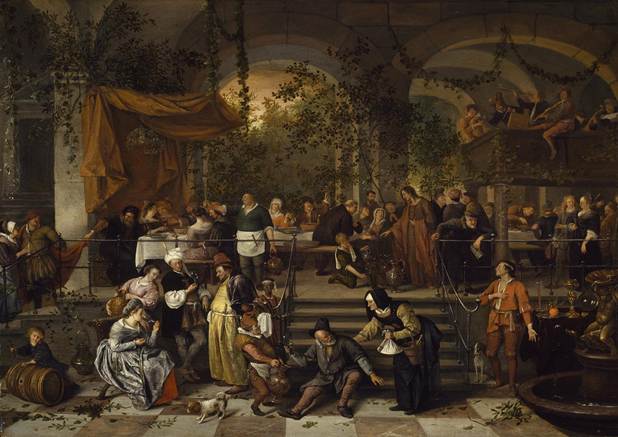
Among the exhibition's highlights is The Village School, where the discipline of a classroom is undermined by mischievous pupils, creating a scene that balances comedy with exquisite technical precision. In contrast, The Marriage Feast at Cana transforms one of the New Testament's best-known miracles into a lively social gathering, with Christ almost disappearing among the revellers as Steen focuses his attention on the colourful personalities surrounding the biblical event.
Elsewhere, The Wrath of Ahasuerus showcases the artist's ability to capture theatrical emotion, depicting the dramatic moment Queen Esther reveals Haman's plot against the Jewish people. The painting demonstrates Steen's command of expression and narrative, while Ascagnes and Lucelle, inspired by a Dutch stage play, reflects the influence of theatre on his work, combining romance with the playful humour that became one of his defining characteristics.
The exhibition also reveals Steen's remarkable versatility through portraits such as Baker's Couple Arent Oostwaard and Catharina Keizerswaard, an unusually intimate depiction of a working Dutch couple that combines portraiture, genre painting and still life in a single composition. At the opposite end of the social spectrum, The Effects of Intemperance offers a biting critique of excess and idleness, while Easy Come, Easy Go explores the fleeting nature of prosperity through a carefully constructed scene filled with symbols warning that good fortune rarely lasts forever.
Together, the seven paintings illustrate why Steen continues to occupy such an important place within Dutch art. His pictures entertain with their wit and meticulous detail, but they also invite viewers to look more closely at the decisions, flaws and virtues that shape everyday life. Rather than presenting idealised visions of society, Steen painted people as they were, capable of generosity and vanity, discipline and excess, devotion and distraction.
As museums increasingly look beyond blockbuster exhibitions in favour of more focused explorations of individual artists, Jan Steen: Sacred and Profane offers visitors the opportunity to engage deeply with a painter whose understanding of humanity has lost none of its relevance. Four centuries after his birth, his work continues to demonstrate that the line between the sacred and the profane is often far thinner than we imagine.
Continue Reading
More Art & Design
Josie Ryan paints the wildlife she refuses to let us forget
In the Tarn hills, Anne Briaud turns fragments into imagined worlds
Heinz Mack brings a lifetime’s study of light to Berlin