In the Tarn hills, Anne Briaud turns fragments into imagined worlds
Anne Briaud's collages made from paper, lace and fabric open at Château de Fiac September 4. The Toulouse-born artist transforms Tarn landscape details into dreamlike compositions through October 30.
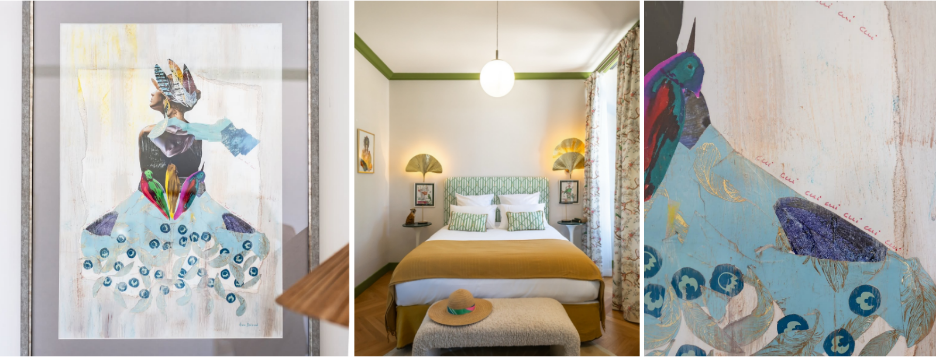
Image: Séverine @dans_les_yeux_de_sev_
A new exhibition at Château de Fiac brings the Toulouse born artist’s delicate collages into the landscape that has become one of their principal sources of inspiration
Long before Anne Briaud settled among the hills of the Tarn, there was a printing press, a collection of art books and a child fascinated by colour.
Briaud grew up in Toulouse as the daughter of a painter and engraver, in an apartment that was also her father’s studio. She drew, watched him work and disappeared into the images contained in his books. Hieronymus Bosch’s The Garden of Earthly Delights, with its strange abundance of figures, creatures and imagined landscapes, became her childhood equivalent of Alice in Wonderland.
At six, she made her first collage, combining a drawing with a piece of lace.
The materials have remained.
From September 4, Château de Fiac by The Pavilions will present an exhibition of Briaud’s contemporary collage work, bringing together compositions made from paper, lace and fabric. The exhibition runs until October 30 and places the work of an artist now based locally within the surroundings that continue to inform her practice.
Her collages have the quality of assembled memories. Trees, leaves, flowers, branches and animals emerge among female figures, while different textures interrupt and overlap one another. Rather than attempting to reproduce the landscape literally, Briaud uses its details as material for something more dreamlike.
It is an approach particularly suited to collage. The medium depends upon separation and reconstruction, taking objects and images from one context and allowing them to acquire another. In Briaud’s work, delicate materials are used to capture moments that might otherwise disappear, with nature and the progression of the seasons providing a recurring rhythm.
The setting of the exhibition consequently matters.
Château de Fiac stands in Occitanie, in the Tarn countryside around 24 miles from Toulouse Blagnac International Airport. The property has 16 rooms and suites and combines the heritage of the estate with its present life as a contemporary hotel.
Art is increasingly being incorporated into that identity.
Its recently renovated Room 8 already contains Briaud’s collages. Conceived as a quieter, more residential space, the room places her work within the everyday experience of the château rather than treating it simply as decoration.
The exhibition extends that relationship.
There is an obvious temptation for hotels to use art as another expression of luxury. The more interesting approach is to allow it to establish a connection with the place itself. At Château de Fiac, choosing an artist who lives and works in the surrounding landscape gives the collaboration a particular relevance.
For Briaud, that landscape supplies an evolving vocabulary of colour, vegetation, animals and seasonal change. For the château, her work offers visitors another way of encountering the region beyond the conventional itinerary of a country stay.
The result is an exhibition concerned less with spectacle than observation.
A scrap of lace, a piece of paper, a flower or a remembered image may appear insignificant in isolation. Briaud’s work is built upon the possibility that, assembled carefully enough, such fragments can preserve something more elusive: a place, a season or a moment before it passes.
Anne Briaud’s exhibition is at Château de Fiac by The Pavilions from September 4 to October 30, 2026.
Continue Reading
More Culture
Q&A with Ajay Chowdhury
New School Resource Uses Original Songs to Help Children Talk About Difficult Feelings
The Human League will headline Cornwall’s most eccentric festival in 2027