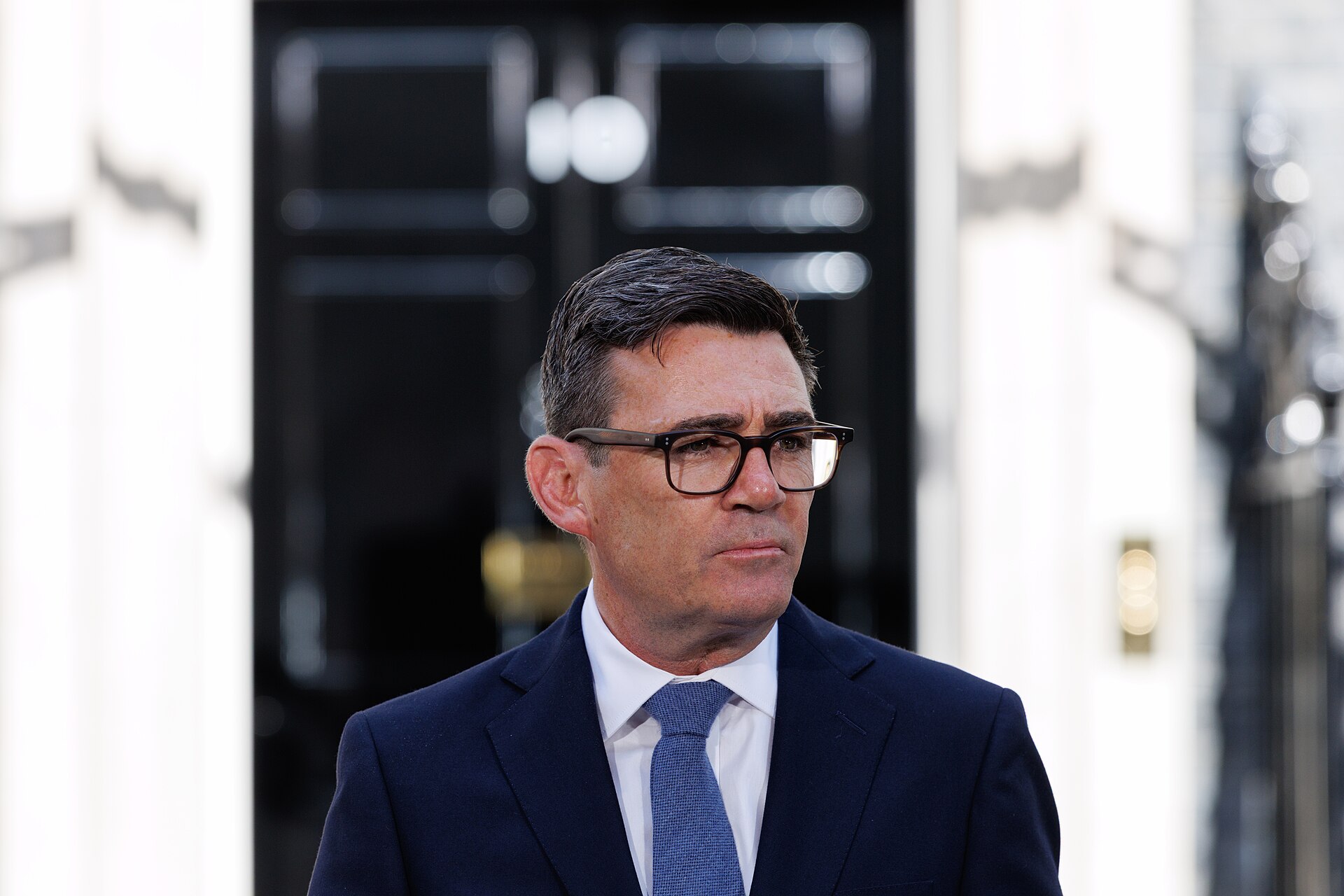
Two thirds of Britons back police powers to stop protesters hiding their faces
68% of Britons back police powers to stop masked protesters, new YouGov poll finds. Crime and Policing Act 2026 makes concealing identity at protests a criminal offence.
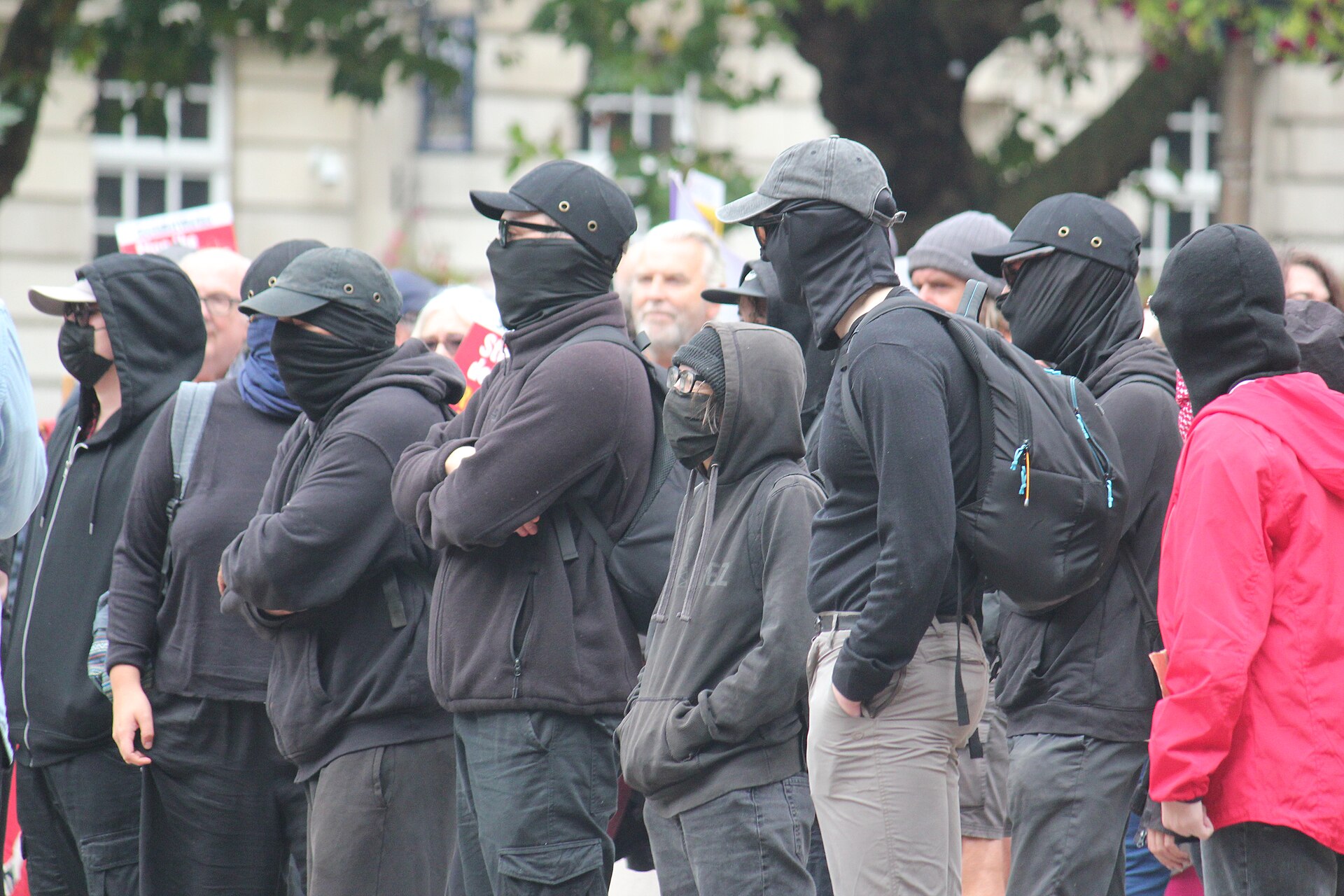
Antifa protesters facing demonstrators in Portsmouth, September 2024. Credit: Tim Sheerman Chase / Wikimedia Commons, CC BY 2.0.
New YouGov polling finds broad public support for restrictions on masks and other face coverings at demonstrations, as strengthened protest laws place greater responsibility on the police to identify those concealing themselves while offences are committed.
The right to protest has long been part of British democratic life. The right to do so anonymously while breaking the law appears to command rather less public sympathy.
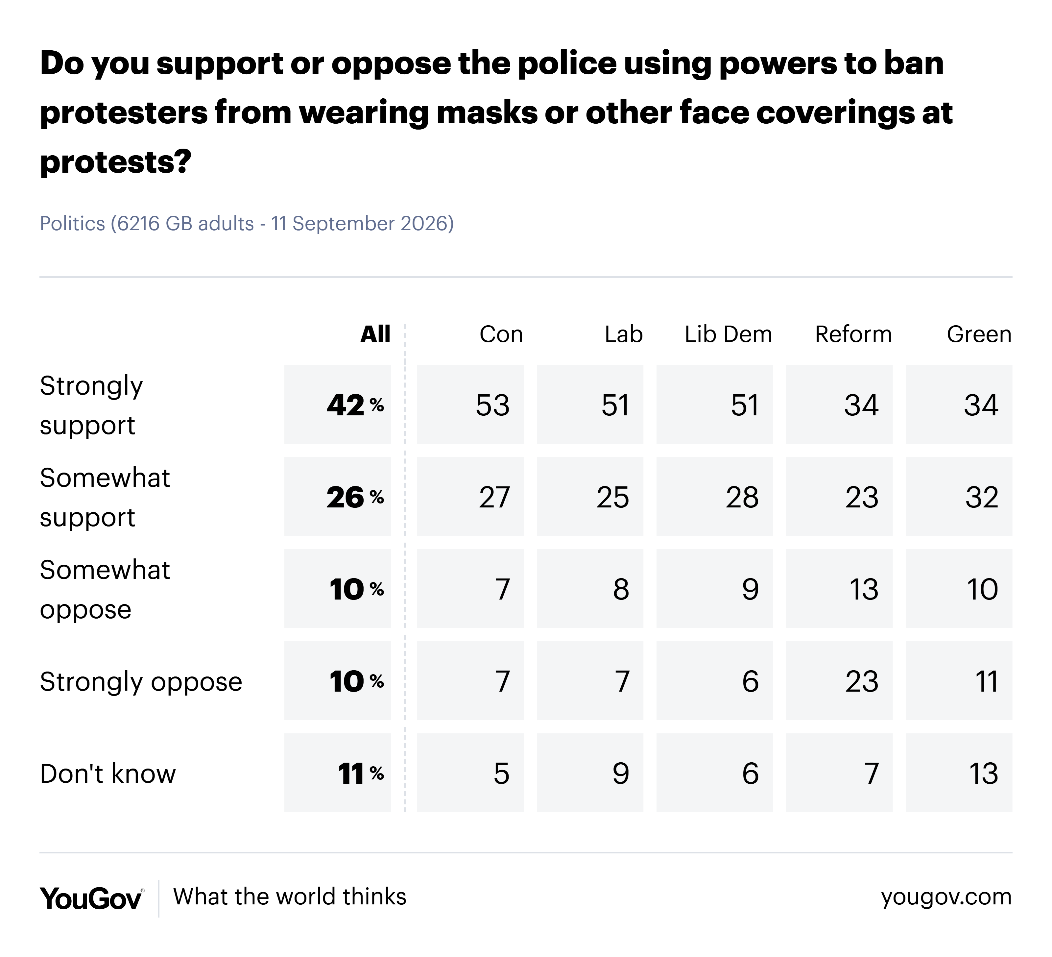
New YouGov polling finds that 68 per cent of Britons support the police using powers to prevent protesters from wearing masks or other face coverings at demonstrations. Twenty per cent oppose their use, while 11 per cent are unsure. The survey was conducted among 6,216 adults in Great Britain on September 11.
The result suggests a substantial majority of the public sees little contradiction between protecting peaceful protest and expecting demonstrators to remain identifiable when circumstances give the police grounds to intervene.
The question has acquired greater significance following changes to public order law this summer. Under the Crime and Policing Act 2026, deliberately concealing one’s identity at a protest can now constitute a criminal offence within an area designated by a senior police officer. Such an area can be designated where an officer reasonably believes a protest is taking place or may take place, offences have been or are likely to be committed, and designation is considered necessary to prevent or limit offending. The provisions came into force on June 29.
That is an important distinction. Britain has not introduced an indiscriminate prohibition on wearing a face covering at every demonstration. The power operates within defined circumstances and sits alongside longstanding protections for freedom of expression and peaceful assembly.
But once those circumstances are met, the argument for enforcement is straightforward. A protester who peacefully carries a placard presents a very different public order question from somebody who conceals their identity before committing criminal damage, threatening others or engaging in violence.
The principle must also be politically neutral.
Whether those concealing their identities identify with Antifa or other movements on the radical left, with groups on the far right, or with any other political cause should make no difference to the application of the law. Where the statutory conditions are satisfied, police powers should be exercised according to conduct and evidence, not the ideology written on a banner.
That consistency will matter if the legislation is to command confidence. Masked political groups have become an increasingly conspicuous feature of demonstrations in several Western countries, and the anonymity provided by face coverings can present an obvious difficulty when the police subsequently need to identify suspects accused of offences.
The British legislation does not outlaw Antifa as a political label, nor does the available evidence justify treating everybody associated with anti fascist protest as criminal. What it does provide is a mechanism that can apply to individuals at any protest where the legal threshold is reached. That is the more defensible position: police the offence rather than the opinion.
Interestingly, YouGov found somewhat greater opposition among people who voted Reform UK in 2024. Thirty six per cent of those voters oppose the police using the powers, although a clear majority, 57 per cent, remain supportive.
There remains a legitimate civil liberties argument against allowing the state excessive control over demonstrations. Articles 10 and 11 of the European Convention on Human Rights protect freedom of expression and peaceful assembly, and restrictions imposed by police must remain necessary and proportionate. Parliament’s Joint Committee on Human Rights has previously expressed concern about the volume of changes to protest law in recent years.
Those safeguards matter. Protest sometimes needs to be uncomfortable, unpopular and disruptive. A government should not be able to suppress political opposition merely because it finds the message inconvenient.
But protecting that principle does not require accepting anonymity as a shield for criminal behaviour.
The Government has already strengthened powers concerning pyrotechnics, intimidation around places of worship and repeated protests causing serious cumulative disruption. The challenge now is less about creating further legislation than demonstrating that the powers Parliament has provided can be applied fairly and consistently.
On face coverings, at least, the public appears considerably less divided than much of the political debate surrounding protest.
More than two thirds support police intervention. The test now is whether the law is enforced without fear or favour, from the radical left to the far right, while leaving peaceful demonstrators free to make their case.
Continue Reading
More News
The old football boots being given another match
Starmer leaves Parliament with public backing for his departure
Farage faces a test of credibility as Reform’s momentum begins to fade