Eight in ten Britons oppose Labour plan to release serious offenders earlier
82% of Britons oppose cutting prison time for serious offenders from 67% to 50%, new YouGov poll reveals ahead of October 1 early release rules.
Lauren Hurley / No 10 Downing Street / Wikimedia Commons
A newYouGov poll exposes the scale of public resistance to attempts to relieve pressure on Britain’s prisons, with voters overwhelmingly preferring more prison construction and the early deportation of foreign offenders
The Government’s attempt to solve Britain’s prison capacity crisis is colliding with a rather different public demand: people want more prison places, not shorter periods behind bars.
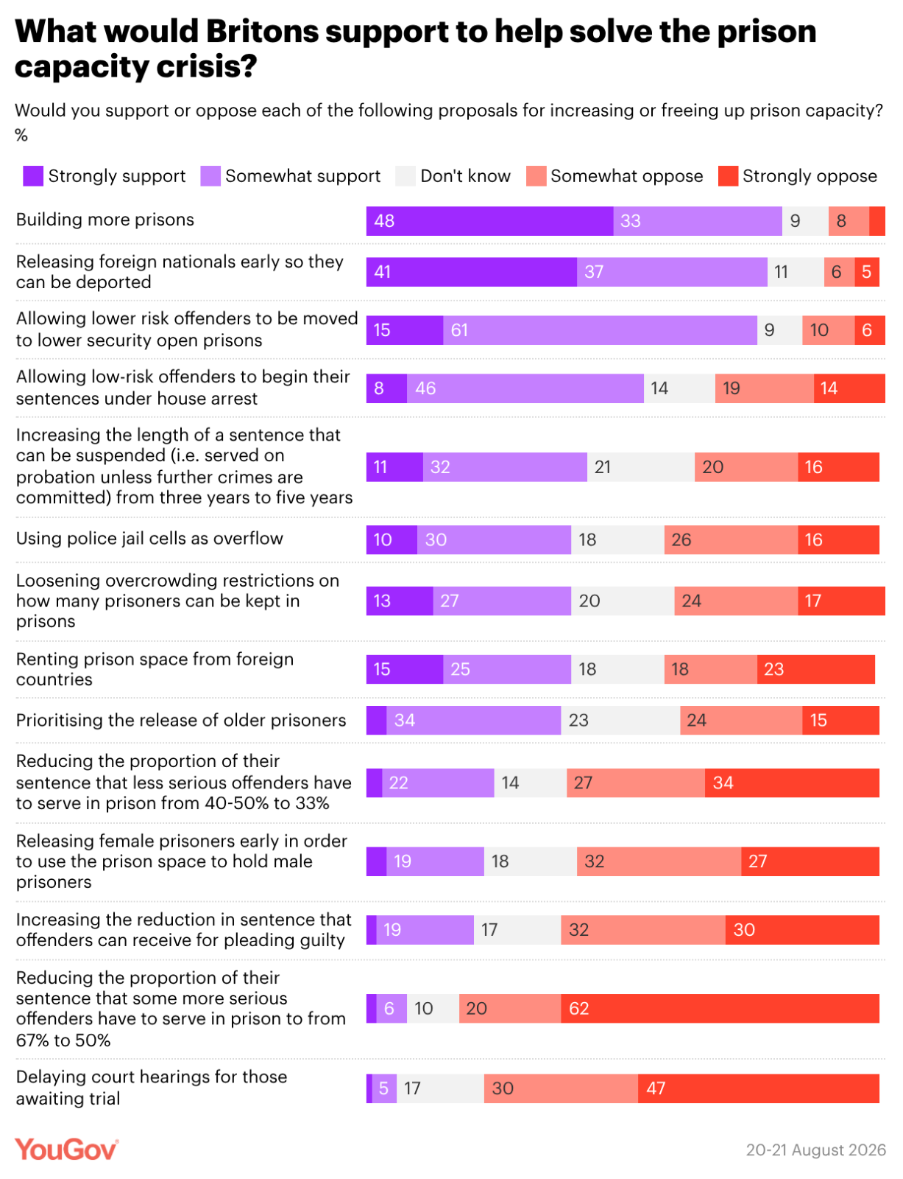
New YouGov polling has found overwhelming opposition to proposals that would allow some serious offenders to spend a smaller proportion of their sentences in prison. Some 82 per cent of Britons oppose reducing the custodial portion of sentences for certain more serious offenders from 67 per cent to 50 per cent.
Of 14 possible responses to the prison capacity crisis tested by YouGov, it attracted the greatest opposition.
The finding presents a considerable political difficulty for ministers as new early release rules are due to take effect on October 1. It follows separate YouGov polling for The Times in August which found 64 per cent of Britons believed the Government was wrong to allow prisoners to be released early.
The latest results suggest that the objection extends beyond the principle of early release and into the detail of how the Government intends to manage overcrowding.
Reducing the proportion of a sentence served in prison by less serious offenders from between 40 and 50 per cent to 33 per cent is opposed by 61 per cent.
For violent offenders, the public mood is considerably harder still.
Voters draw the line at violence
Under the changing arrangements, prisoners serving at least four years for specified violent offences could see their release point move from two thirds to halfway through their sentence. Other eligible violent offenders serving shorter sentences could spend 33 per cent of their sentence behind bars rather than between 40 and 50 per cent.
The public appears uncomfortable with the premise that many violent offenders should qualify for early release at all.
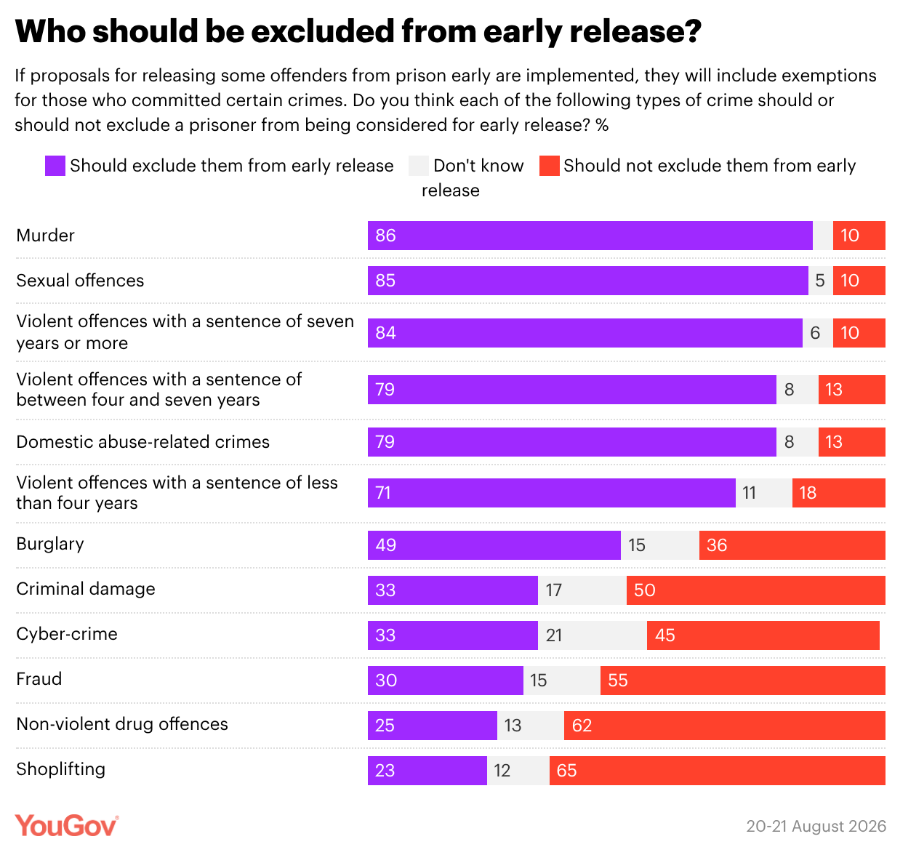
Among those convicted of violent crimes and sentenced to more than seven years, 84 per cent of Britons believe they should be excluded. That falls only slightly to 79 per cent for sentences of between four and seven years and remains at 71 per cent even when the sentence is shorter than four years.
When voters are presented with particular offences, the distinction becomes sharper. Some 86 per cent believe murderers should not qualify for early release, 85 per cent say the same of sexual offenders and 79 per cent want those convicted of domestic abuse related crimes excluded.
There is substantially greater tolerance when less serious offences are considered. For burglary, 49 per cent favour excluding offenders compared with 36 per cent who believe they should be eligible.
Only between 23 and 33 per cent believe those convicted of criminal damage, cyber crime, fraud, shoplifting and non violent drug offences should be automatically excluded.
The figures suggest the public is capable of distinguishing between categories of offending. Opposition is not simply a demand that every prisoner serve every day of every sentence. It is concentrated most strongly around violence and serious offending, precisely where some of the Government’s proposed changes are proving most contentious.
Build more prisons
Asked how the capacity problem should instead be addressed, voters gave ministers a strikingly clear answer.
Building more prisons is supported by 81 per cent of Britons, including 48 per cent who strongly support it. Releasing foreign national offenders early so that they can be deported attracts almost as much support, at 78 per cent, with 41 per cent strongly in favour.
Moving lower risk offenders into lower security open prisons is also supported by 76 per cent, although enthusiasm is less intense, with 15 per cent strongly backing the proposal.
There is more modest support for increasing the maximum sentence that can be suspended from three years to five. Some 43 per cent support the idea while 36 per cent oppose it.
One proposal associated with Reform UK, renting prison capacity overseas, divides the country almost precisely down the middle. Forty per cent support the idea and 41 per cent oppose it.
Ministers have also reportedly examined converting women’s prisons to accommodate male offenders. Some 59 per cent oppose such a move.
Taken together, the polling points towards a public preference for expanding or making different use of capacity rather than substantially reducing the amount of time serious offenders spend incarcerated.
That presents the Government with an uncomfortable practical reality. New prisons are expensive and slow to build. Overcrowding, however, is immediate.
Labour can no longer simply point to its inheritance
There is another warning in the polling.
When YouGov asked about the shortage of prison places in July 2024, shortly after Labour entered government, 49 per cent of Britons primarily blamed the Conservatives. Just 2 per cent blamed Labour, while 32 per cent held both parties equally responsible.
More than two years later, that political inheritance appears to be losing some of its potency.
Now 45 per cent say Labour and the Conservatives are equally responsible for the shortage. The proportion primarily blaming the Conservatives has fallen to 32 per cent, while 5 per cent primarily blame Labour.
That does not amount to voters principally holding the present Government responsible. It does, however, suggest that the longer Labour remains in office, the harder it becomes to explain the prison crisis solely by reference to the governments that preceded it.
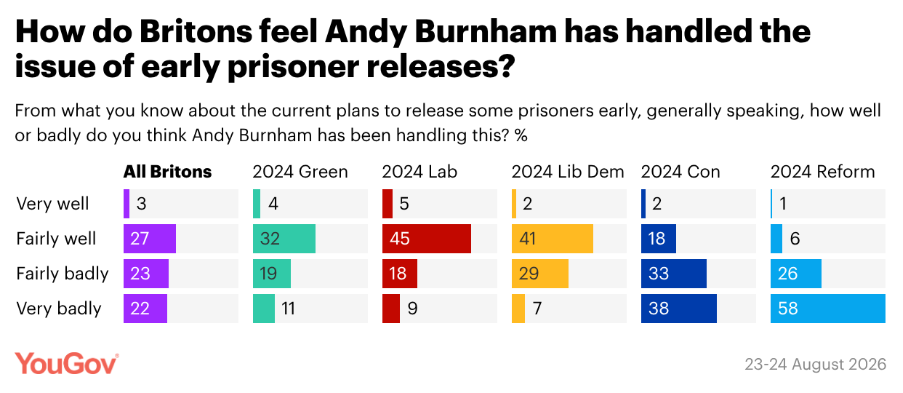
Separate recent YouGov polling for Sky News offers another indication of the political difficulty. Thirty per cent of Britons believe Andy Burnham is handling plans to release some prisoners well, compared with 45 per cent who say he is doing badly, although he retains net support among Labour, Liberal Democrat and Green voters.
The Government faces a genuine capacity problem and there are few painless solutions available to it. Keeping prisoners incarcerated requires cells, staff and money. Building substantial new capacity requires all three, as well as time.
But criminal justice depends upon more than the arithmetic of available prison places. Sentences are also a public expression of punishment, deterrence and confidence in the justice system.
On that question, the electorate appears considerably less willing to compromise.
The message contained in YouGov’s polling is unusually emphatic. Britons recognise that the prison estate needs a solution. They simply do not believe that releasing serious offenders substantially earlier should be
Continue Reading
More News
One in three Britons believe the Green Party has a significant antisemitism problem

Justin Timberlake and Jessica Biel join protein soda brand PRODA as co-founders

More than half of Britons want inheritance tax cut or abolished