Farage faces a test of credibility as Reform’s momentum begins to fade
Nigel Farage's net favourability has plunged to minus 44 as Reform UK support falls six points to 24%. Kemi Badenoch now leads him on prime minister credibility.
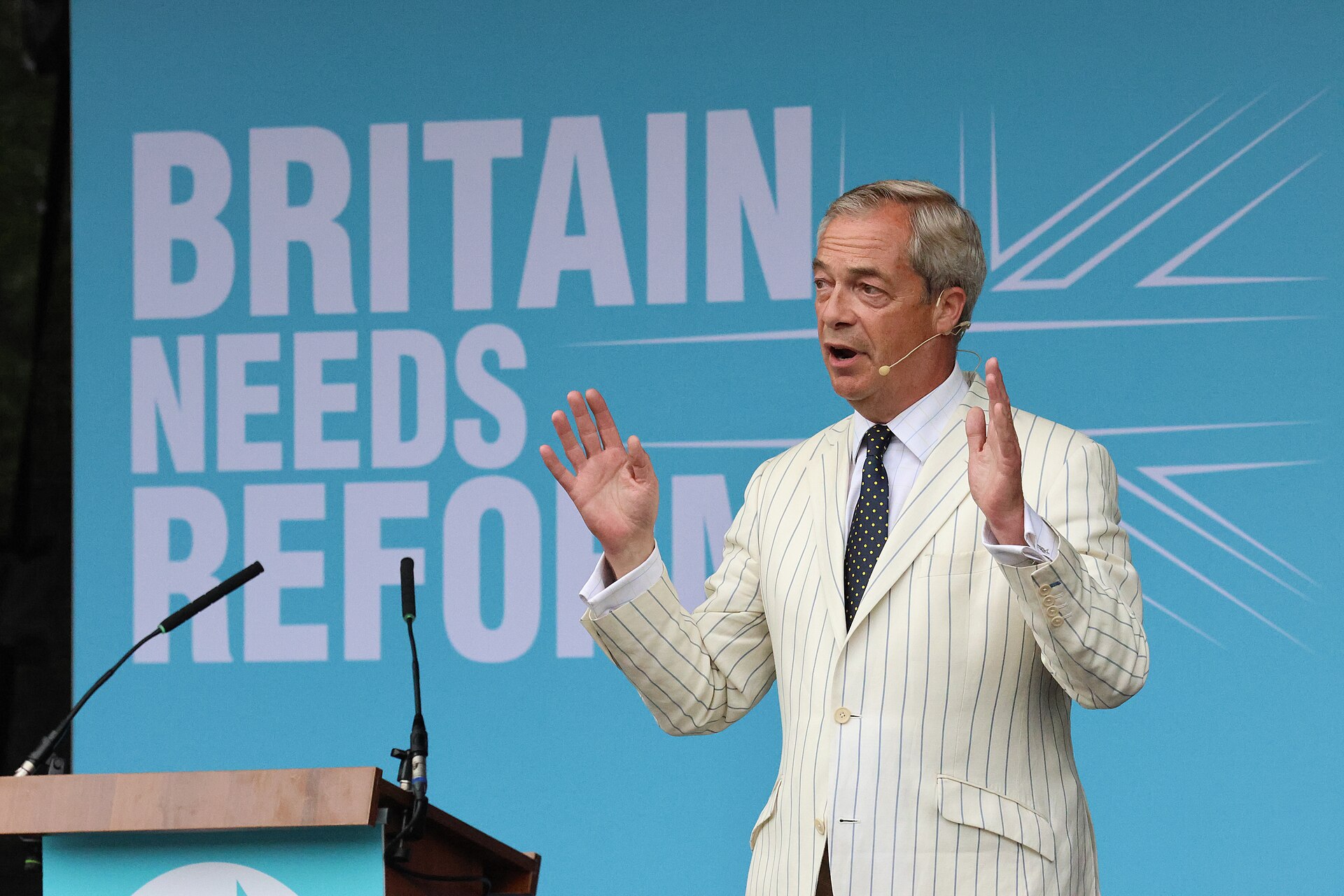
Nigel Farage addressing a Reform UK rally at Trago Mills in Devon, June 2024. Credit: Owain Davies / Wikimedia Commons, CC BY SA 4.0.
Reform UK enters conference season with its support below last year’s peak and Nigel Farage’s personal ratings deteriorating. Yet the polling also reveals a political movement whose voters remain remarkably loyal to its leader and whose appeal continues to trouble the Conservatives.
For much of the past two years, the most important question on the British Right has been how far Reform UK could rise. As the party prepares for its conference, a different question is beginning to emerge: has it reached its ceiling?
New YouGov polling suggests that some of the momentum which propelled Reform into the centre of British politics has weakened.
The proportion of Britons who say they would consider voting Reform has fallen six points over the past year to 24 per cent, while those naming it as their principal voting intention have fallen five points to 16 per cent. On both measures, YouGov says the party has returned to approximately where it stood before the 2025 council elections.
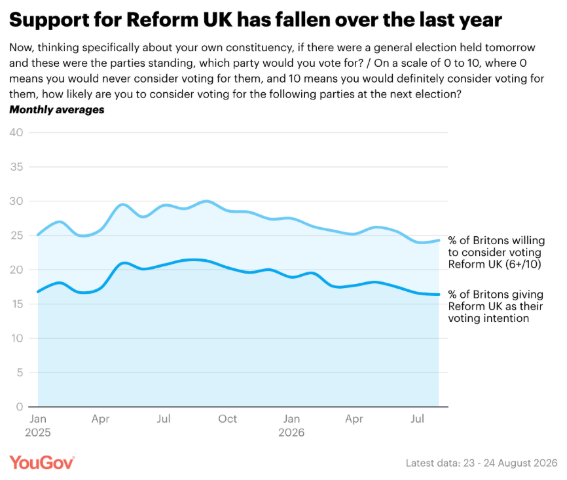
For a party that has spent much of the period since the general election threatening to overturn the established political order, that is significant.
But the more immediate difficulty may be Nigel Farage himself.
His latest net favourability rating stands at minus 44, compared with a peak of minus 27 last summer. Assessments of his performance as Reform leader have deteriorated more dramatically still, moving from a net positive rating of 18 this time last year to minus 33 today.
Perhaps most damaging is the question that ultimately matters for any insurgent leader hoping to convert protest into power.
Only 19 per cent of Britons now regard Farage as a prime minister in waiting, seven points fewer than in June. Two thirds, 66 per cent, do not believe he has the qualities required for Number 10.
That includes 27 per cent of Reform voters.
Badenoch overtakes Farage
The comparison with Kemi Badenoch will make particularly uncomfortable reading for Reform.
Some 26 per cent of Britons now regard the Conservative leader as a prime minister in waiting. Half do not, meaning Badenoch remains some distance from convincing the electorate that she is ready for Downing Street.
Yet this is the first time YouGov has recorded a higher score for Badenoch than Farage on the measure.
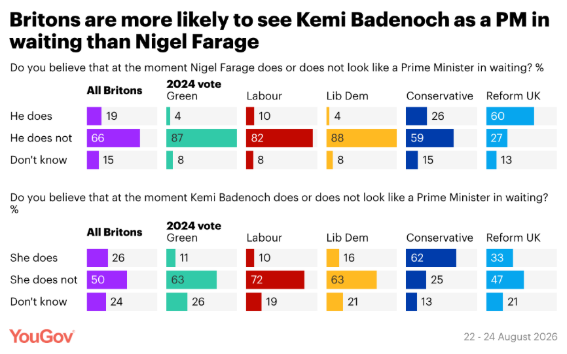
More strikingly, 33 per cent of Reform voters regard Badenoch as a potential prime minister, compared with the 19 per cent figure for Farage among the country as a whole.
The significance extends beyond the personalities involved.
Reform’s rise has depended partly upon the proposition that the Conservatives had ceased to provide an effective political home for voters on the Right. If Badenoch can rebuild credibility while Reform loses momentum, the competition for those voters becomes considerably more complicated.
YouGov’s recent Big Voter Study had already suggested that Reform’s position as the largest force on the political Right was less secure than headline polling might previously have implied.
The latest figures add another warning.
A deeply polarising leader
YouGov also asked respondents to describe Farage in three words of their own choosing, producing a revealing picture of the gulf between his supporters and the wider electorate.
Some 71 per cent of Britons used at least one negative description.
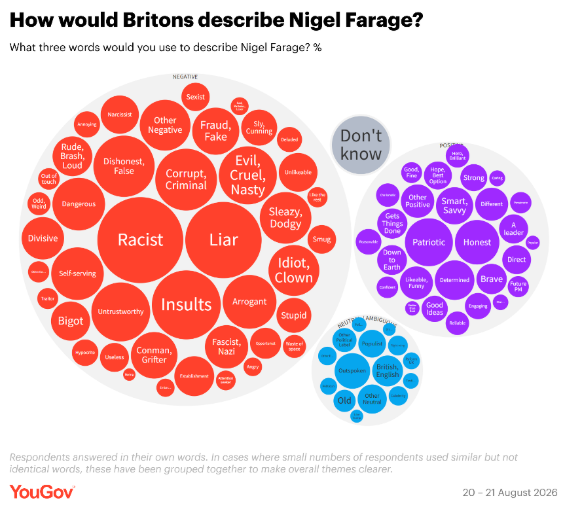
The most commonly volunteered term was “racist”, used by 15 per cent, followed by “liar” at 12 per cent. These are respondents’ descriptions of Farage rather than findings of fact about him, an important distinction when interpreting the poll.
Other responses concentrated heavily on perceptions of trust. Eight per cent described him as dishonest, another 8 per cent as corrupt or crooked, 7 per cent as untrustworthy or unreliable and 6 per cent as self serving.
One in ten respondents included at least one swearword or insult.
Yet that picture changes dramatically among Reform supporters.
Three quarters of those who voted Reform in 2024 used at least one positive description of Farage. “Patriotic” was the most common, at 16 per cent, followed by “honest” at 13 per cent and “intelligent” at 10 per cent.
Eight per cent referred to his determination, while others praised his ability to get things done, his bravery or described him as the best available political option.
This is the central contradiction surrounding Farage. He remains capable of inspiring unusually strong loyalty among a substantial section of the electorate while provoking equally intense hostility beyond it.
That can be a formidable advantage when building a disruptive political movement. Winning a general election requires something more difficult: expanding beyond the committed base without weakening the characteristics that attracted it in the first place.
Reform has a party problem too
The negativity identified by YouGov is not confined to its leader.
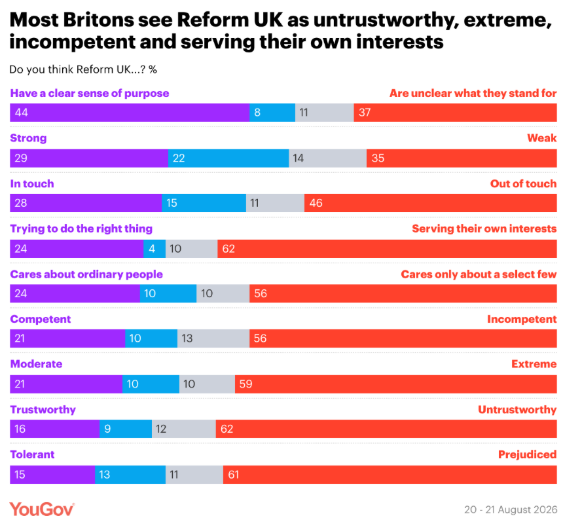
Between 59 and 62 per cent of Britons describe Reform as untrustworthy, serving its own interests, prejudiced or extreme. Some 56 per cent regard it as incompetent and the same proportion believe it cares only about a select few rather than ordinary people.
By 46 per cent to 28 per cent, voters are more likely to regard Reform as out of touch than in touch.
There is, however, one important strength.
Forty four per cent believe Reform has a clear sense of purpose, compared with 37 per cent who say it is unclear what the party stands for.
For an insurgent movement, clarity can be politically valuable. Voters may dislike Reform, but a substantial proportion believe they understand what it represents.
The Conservatives illustrate the dilemma particularly well.
Tory voters are more likely to regard Reform as purposeful, in touch and strong. At the same time, they are more likely than not to describe it as prejudiced, extreme, untrustworthy and incompetent.
That ambivalence is likely to determine much of the battle on the Right.
Reform has already demonstrated that it can take dissatisfied Conservative voters away from their former party. The challenge now is retaining them if the Conservatives begin to look competitive again.
Party conferences are designed partly to provide an answer to such moments. Reform will want to demonstrate discipline, seriousness and a programme capable of extending beyond opposition to the political establishment.
Farage faces the larger task.
He has spent decades proving that he can influence British politics without occupying Downing Street. If Reform is to make the transition from insurgency to government, voters must eventually be persuaded that its leader could occupy it.
For the moment, YouGov’s polling suggests they are moving in the opposite direction.
Continue Reading
More News
One in three Britons believe the Green Party has a significant antisemitism problem

Justin Timberlake and Jessica Biel join protein soda brand PRODA as co-founders

More than half of Britons want inheritance tax cut or abolished