NHS drawn into culture war as voters back limits on political symbols
NHS staff political badge ban backed by 45% of voters in new YouGov poll, as Lord Mann calls for restrictions on uniforms amid concerns over patient comfort.
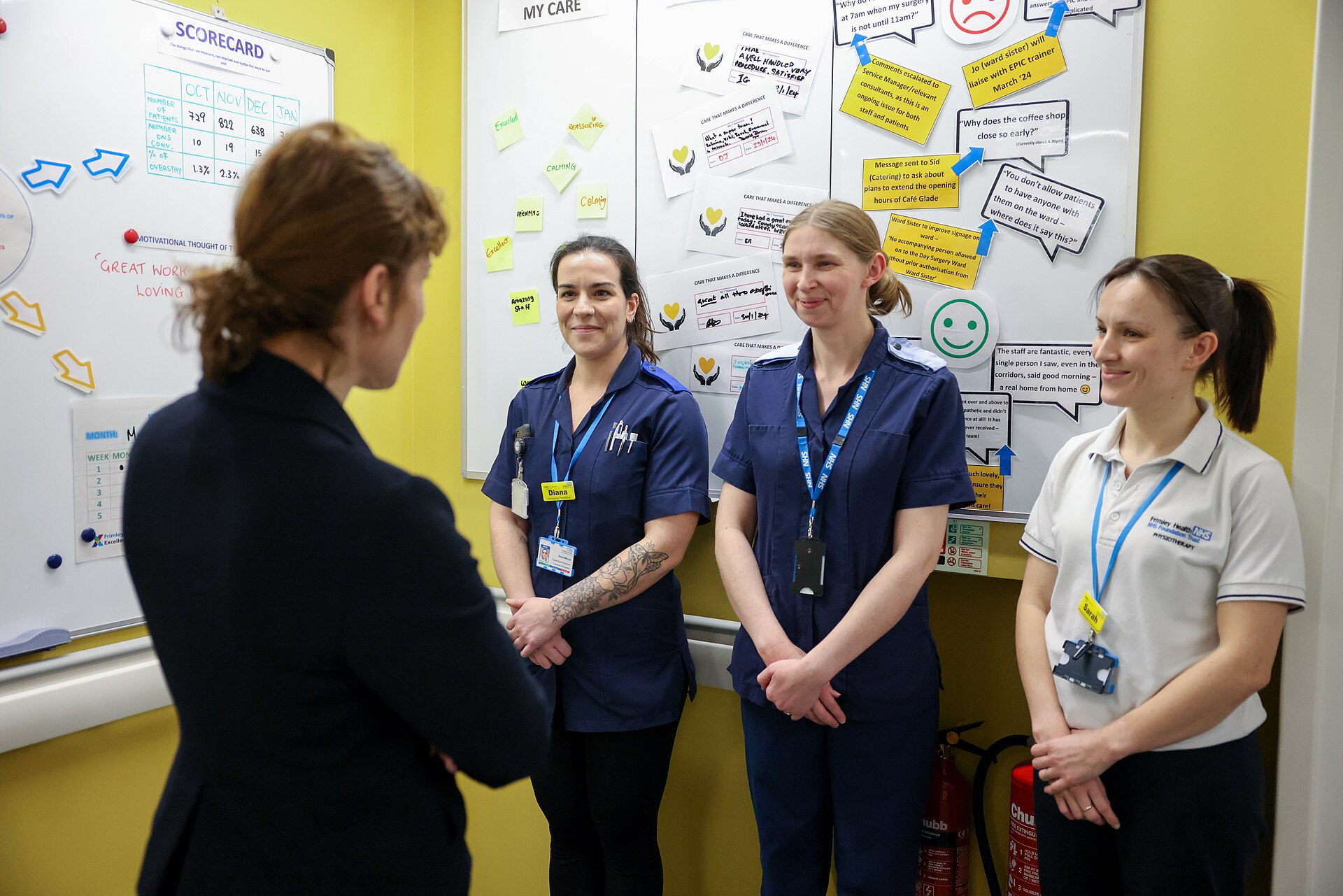
Photo: Simon Dawson / No 10 Downing Street (Open Government Licence v3.0)
For much of its history, the NHS has occupied a unique place in British life. Governments have fought over its funding, reorganised its structures and argued over its future, yet the institution itself has largely remained insulated from the ideological battles that increasingly define public debate. Patients entering a hospital have generally expected one thing above all else: treatment without reference to politics.
That assumption is now being tested.
New polling from YouGov suggests voters narrowly support preventing NHS staff from wearing political badges and symbols while on duty, following calls from Lord Mann, the government's independent adviser on anti-Semitism, for restrictions on political insignia being displayed on uniforms. The recommendation comes amid concerns that some Jewish patients and healthcare workers feel uncomfortable or intimidated by overt political messaging within clinical settings.
According to the survey, 45% support a ban on NHS staff wearing political badges while at work, compared with 40% who oppose such a move. The figures do not point to overwhelming public agreement, but they do suggest that more voters favour visible neutrality within healthcare settings than oppose it.
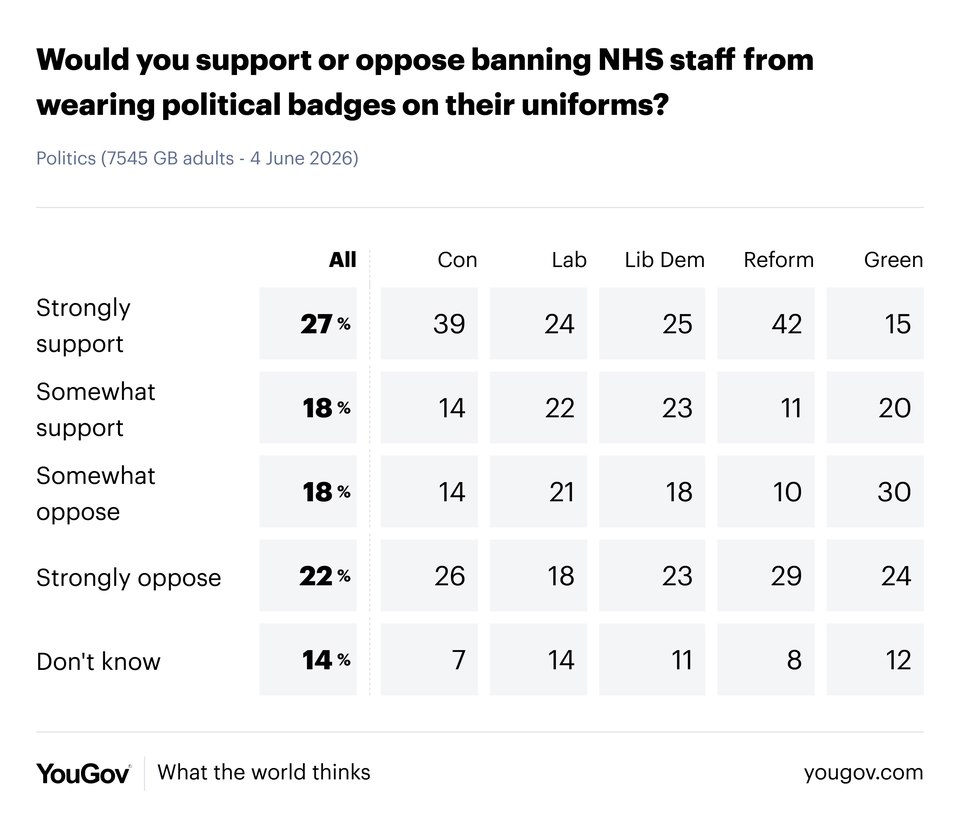
The findings are significant because support for restrictions extends across much of the political spectrum. Conservative and Reform UK voters are the strongest supporters of a ban, but Liberal Democrat voters are also more likely to support restrictions than oppose them. Labour supporters remain closely divided, while Green voters are the only major political group to show clear opposition to the proposal.
The debate arrives at a moment when public institutions increasingly find themselves drawn into disputes that would once have been considered far beyond their remit. Universities, schools, museums, corporations and charities have all faced growing pressure to take positions on contentious political issues. The NHS, despite its status as one of the country's most trusted institutions, is no longer immune from those pressures.
Supporters of a ban argue that hospitals and surgeries should remain politically neutral environments. Their case is not necessarily rooted in opposition to any particular cause, but in the belief that patients should never feel they are entering a space associated with a political movement, campaign or international dispute. For them, neutrality is not merely symbolic. It is fundamental to maintaining trust between healthcare professionals and the public.
That argument carries particular weight because healthcare often involves moments of vulnerability. Patients do not choose when they require treatment, nor do they arrive at hospitals expecting to navigate political messaging. Those backing restrictions contend that the NHS should remain focused exclusively on care and that visible political symbols risk distracting from that mission.
Opponents take a different view. They argue that healthcare workers do not cease to be individuals when they put on a uniform and that restrictions on political expression raise difficult questions about where the line should be drawn. What qualifies as a political symbol, who decides and whether such rules could be applied consistently are questions that remain unresolved.
Yet the controversy reflects something larger than a disagreement over badges. It speaks to a broader unease about the growing politicisation of public life. Issues that once remained largely outside institutions are increasingly finding their way inside them, forcing organisations to decide whether neutrality is still possible or even desirable.
The NHS finds itself in a particularly difficult position. Unlike many other organisations, it serves people of every faith, ethnicity, political persuasion and background. Maintaining confidence across such a diverse population requires not only impartial treatment but also the perception of impartiality. Once that perception is called into question, however unfairly, public trust can become harder to sustain.
The YouGov polling suggests that many voters believe visible political neutrality remains an important principle within healthcare. Whether ministers or NHS leaders choose to act on that sentiment is another matter. What is clear is that a debate once confined to political circles has now reached one of the country's most cherished institutions.
The question is no longer whether the culture wars have reached the NHS. The question is how the NHS responds when they do.
Source: YouGov polling of adults in Great Britain.
Continue Reading
More News
One in three Britons believe the Green Party has a significant antisemitism problem

Justin Timberlake and Jessica Biel join protein soda brand PRODA as co-founders

More than half of Britons want inheritance tax cut or abolished