Labour has lost six in ten of its voters as working-class support drifts to Reform

Gage Skidmore / Wikimedia Commons / CC BY-SA 2.0
Labour has retained the support of just 41 per cent of those who voted for the party at the 2024 general election, according to new YouGov analysis that exposes the scale of the collapse in its electoral coalition and the growing divide between the voters it has kept and those it has lost.
While the Greens have been the largest beneficiaries of Labour's decline, attracting 17 per cent of its former voters, the more consequential long-term warning may lie in the continued movement of older, working-class and Brexit-supporting voters towards Reform UK.
The figures reveal a Labour coalition splintering in almost every direction. Nine per cent of its 2024 voters now intend to support the Liberal Democrats, 6 per cent have moved to Reform UK and 4 per cent to the Conservatives, while a further 12 per cent are unsure how they would vote.
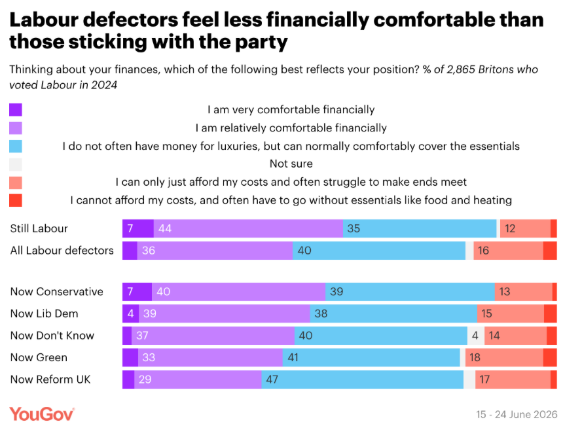
Yet behind these political defections lies a more fundamental problem for Labour: those who have abandoned the party are considerably more likely to feel financially insecure than those who remain loyal.
While 51 per cent of Labour loyalists describe themselves as financially comfortable, the figure falls to just 39 per cent among those who have left the party. Among former Labour voters who now support Reform, only 32 per cent consider themselves financially comfortable.
The cost of living has emerged as the single most common grievance, with 31 per cent of all Labour defectors citing the failure to deliver sufficient improvement as one of the main reasons they no longer intend to vote for the party. A further 26 per cent say Labour has failed to deliver on its promises, 26 per cent believe the Government lacks direction, and the same proportion blame Keir Starmer's performance as prime minister.
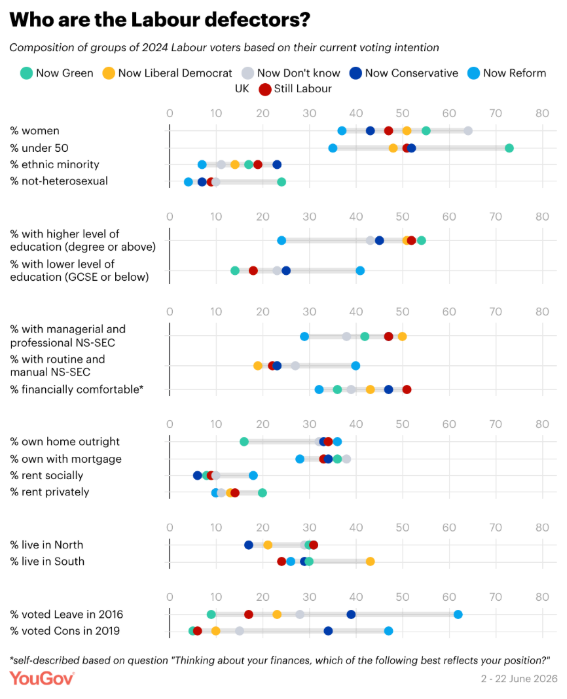
The figures present a particularly uncomfortable picture of Labour's relationship with parts of the working class. Those moving from Labour to Reform are the only significant group of 2024 Labour voters more likely to have no qualifications above GCSE level than to hold a degree, by 41 per cent to 24 per cent.
They are also more likely to have worked in routine or manual occupations than professional ones, by 40 per cent to 29 per cent. Almost two thirds, 62 per cent, voted Leave in the 2016 European Union referendum, compared with just 17 per cent of those who remain loyal to Labour.
This is not an entirely new problem for the party. Labour's estrangement from parts of its traditional working-class base has been developing for years, most visibly through the loss of the so-called Red Wall constituencies to Boris Johnson's Conservatives in 2019. The new YouGov figures suggest that the political realignment has not ended. The destination for some of those voters has simply changed.
Reform's share of Labour defectors remains smaller than that of the Greens or Liberal Democrats, but numbers alone do not tell the whole story. A voter moving from Labour to the Greens remains broadly within the political left. A former Labour voter moving to Reform represents something more profound: a journey across the traditional political divide, driven by a combination of economic dissatisfaction, Brexit sympathies and disillusionment with the established parties.
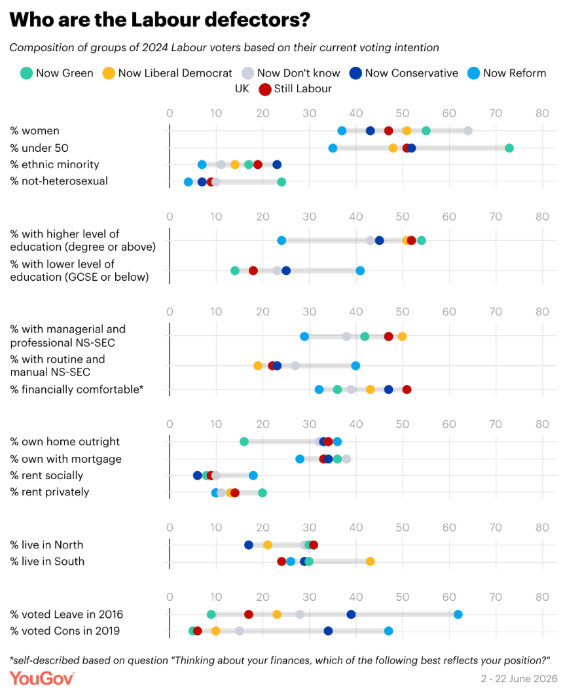
The contrast with those defecting to the Greens could hardly be greater. Almost three quarters, 73 per cent, of Labour-to-Green defectors are under the age of 50, compared with only 35 per cent of those moving to Reform. Green defectors are also more likely to be women and considerably more likely to identify as non-heterosexual than those remaining with Labour.
This leaves Labour attempting to hold together groups whose political priorities can be markedly different and, at times, directly opposed. Moving left to recapture younger Green voters risks further alienating the older, socially conservative and Brexit-supporting voters attracted to Reform. Moving right on immigration, crime or cultural questions risks accelerating losses to the Greens.
Andy Burnham, as he prepares to replace Keir Starmer, therefore inherits a party whose challenge goes considerably beyond changing its leader. The central question is whether the electoral coalition that delivered Labour to power in 2024 can ever be reconstructed, or whether it was held together primarily by dissatisfaction with the Conservatives rather than genuine enthusiasm for Labour.
The economic figures may provide the clearest answer. Voters can tolerate ideological disagreements and broken promises for only so long when they believe their own standard of living is deteriorating. The fact that Labour defectors are substantially less likely to feel financially comfortable than those who remain loyal should concern the party more than any Westminster argument over political positioning.
There is also a wider lesson in the findings. Britain's political class has spent much of the past decade attempting to understand voters through the language of identity, education, Brexit and the cultural divide between metropolitan and provincial Britain. Those factors undoubtedly matter, but household finances remain capable of cutting through them all.
A young voter moving to the Greens and an older former manual worker moving to Reform may have profoundly different views of Britain and its future. Yet both may arrive at the same conclusion when looking at their bank accounts: Labour promised change, and they have not felt enough of it.
For the centre right, the most significant opportunity lies with those voters who once considered Labour their natural political home but no longer recognise the party as representing their priorities. The Conservatives once proved they could win many of those voters. Reform is now making its own claim for their support.
With only 41 per cent of its 2024 voters intending to back it again, Labour's problem is no longer simply one of dissatisfaction around the edges. Almost six in ten of the people who put the party into power have either left or are uncertain about returning. That is not a minor electoral warning. It is evidence of a coalition coming apart.
Continue Reading
More News
More than half of Britons want inheritance tax cut or abolished
Kemi Badenoch is winning back some voters. The Conservatives are not there yet
Labour members put pensions top of the list for spending cuts