Jeanette Mundt Paints For An Age That No Longer Trusts Images
Jeanette Mundt's first German solo show at G2 Kunsthalle Leipzig responds to image manipulation and fractured truth with unstable, layered paintings.
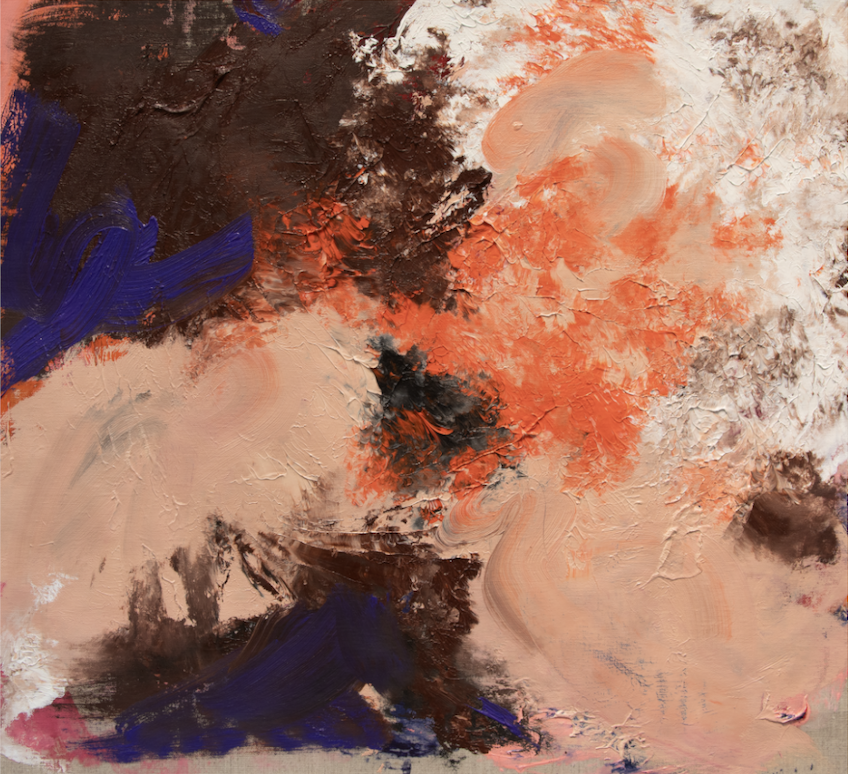
There was a time when paintings attempted to clarify the world. Jeanette Mundt seems more interested in capturing what it feels like to live inside its confusion.
Her new exhibition at G2 Kunsthalle Leipzig, Public and Beyond Judgement, arrives at a moment when certainty itself feels increasingly unstable. Images are manipulated endlessly, political realities fracture online in real time and even the idea of objective truth has become contested territory. Mundt’s response is not to retreat from that instability, but to paint directly through it.
The exhibition, her first institutional solo presentation in Germany, brings together a new body of paintings alongside a large scale mural in which recognisable art historical motifs dissolve into dense, unstable layers of colour and gesture. Classical nudes, landscapes and still lifes flicker briefly into view before collapsing back into abstraction. Representation remains present, but only barely.
That tension sits at the centre of the exhibition itself.
The title Public and Beyond Judgement comes from a letter written by Gustave Courbet, who once described his paintings as existing “beyond judgement”. Mundt has spoken of being drawn immediately to the phrase and its almost confrontational confidence, the suggestion that painting can still operate according to its own internal logic even within a culture saturated by digital reproduction and visual overload.
There is something distinctly contemporary about that struggle.
For decades, painting has repeatedly been declared exhausted, surpassed first by photography, then television, then the internet and now algorithmic image culture. Yet artists continue returning to it precisely because paint retains something resistant to speed and replication. Mundt’s work understands that instinctively.
Her paintings are not cleanly composed images so much as accumulations of pressure.
Using a process closer to monoprinting than traditional brushwork, she pushes and drags oil paint across the canvas using knives, cardboard and plastic, partially surrendering control as forms emerge and disappear through layered gestures. The surfaces feel unstable, crowded and physically worked over, as though the paintings themselves are struggling to stabilise meaning.
That material intensity matters because Mundt’s real subject is less imagery itself than perception.
She has described contemporary visual culture as “groundless” and “history less”, an environment where images circulate endlessly while gradually losing emotional or political weight. Her return to traditional genres therefore feels less nostalgic than strategic. By filtering classical motifs through distortion and abstraction, she attempts to reconnect painting with physical sensation rather than easy recognition.
In many ways, the exhibition feels almost anti digital.
Not because it rejects contemporary culture, but because it insists on slowness, texture and ambiguity in opposition to the frictionless speed of online imagery. Mundt’s paintings refuse instant readability. They ask viewers to remain uncertain.
That uncertainty gives the work much of its force.
At moments the paintings verge on violence, figures compressed beneath layers of movement and pigment, while elsewhere they drift toward something unexpectedly lyrical. Throughout the exhibition there is a persistent sense of instability, as though the image is constantly threatening to dissolve completely.
And perhaps that is precisely what makes the work feel convincing now.
Much contemporary art about technology or media culture tends toward illustration, offering straightforward commentary on screens, surveillance or digital life. Mundt instead translates the psychological atmosphere of the present into paint itself. The result is less explanatory than experiential.
Public and Beyond Judgement ultimately asks a deceptively simple question: what can painting still do in an age overwhelmed by images?
Mundt’s answer appears to be that painting can still disorientate, destabilise and resist easy consumption.
Which may be exactly what contemporary art should be doing.
Continue Reading
More Art & Design
The wooden frame changing the view of one of Russia’s great architectural monuments
Christoph Schlingensief’s art was never meant to make its audience comfortable
Josie Ryan paints the wildlife she refuses to let us forget