One in three Britons believe the Green Party has a significant antisemitism problem
One in three Britons believe the Green Party has a significant antisemitism problem, up from one in four in May, according to new YouGov polling.

Image credit: London Assembly / Wikimedia Commons / CC BY 3.0 Copy
New polling reveals growing concern about antisemitism within the Greens, alongside a wider deterioration in public perceptions of the party and its political direction.
More than a third of Britons believe the Green Party has a significant problem with antisemitism, according to new YouGov polling that also reveals a broader decline in the party's public image.
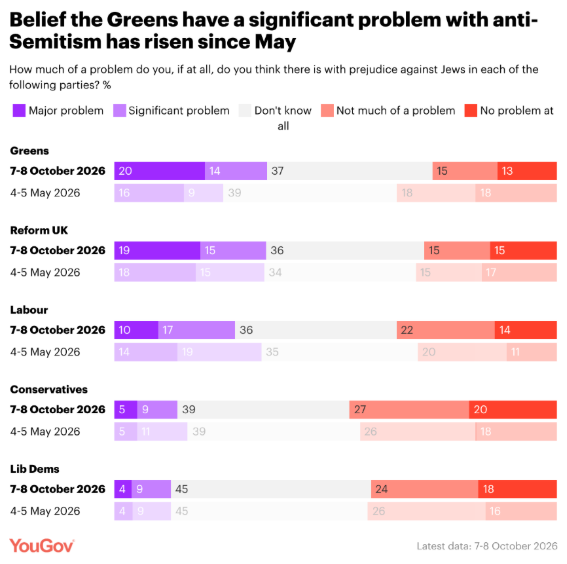
The survey, conducted on 7 and 8 October 2026, found that 34 per cent of adults in Great Britain believe the Greens have a significant or major problem with prejudice against Jewish people, compared with 25 per cent in May.
Meanwhile, the proportion who believe the party has little or no problem with antisemitism has fallen to 28 per cent, leaving more respondents expressing concern than dismissing it.
The findings reflect public perceptions rather than independently established levels of antisemitism within the party, but represent a notable change in attitudes over five months.
How the Greens compare with other parties
The Green Party is now viewed as having a significant antisemitism problem by the same proportion of Britons as Reform UK, at 34 per cent.
However, perceptions of Reform have remained relatively stable in recent months, with 30 per cent believing the party has little or no problem with prejudice against Jewish people.
Labour is seen as having a significant or major problem by 27 per cent of respondents, down six percentage points since May. A larger proportion, 36 per cent, believe the party has little or no problem.
The issue has a particular historical significance for Labour. In 2020, the Equality and Human Rights Commission found that the party had committed unlawful acts of discrimination and harassment related to antisemitism during Jeremy Corbyn's leadership.
The Conservatives and Liberal Democrats recorded substantially lower levels of public concern in the latest survey, with approximately 13 to 14 per cent believing either party has a notable antisemitism problem.
Concern among Green voters themselves
Perhaps more significant for the Greens is the change in attitudes among their own supporters.
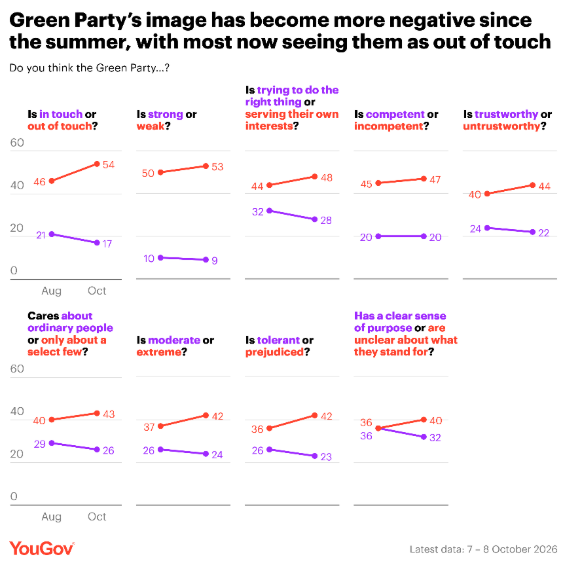
Among people who voted Green at the 2024 general election, 22 per cent now believe the party has a significant or major antisemitism problem, compared with 12 per cent in May.
Nevertheless, 52 per cent of Green voters continue to believe antisemitism is not a significant issue within the party.
Labour voters have also become more concerned. Some 30 per cent now believe the Greens have a substantial problem, compared with 17 per cent in May.
Among Conservative voters, 51 per cent hold that view, rising to 62 per cent among Reform supporters.
Perceptions of Reform UK reveal a different political divide. Between 48 and 51 per cent of Labour, Liberal Democrat and Green voters believe Reform has a significant antisemitism problem, compared with 26 per cent of Conservatives and just 10 per cent of Reform voters themselves.
The differences underline the extent to which perceptions of prejudice within political parties can vary according to voters' existing allegiances.
A wider deterioration in the Green Party's image
The polling also suggests that concerns about antisemitism form part of a broader shift in public attitudes towards the Greens.
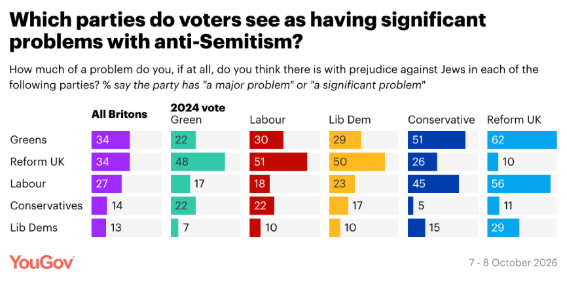
Since August, the proportion of Britons describing the party as out of touch has risen eight points to 54 per cent. Only 17 per cent now regard it as in touch with ordinary people.
A majority, 53 per cent, consider the party weak, while 48 per cent believe it prioritises its own interests over doing the right thing.
The proportion describing the Greens as untrustworthy has risen to 44 per cent, while 43 per cent regard the party as elitist.
Meanwhile, 42 per cent now consider the Greens generally prejudiced, and the same proportion describe the party as extreme.
Public uncertainty about the party's political identity has also increased. Some 40 per cent say it is unclear what the Greens stand for, compared with 32 per cent who believe their position is clear.
The changes are particularly notable because they have occurred over a relatively short period, with YouGov recording a worsening average margin across nine measures of the party's public image.
Supporters are becoming more critical
The deterioration is not confined to voters who support rival parties.
In August, 69 per cent of 2024 Green voters regarded the party as tolerant, compared with just 8 per cent who considered it prejudiced.
By October, the proportion of Green voters describing the party as prejudiced had risen to 17 per cent, narrowing the margin between positive and negative perceptions.
A similar change has occurred in perceptions of whether the party understands ordinary people.
In August, 65 per cent of Green voters considered the party in touch, compared with 14 per cent who disagreed.
The latest figures show 52 per cent describing it as in touch and 21 per cent as out of touch.
Although a majority of its existing supporters continue to express positive views on these measures, the narrowing margins suggest that some of the party's previous goodwill has weakened.
Fewer Britons willing to consider voting Green
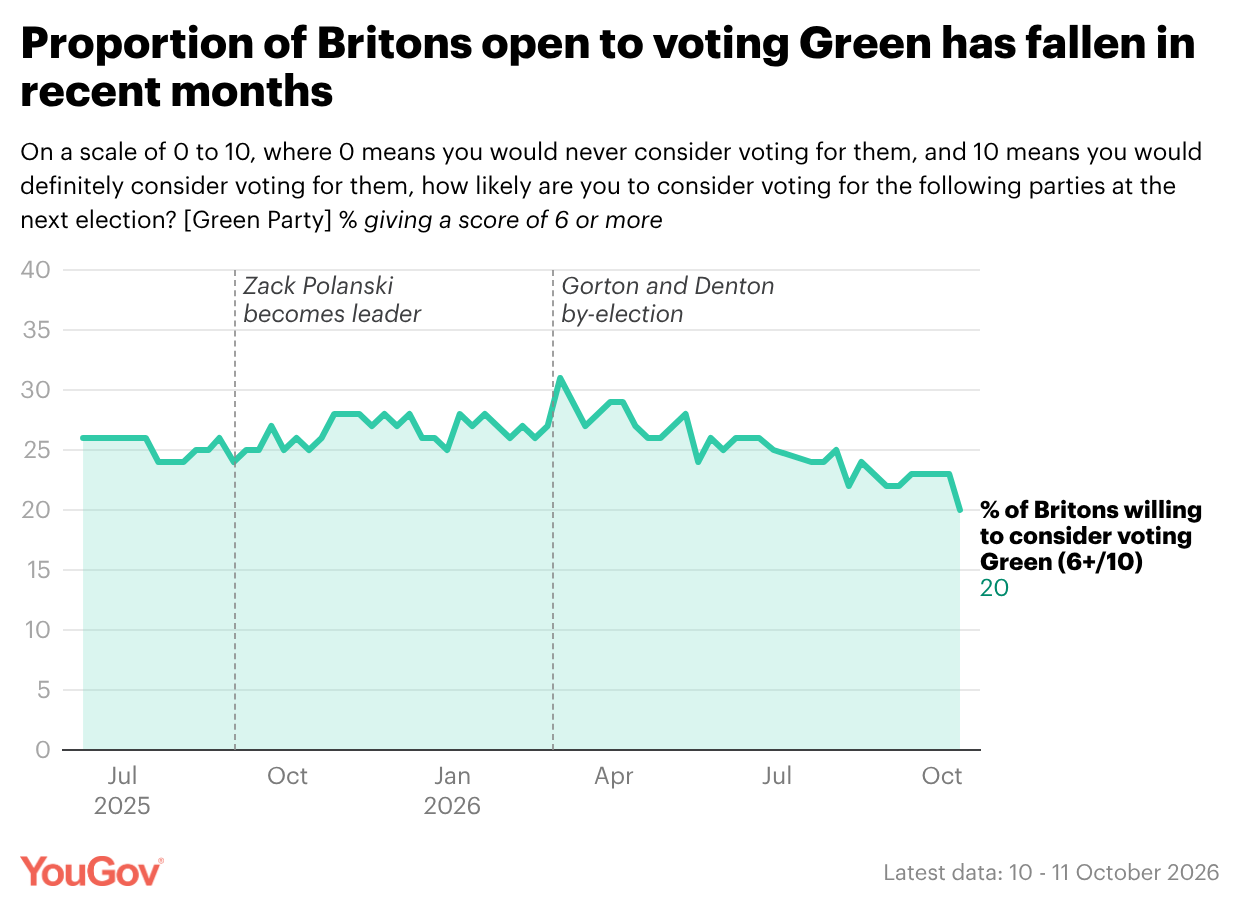
The findings coincide with a decline in the proportion of Britons prepared to consider supporting the Green Party at an election.
YouGov's latest political tracking places that figure at 20 per cent, which the polling organisation says is its lowest recorded level for the party.
Before Zack Polanski became leader, approximately 24 to 26 per cent of Britons said they would consider voting Green. That figure reached 31 per cent in March 2026.
The latest results do not establish why individual voters have changed their views, and the polling cannot determine whether concerns about antisemitism are directly responsible for the decline in willingness to consider the party.
Nevertheless, the combination of increased concern about prejudice, worsening perceptions of the party's character and reduced willingness to consider voting for it presents a significant challenge for its leadership.
For the Greens, the immediate question is not simply how to respond to criticism from political opponents, but how to address concerns that are increasingly visible among people who have previously supported the party.
The polling suggests that the party's public image has become more contested, even within its own electoral base.
The YouGov survey was conducted online between 7 and 8 October 2026 among 2,082 adults aged 18 and over in Great Britain. The findings measure respondents' perceptions of political parties, not independently verified instances of antisemitism.
Continue Reading
More News
Justin Timberlake and Jessica Biel join protein soda brand PRODA as co-founders

More than half of Britons want inheritance tax cut or abolished
Kemi Badenoch is winning back some voters. The Conservatives are not there yet