More than half of Britons want inheritance tax cut or abolished
52% of Britons want inheritance tax cut or abolished, YouGov poll finds. Abolition backed by 36%, with support spanning all five major parties.

New polling suggests that opposition to inheritance tax extends well beyond Conservative and Reform voters, with abolition the most popular individual option among supporters of all five major parties surveyed.
Inheritance tax has long occupied an uncomfortable position in British politics. Intended to tax wealth passed between generations, it has also become a source of anxiety for families concerned about what will happen to their homes, savings and estates after death.
Now new YouGov pollingsuggests that more than half of Britons would like to see the tax reduced or removed altogether.
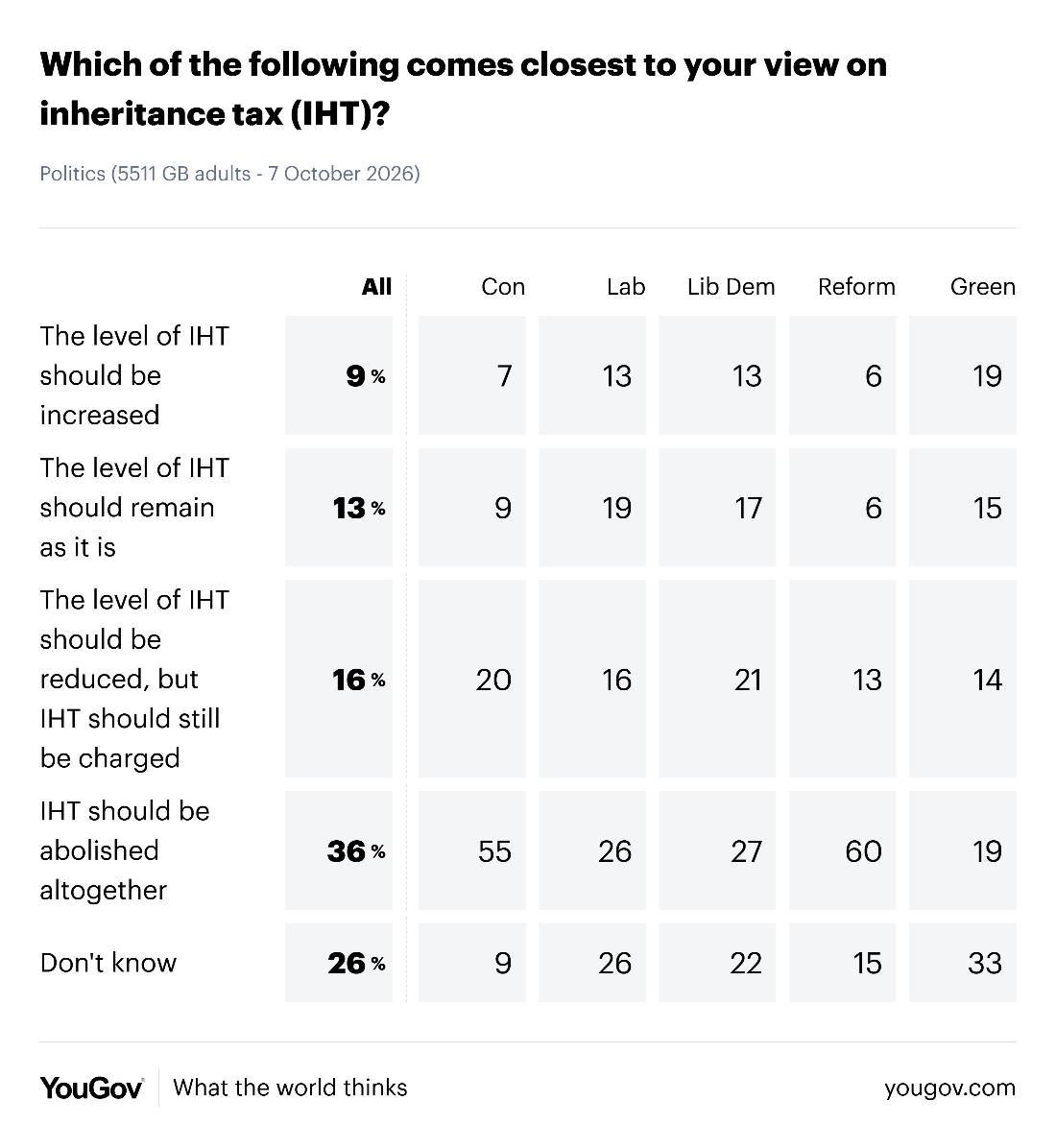
Research conducted by YouGov on October 7 found that 52 per cent of adults in Great Britain favour either cutting inheritance tax or abolishing it entirely. Of those surveyed, 36 per cent supported abolition, while a further 16 per cent wanted the level of taxation reduced.
Only 13 per cent believed inheritance tax should remain at its present level, while 9 per cent thought it should be increased.
The findings point to a notable distinction between the political debate surrounding inheritance tax and the attitudes of the wider electorate. Although the issue is frequently associated with Conservative arguments about wealth, property and family inheritance, support for abolition extends across party lines.
A tax that divides voters across party lines
The strongest support for abolishing inheritance tax came from those who voted for Reform UK and the Conservatives at the 2024 general election.
Among Reform voters, 60 per cent favoured abolition, compared with 55 per cent of Conservative voters.
The results were less emphatic among supporters of other parties, but the complete removal of inheritance tax remained the most frequently selected individual option.
Among those who voted Labour in 2024, 26 per cent supported abolition, while 27 per cent of Liberal Democrat voters expressed the same preference.
Green voters were more evenly divided. Some 19 per cent favoured abolishing the tax, exactly the same proportion who wanted it increased.
These figures suggest that attitudes towards inheritance tax do not fall neatly along traditional party lines.
However, the distinction between abolition being the most popular single response and commanding majority support is important. Among Labour and Liberal Democrat voters, for example, those favouring abolition still represented considerably fewer than half of respondents.
The findings therefore indicate a broad appetite for change, rather than a uniform consensus about what should replace the existing system.
The politics of inherited wealth
Inheritance tax raises questions that extend beyond the immediate question of how much an estate should pay.
For those who oppose it, the central concern is often the principle of taxing assets accumulated during a person's lifetime when they are transferred to their family. Property ownership, in particular, can make inheritance tax a sensitive subject, even for households that do not regard themselves as wealthy.
Those who defend the tax approach it from a different perspective. Inherited wealth can provide substantial financial advantages that are unrelated to an individual's earnings or work, and taxing larger estates is one way of raising revenue while addressing inequalities between generations.
The debate is further complicated by the difference between public perceptions of inheritance tax and the circumstances in which it is actually payable.
Not every estate incurs a liability, and exemptions and allowances can substantially affect the amount due. The consequences also vary according to the composition of an estate, family circumstances and the reliefs available.
As a result, a person's view of the principle of inheritance tax may not necessarily reflect whether their own estate would be subject to it.
The YouGov findings establish the direction of public opinion on the level of the tax, but do not explain the reasons behind individual responses or whether voters would support particular alternatives.
A renewed political debate
The polling comes as inheritance tax remains a subject of political disagreement over how wealth should be passed between generations.
Proposals to reduce inheritance tax typically focus on raising the amount families can inherit without paying it, lowering the rate charged on taxable estates or introducing additional exemptions.
Those advocating reform argue that families should be able to pass on more of the wealth they have accumulated, particularly when that wealth is tied up in a family home.
Opponents of substantial reductions point to the implications for government revenue and the potential benefits for households with the largest estates.
Under existing rules, inheritance tax is generally charged at 40 per cent on the taxable value of an estate above the relevant allowances.
The standard threshold is £325,000, with an additional allowance of up to £175,000 available in qualifying circumstances when a home passes to direct descendants. Married couples and civil partners can potentially combine unused allowances, allowing qualifying estates to pass on up to £1 million without incurring the tax.
These distinctions matter because the headline rate does not apply to the entire value of every estate, and the actual liability can vary considerably.
Nevertheless, the new survey suggests that the political argument over inheritance tax cannot be understood solely in terms of those who currently pay it.
For many voters, the question may concern the principle of taxing inheritance as much as its immediate financial consequences, although the polling does not establish their motivations.
A majority for change, but not necessarily abolition
The central finding from YouGov is that 52 per cent of Britons want inheritance tax either reduced or abolished.
That is a substantial proportion of the electorate, but it should not be confused with majority support for abolishing the tax outright. At 36 per cent, abolition remains a minority position among all respondents, albeit the most popular individual answer.
The distinction is important for politicians considering reform.
Reducing the tax rate, increasing the threshold, exempting certain assets and removing inheritance tax altogether would produce very different outcomes for families and the public finances.
The polling does not establish which of those approaches voters would prefer when presented with their respective costs and consequences.
What it does demonstrate is that dissatisfaction with the existing level of inheritance tax reaches across political affiliations, including among voters who supported parties traditionally associated with a greater emphasis on wealth taxation.
Whether that sentiment translates into support for a particular reform remains an open question.
For now, the figures suggest that inheritance tax continues to occupy a distinctive place in British public opinion: a levy paid by a relatively small proportion of estates, but one whose future concerns a much wider electorate.
The YouGov survey was conducted online on 7 October 2026 among 5,511 adults aged 18 and over in Great Britain.
Continue Reading
More News
Kemi Badenoch is winning back some voters. The Conservatives are not there yet
Labour members put pensions top of the list for spending cuts
Labour would lose 170 seats but remain largest party in a hung parliament