Andy Burnham faces an uphill battle to win back Labour voters now backing Reform UK
Andy Burnham faces uphill battle as only 11% of Labour defectors to Reform UK would consider returning, new YouGov polling reveals.
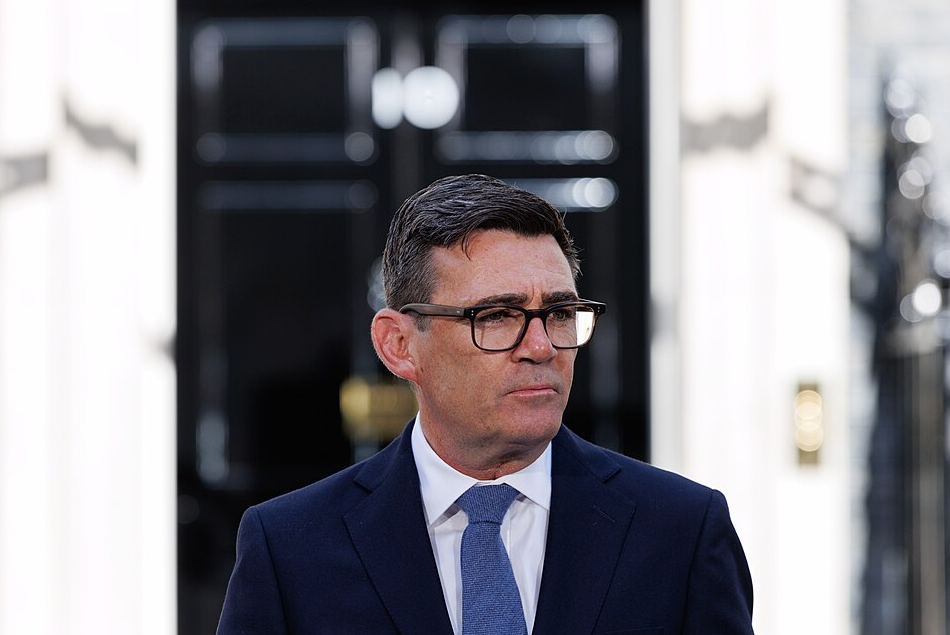
Chris McAndrew / House of Commons / Wikimedia Commons / CC BY 3.0
Andy Burnham may represent a fresh start for Labour, but new polling suggests winning back voters who have defected to Reform UK will prove far more difficult than simply changing the party leader.
A majorYouGov studyexamining Britain's political landscape two years after the 2024 general election indicates that while Burnham is viewed more favourably than his predecessor among some Reform supporters, only a small minority of former Labour voters who have switched to Nigel Farage's party are prepared to return.
The findings underline one of the defining political challenges facing the new Prime Minister. Labour's losses to Reform UK have not simply been driven by dissatisfaction with personalities in Westminster, but by a broader realignment among working-class and traditionally Labour voters who appear increasingly comfortable supporting a party once viewed as outside the political mainstream.
Reform UK's electoral coalition now rests on three distinct groups: those who backed the party at the 2024 general election and remain loyal, former Conservative voters who have crossed over in significant numbers, and a smaller but politically significant group of former Labour supporters.
Although these voters now back the same party, YouGov's research suggests they are far from identical.
Former Conservative voters who have moved to Reform tend to be financially more secure, with over half describing themselves as comfortable and a majority owning their homes outright. By contrast, Reform supporters who previously voted Labour are noticeably less affluent. Only around a third say they are financially comfortable, while nearly one in five live in council or housing association accommodation, three times the proportion among former Conservative voters now backing Reform.
The figures challenge the assumption that Reform's rise has been fuelled exclusively by traditionally Conservative voters. Instead, the party has established a foothold among sections of Labour's historic working-class coalition, particularly voters who appear to have become disillusioned with the direction of the party rather than simply attracted by Conservative alternatives.
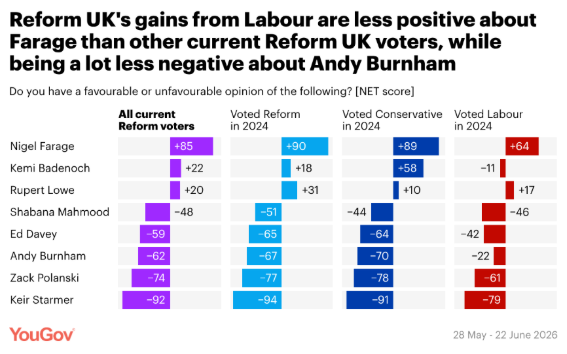
Nigel Farage remains central to that appeal. More than nine in ten current Reform supporters hold a favourable opinion of the party leader, with almost half expressing a very favourable view. Even among former Labour voters, who are marginally less enthusiastic than those arriving from the Conservatives, nearly eight in ten now view Farage positively, while only 15 per cent express an unfavourable opinion.
For Labour, however, there are faint signs that Burnham may be better placed than Sir Keir Starmer to reopen a conversation with some of those voters.
Nearly three in ten former Labour voters who now intend to vote Reform hold a favourable opinion of Burnham, compared with just over half who view him negatively. While those figures remain underwater, they represent a considerably stronger starting position than Labour often enjoyed under its previous leadership.
Yet personal popularity alone is unlikely to reverse the trend.
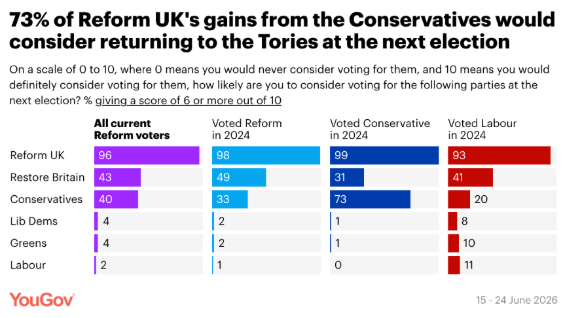
Only 11 per cent of Labour voters who have defected to Reform currently say they would consider voting Labour again. By comparison, almost three quarters of former Conservative voters now supporting Reform remain open to eventually returning to the Conservative Party.
The contrast suggests Labour faces a much deeper structural problem. Many former Conservative voters appear to regard Reform as a temporary political home, whereas Labour defectors increasingly resemble voters who have fundamentally changed their political identity.
The research also offers an insight into what continues to concern Reform supporters about their chosen party.
More than four in ten say they have no reservations whatsoever about supporting Reform, although certainty is lower among those who have recently switched from Labour. Their principal concerns include the growing number of former Conservative MPs joining Reform, allegations of racism or extremism associated with some individuals connected to the party, and questions over whether Reform could successfully manage the NHS.
Even so, those concerns have yet to translate into a meaningful willingness to return to Labour.
The findings highlight the scale of the political realignment that has taken place since the 2024 general election. For decades, British politics was largely defined by competition between Labour and the Conservatives. Reform UK's emergence has complicated that picture, particularly in communities that once formed the backbone of Labour's electoral coalition.
For Burnham, the challenge extends beyond presenting a different style of leadership. If Labour hopes to recover voters now backing Reform, it will need to persuade them not only that the party has changed, but that it once again understands the economic pressures, cultural concerns and sense of political frustration that prompted many of them to leave in the first place.
The YouGov polling suggests that task has only just begun.
Continue Reading
More News
Biscuits, berries and the weak links in Britain’s food supply

EU fund puts €20m into Swedish investor hunting founders others ignore

ISS appoints Antony Collett as Managing Director of Technical Services