The artist who taught architects to laugh gets a London retrospective
Madelon Vriesendorp retrospective opens at Sir John Soane's Museum in July. The Dutch artist transformed architecture into surreal narratives for OMA.
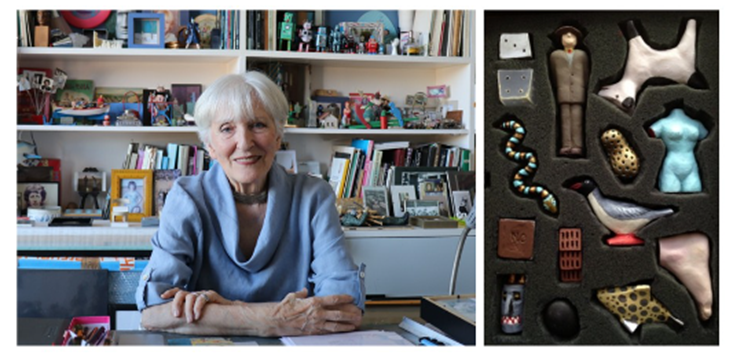
Madelon Vriesendorp
Architecture is not often associated with humour.
Its public image tends to be one of seriousness and certainty, dominated by technical drawings, grand theories and debates about form, function and urban life. Yet few figures have done more to challenge that perception than Madelon Vriesendorp, whose playful, surreal and often mischievous work has spent decades revealing the absurdities hidden within the built environment.
This summer, Sir John Soane's Museum will celebrate that achievement with the most significant UK retrospective of the Dutch artist's work in recent years.
Opening in July, Madelon Vriesendorp: Mind Games brings together more than fifty works spanning a career that has consistently blurred the boundaries between architecture, art, storytelling and satire. Drawings, etchings, sculptures, jewellery and collected objects will chart the development of an artist whose influence extends far beyond the traditional confines of the art world.
Vriesendorp occupies a unique position within contemporary culture. Although widely recognised within architectural circles, she remains less familiar to the broader public than many of the figures whose work she helped define. As a founding member of the Office for Metropolitan Architecture alongside Rem Koolhaas, she played a significant role in shaping the visual language of one of the world's most influential architectural practices.
Her contribution, however, was never purely architectural.
While others produced plans and manifestos, Vriesendorp created images. Her drawings and paintings gave shape to ideas that might otherwise have remained abstract. Buildings became characters. Cities became narratives. Architecture was transformed from a technical discipline into something more imaginative, emotional and occasionally absurd.
Perhaps nowhere is this more apparent than in her celebrated depictions of New York, where skyscrapers acquire human qualities and urban landscapes become theatrical stages for surreal encounters. Such works helped establish a visual identity for postmodern architecture at a time when the profession was increasingly questioning its own assumptions.
The exhibition's title derives from one of Vriesendorp's most intriguing creations, a work known as Mind Game. Part parlour game and part psychological experiment, it invites participants to arrange a collection of seemingly unrelated objects according to instinct and association. The resulting combinations are then interpreted in ways that reveal something about the participant's personality, fears or desires.
It is characteristic of an artist whose work has always been fascinated by perception.
Throughout her career, Vriesendorp has demonstrated an ability to take ordinary objects and reveal unexpected possibilities within them. Plastic bottles become sculptures. Everyday items acquire symbolic meaning. Humour becomes a means of understanding rather than simply entertaining.
That approach feels particularly appropriate within Sir John Soane's Museum itself.
The museum is, after all, one of Britain's great collections of curiosities. Soane assembled objects not merely for their historical significance but because they sparked ideas, conversations and connections. His house remains a testament to the creative possibilities of collecting, displaying and reinterpreting the world around us.
Vriesendorp shares that instinct. Her collections of postcards, toys, models and found objects have long informed her artistic practice, providing inspiration for works that encourage viewers to look again at things they thought they understood.
At a time when contemporary art often feels burdened by theory and explanation, there is something refreshing about an artist who places curiosity and play at the centre of her work. Yet that playfulness should not be mistaken for frivolity. Beneath the humour lies a serious exploration of how people construct meaning, interpret symbols and understand the spaces they inhabit.
The exhibition arrives at a moment when architecture itself is once again grappling with questions about identity, purpose and public engagement. Vriesendorp's work offers a reminder that creativity often flourishes when disciplines are allowed to overlap and when imagination is given room to challenge convention.
The result is a body of work that remains as relevant today as when it first emerged.
For visitors to Soane's Museum, Mind Games will provide an opportunity not simply to view an artist's career, but to enter a world where nothing is quite as straightforward as it first appears. In Vriesendorp's hands, even the most familiar object can become something unexpected.
That ability to surprise may be her greatest achievement of all.
Continue Reading
More Art & Design
Josie Ryan paints the wildlife she refuses to let us forget
In the Tarn hills, Anne Briaud turns fragments into imagined worlds
Heinz Mack brings a lifetime’s study of light to Berlin