The £35 gadget that promises to tell you what your houseplants actually need
Willow monitors soil moisture every 15 minutes and translates data into watering alerts. The £34.99 sensor aims to solve overwatering for Britain's plant owners.
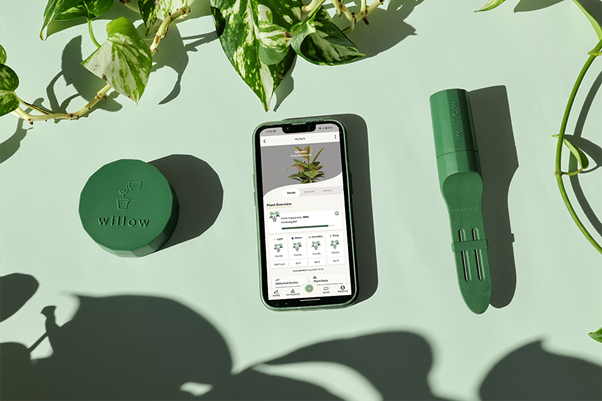
Willow monitors water, light, temperature and humidity before turning the data into practical instructions. For a nation of enthusiastic but occasionally unsuccessful plant owners, it is a rather sensible use of smart home technology
Houseplants have become increasingly sophisticated additions to British homes. Looking after them has not.
The advice is familiar enough. Water when necessary. Provide plenty of indirect light. Avoid overwatering. Maintain the correct humidity.
The difficulty lies in knowing what any of that means for the plant sitting in your particular living room.
A new generation of technology is attempting to provide an answer. Willow is a connected plant monitoring system that measures conditions around and beneath a houseplant before translating the information into practical advice on a smartphone.
It is, in effect, a health monitor for the pot.
And unlike some smart home devices, whose principal achievement can appear to be connecting an object perfectly capable of functioning independently to WiFi, there is a fairly obvious problem for Willow to solve.
Plants cannot tell us what is wrong until something starts going wrong.
What is happening beneath the soil?
The Willow Sensor is inserted directly into a plant pot, where probes measure soil moisture every 15 minutes.
It simultaneously monitors light exposure, temperature and humidity, giving the system four indicators from which to assess the plant's environment.
Importantly, those measurements are not treated equally for every species. Willow says its system takes account of the requirements of the individual plant, as well as factors including soil and seasonal conditions.
That matters because one of the difficulties of plant care is that apparently contradictory advice can be perfectly correct for different plants.
The amount of water that keeps one thriving can damage another. A sunny windowsill can be ideal for one species and distinctly unpleasant for the next.
Willow attempts to make those distinctions automatically.
An answer to the overwatering problem
Water is perhaps where the technology makes the most immediate sense.
Many houseplants are watered according to schedules dictated more by human routine than horticultural need. Sunday arrives, the watering can comes out and every pot receives attention whether it requires it or not.
Willow instead monitors moisture in the soil and can alert its owner when the plant is becoming too dry.
More usefully, it also provides feedback after watering, indicating whether enough water has been added or whether the plant requires more.
For inexperienced plant owners, that may prove considerably more useful than another internet instruction to water "moderately".
Finding the right light
Light presents a similar problem.
Descriptions such as "bright indirect light" are ubiquitous on plant labels but leave considerable room for interpretation.
Willow measures the light a plant actually receives during the day. If exposure becomes excessive, the app can warn that the plant may be at risk. Persistent insufficient light can similarly prompt a recommendation to reconsider its position.
Temperature and humidity are monitored at the same time.
This should be particularly useful for more temperamental varieties whose unhappiness may have relatively little to do with watering and rather more to do with the environment in which the pot has been placed.
Your phone becomes the plant label
The measurements are brought together inside the Willow app.
Rather than requiring users to interpret streams of sensor data, the software translates them into notifications and recommendations.
A Plant Happiness Score is refreshed hourly and provides an overall assessment based on moisture, light, temperature and humidity.
The app can also keep track of fertiliser schedules and record milestones and watering events.
There is even a solution for the surprisingly common problem of owning a plant without having the faintest idea what it is. Users can scan the plant through the app for identification.
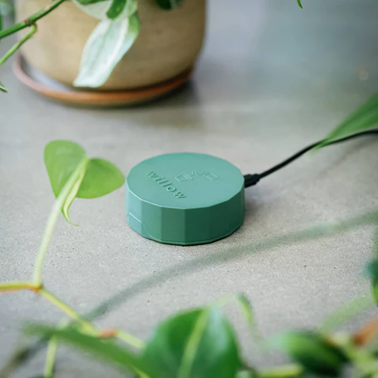
The accompanying WiFi Hub connects the sensors to the internet and allows information to reach the app when the owner is away from home.
One Hub can support as many as 40 sensors, meaning the system is capable of expanding from a single treasured plant to the sort of collection that has quietly taken possession of an entire room.
But does a houseplant really need technology?
There is an obvious objection.
People have successfully grown plants for several thousand years without Bluetooth.
Experienced gardeners can often judge moisture from the soil, recognise the signs of excessive sunlight and understand from experience where a particular plant is likely to thrive.
Willow is unlikely to replace any of that knowledge.
Its more convincing audience is the growing number of people who enjoy having plants in their homes but have neither the experience nor inclination to become amateur horticulturists in order to keep them alive.
For them, the proposition is not that technology should replace plant care. It is that better information might make plant care easier.
There is also something useful about catching a problem before its visible symptoms become serious. A brown leaf tells you that something has happened. A sensor may be able to tell you beforehand.
Starting at £34.99
The Willow Starter Pack costs £34.99 and includes one sensor, one WiFi Hub, a USB cable and a coin cell battery for the sensor.
The moisture probes measure 124mm and are intended for pots up to 20cm deep. The sensor communicates using Bluetooth while the Hub connects to a 2.4GHz WiFi network.
Additional sensors can subsequently be added.
Setup involves downloading the Willow app, pairing the sensor and Hub, connecting them to WiFi and identifying the plant being monitored. Willow says useful alerts and a plant score can begin appearing within hours.
It is a modest example of a broader development in domestic technology. The most convincing smart home products are increasingly not those that add technology for its own sake, but those that provide information which was previously difficult to obtain.
A connected plant pot will sound excessive to some.
For anybody who has spent £30 on a beautiful houseplant, watched it deteriorate over several mysterious weeks and eventually carried its remains to the bin, £34.99 may suddenly seem rather more reasonable.
Continue Reading
More Lifestyle
The Future of Luxury explores how culture, technology and changing values are reshaping the industry

Inside Chiva-Som, the Thai wellness retreat voted the world's best by travellers

The Chicken Worth Crossing Town For: Cocotte Richmond