Tactical voting is becoming a serious problem for Reform UK
Reform UK trails Conservatives 35% to 20% in head-to-head contests as tactical voting surges, new YouGov data shows. Anti-Farage sentiment at record high.
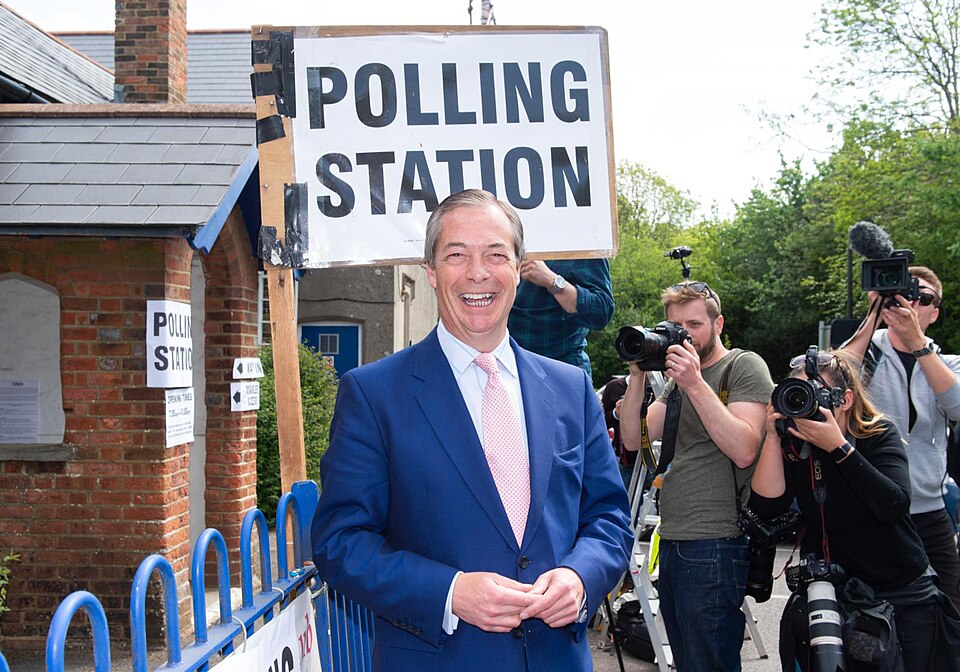
European Union 2019 / European Parliament, via Wikimedia Commons.
New YouGov research suggests Nigel Farage’s party is struggling to attract support beyond its existing base, while the Conservatives are increasingly benefiting when voters are asked to choose between the two parties.
The electoral challenge facing Reform UK is not simply whether it can retain the voters it has won. Increasingly, it is whether the party can persuade enough people outside that coalition to support it when constituency arithmetic leaves them with a choice between Reform and somebody else.
New YouGov research suggests that hurdle is becoming considerably more difficult.
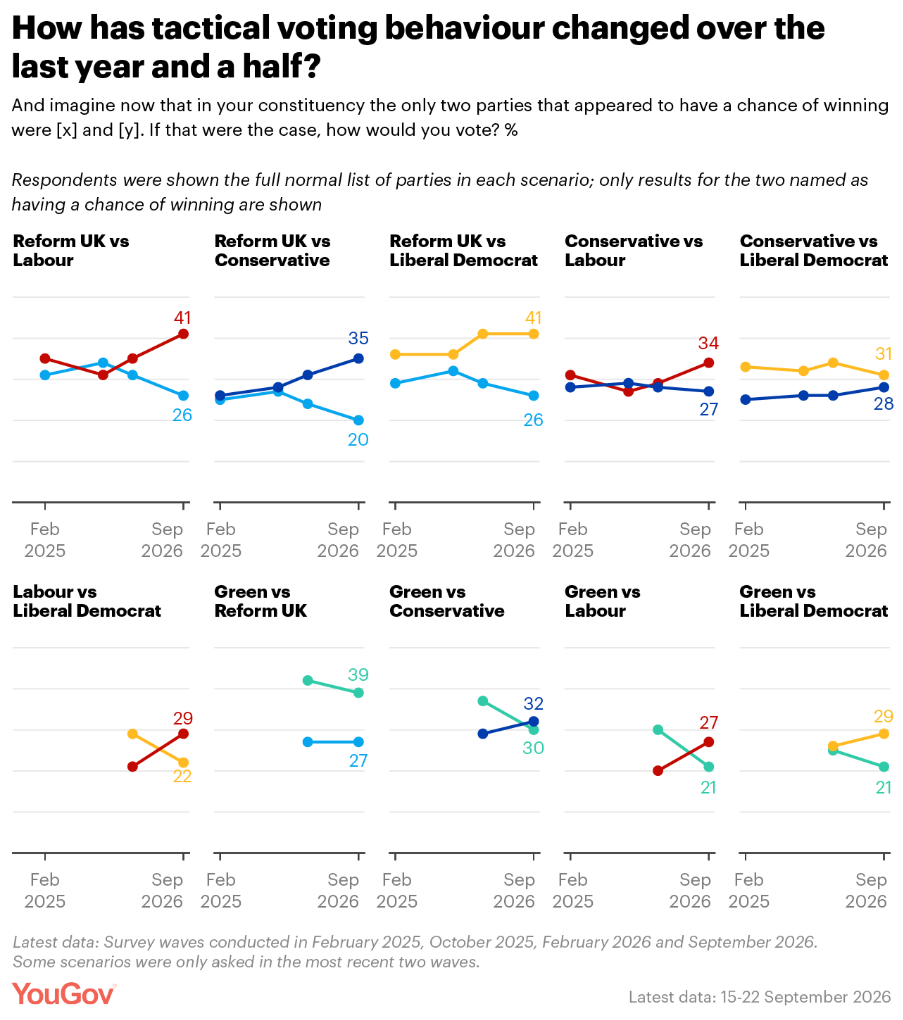
In constituencies where only Reform UK and the Conservatives have a realistic prospect of winning, 35 per cent of voters say they would support Kemi Badenoch’s Conservatives, compared with 20 per cent for Reform. The 15 point Conservative advantage has more than doubled since February, when the parties stood at 31 and 24 per cent respectively.
It is a striking change from February 2025, when the same hypothetical contest produced an effective dead heat of 26 per cent for the Conservatives and 25 per cent for Reform.
The findings matter because Britain’s first past the post electoral system rewards parties capable of assembling local coalitions considerably larger than their core vote.
For Reform, YouGov’s numbers suggest that coalition currently has limits.
The Conservatives have an advantage Reform does not
The most significant finding from the right may be the willingness of voters who would ordinarily support parties of the left or centre to lend their vote to the Conservatives when the alternative is Reform.
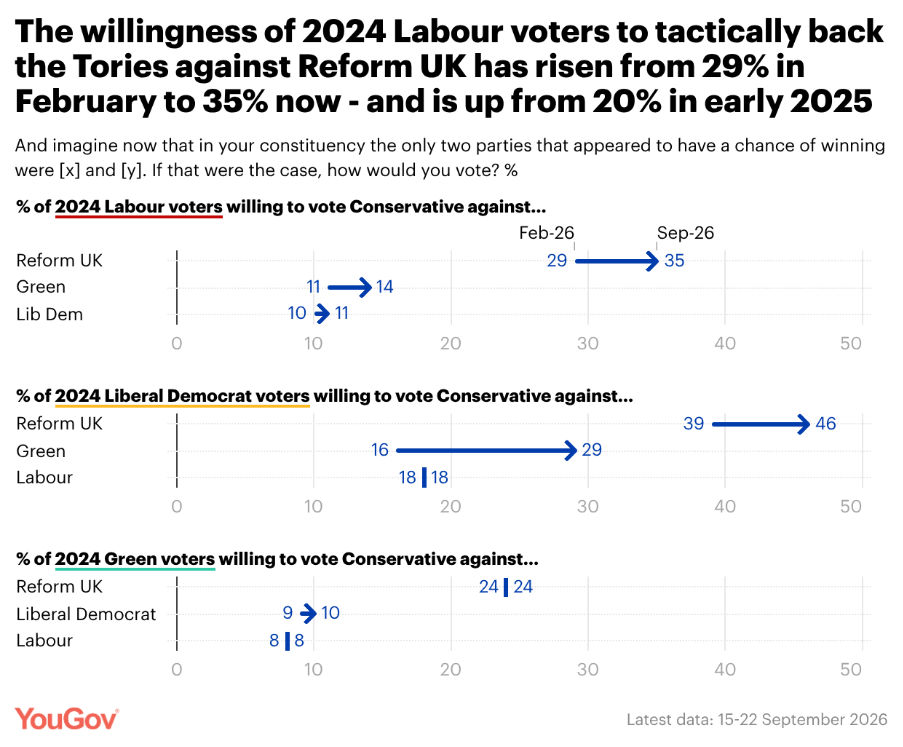
In a Conservative versus Reform contest, 43 per cent of current Labour voters say they would back the Conservatives. Among Liberal Democrat voters that rises to 49 per cent, while 26 per cent of Green voters would do the same.
The traffic is not entirely one way.
Conservative voters themselves show considerable willingness to support Reform when faced with a choice between Farage’s party and the left. Some 37 per cent would vote Reform to prevent Labour winning, 36 per cent would do so against the Liberal Democrats and 40 per cent against the Greens.
That reveals an increasingly complicated relationship between Britain’s two principal parties on the right.
Their electorates are willing to cooperate tactically, but voters outside the right appear considerably more willing to support Badenoch’s Conservatives than Farage’s Reform.
There are signs of movement in the other direction too. Between 41 and 46 per cent of current Reform voters say they would switch to the Conservatives where Badenoch’s party was the viable challenger to Labour, the Liberal Democrats or Greens.
Labour benefits most from the anti Reform vote
The problem becomes still clearer when Reform faces Labour.
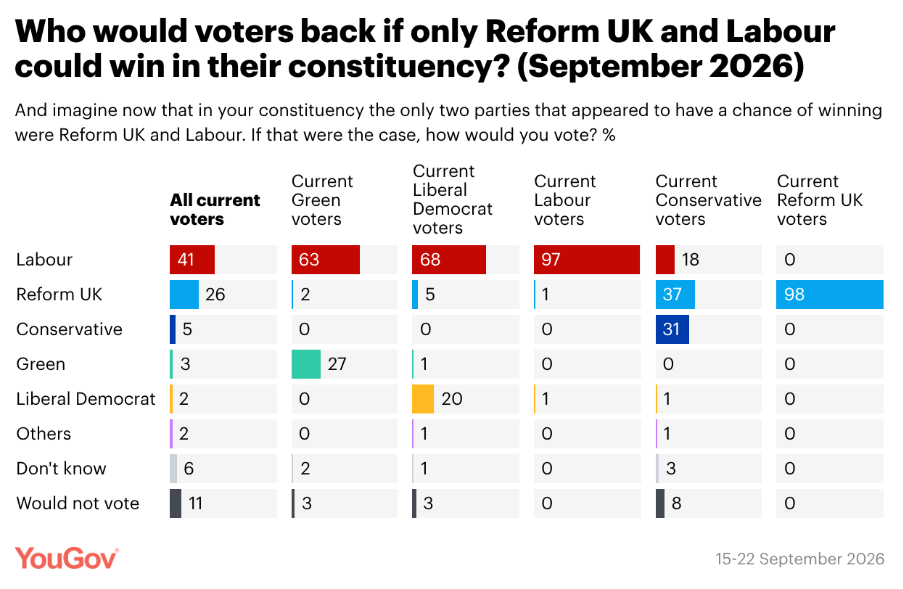
In a constituency where those were the only two realistic contenders, voters choose Andy Burnham’s Labour by 41 per cent to Reform’s 26 per cent. In February, that contest was considerably closer, at 35 to 31 per cent.
Much of the difference comes from tactical voting.
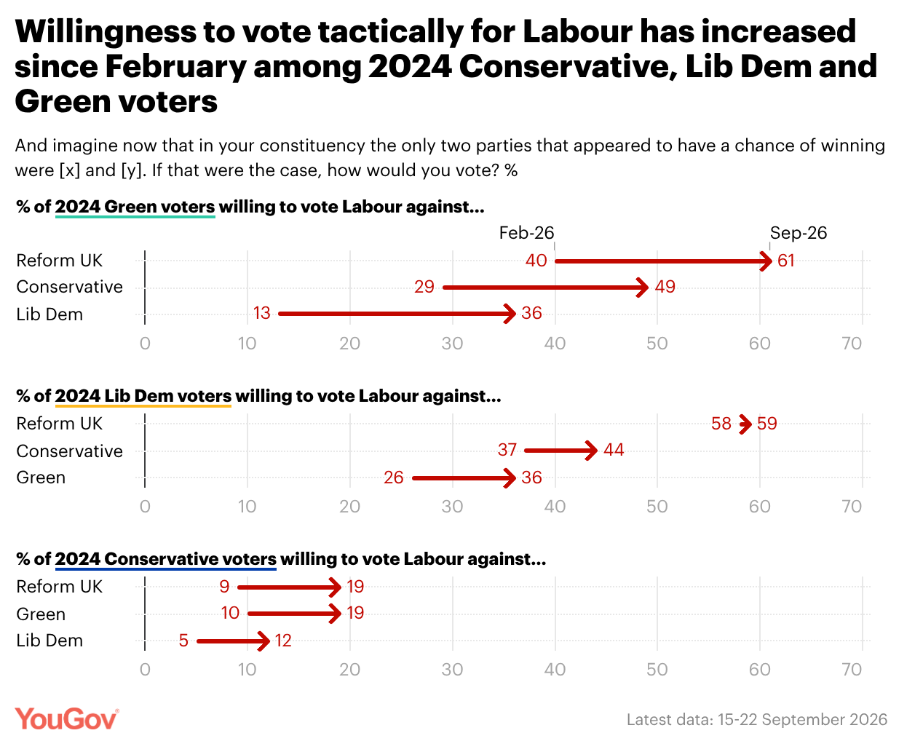
Sixty eight per cent of Liberal Democrat voters and 63 per cent of Green voters would support Labour in such a constituency. Even 18 per cent of current Conservative voters would cross over to Labour rather than support Reform.
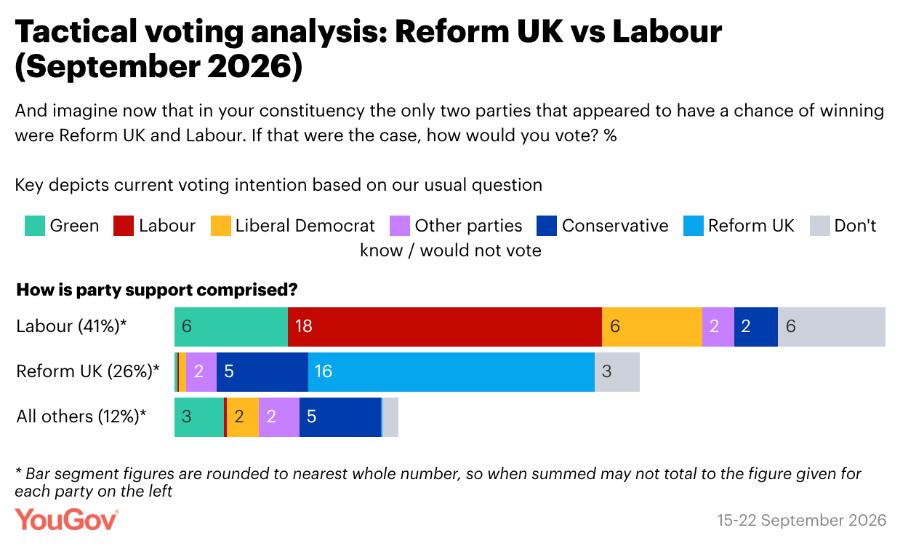
Reform’s 26 per cent, by contrast, comes overwhelmingly from voters already sympathetic to the party or the Conservatives. YouGov calculates that approximately 16 points come from existing Reform supporters and another five from Conservatives. Only around one point comes from Labour, Liberal Democrat and Green voters combined.
That suggests Reform currently has a problem of political reach rather than simply enthusiasm among its supporters.
Recent YouGov polling provides some context. Earlier this month, 69 per cent of Britons said they had an unfavourable opinion of Farage, against 24 per cent who viewed him favourably, the highest unfavourable figure YouGov says it has recorded for him on its tracker.
Labour has its own tactical advantage
The survey is not simply a story about Reform.
Labour has strengthened considerably across several of YouGov’s hypothetical constituency contests since February. Against the Conservatives, Labour now leads by 34 per cent to 27 per cent, compared with an effective dead heat of 29 to 28 per cent seven months ago.
The Greens have also lost ground. Where Labour and the Greens are presented as the only viable candidates, Labour now leads 27 to 21 per cent. In February the Greens led the same contest by ten points.
There is better news for the Conservatives elsewhere. Against the Greens they have moved from an eight point deficit in February to a narrow 32 to 30 advantage, while the Liberal Democrats’ previous eight point advantage over the Conservatives has narrowed to three points.
The research, conducted among 6,077 adults in Great Britain between September 15 and 22, measures hypothetical tactical voting scenarios rather than voting intention in individual constituencies. It therefore cannot tell us how any particular seat would vote at a general election.
But it does reveal something about the electoral coalitions available to each party.
Reform has demonstrated that it can take voters from the Conservatives and Labour and establish a substantial core of its own. What these figures show is a different challenge: when voters are asked to choose between Reform and its principal opponent in a constituency, significant numbers appear prepared to put their usual party allegiance aside to stop Farage’s party winning.
For Badenoch, that creates an important distinction between the Conservatives and their rival on the right. Reform may compete aggressively for Conservative voters, but the Conservatives currently retain something Reform has found much harder to acquire: tactical support from voters who would ordinarily never consider themselves Tories.
Continue Reading
More News
Britons split over Macklemore removal as Ed Sheeran defends keeping politics off stage
Ed Davey’s biggest problem may be that much of Britain barely notices him

Britons are split over tax and spending as the Budget choices tighten