Six in ten Britons want the two child benefit cap brought back
61% of Britons back restoring the two-child benefit cap, including 54% of Labour voters, new YouGov polling reveals after Starmer scrapped the restriction.
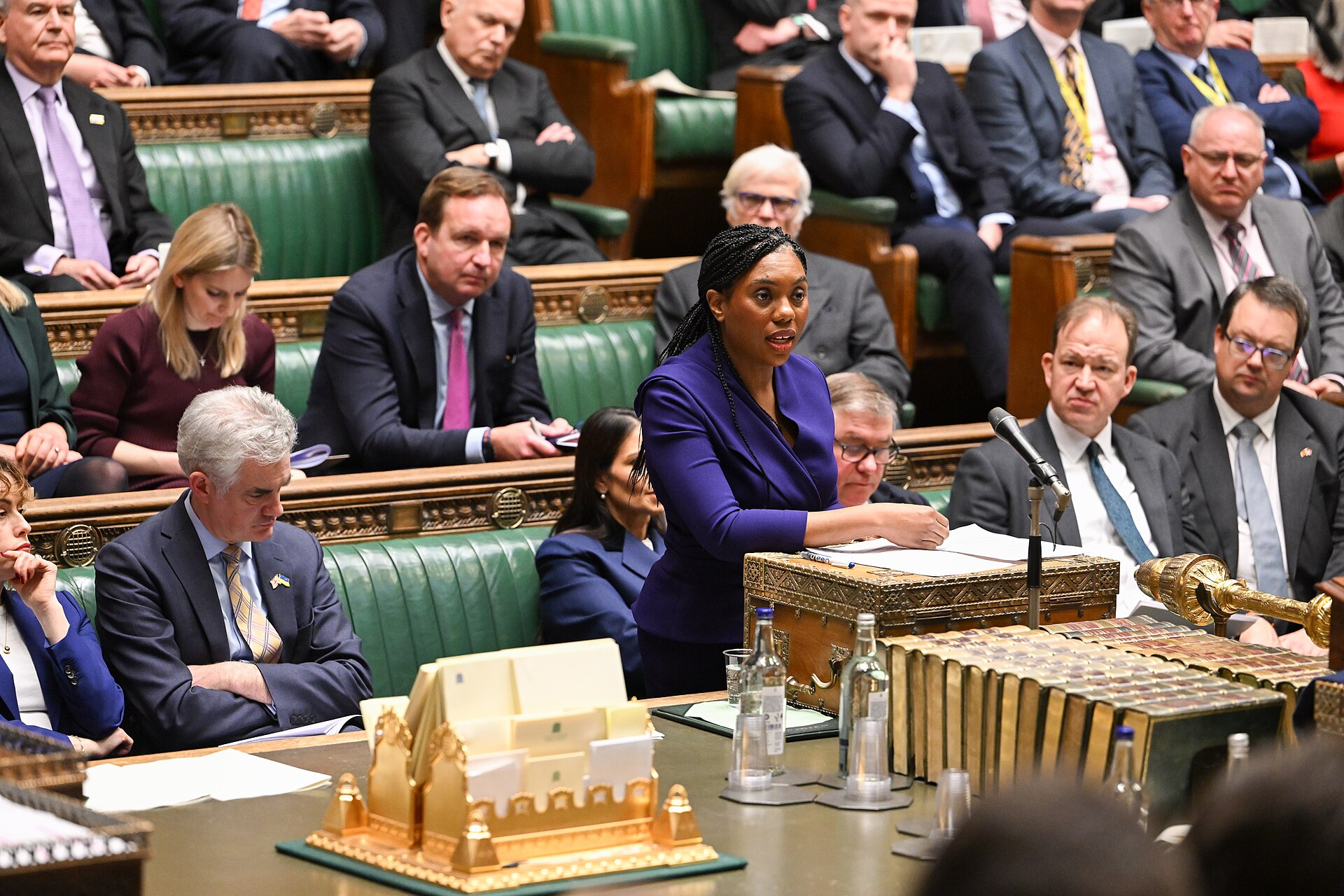
Kemi Badenoch in the House of Commons, February 2025. Credit: House of Commons / Wikimedia Commons, CC BY 3.0.
New YouGov polling suggests Labour’s decision to abolish the welfare restriction is considerably less popular than ministers might have hoped, with majorities of Conservative, Reform, Liberal Democrat and even Labour voters supporting its return.
Labour may regard abolishing the two child benefit cap as an important part of its record in government. The British public appears considerably less convinced.
New YouGov polling finds that 61 per cent of Britons support reintroducing the restriction, which limited the number of children for whom parents could receive certain child related welfare benefits. Just 24 per cent oppose bringing it back.
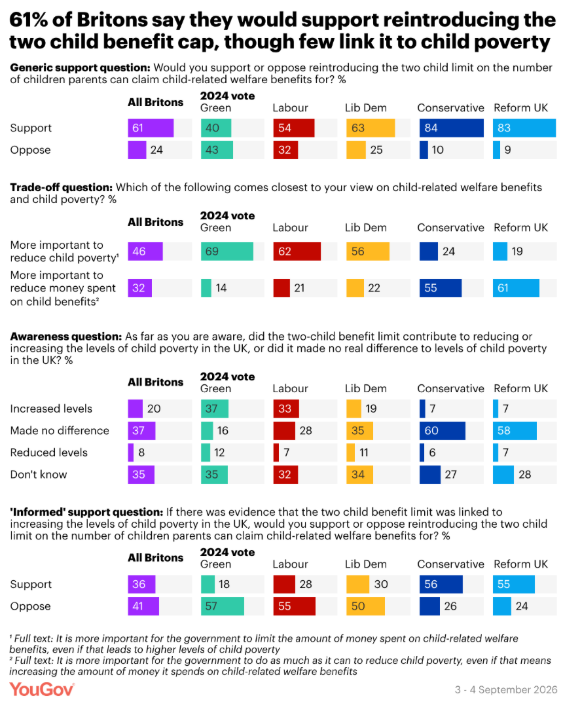
Perhaps more troublesome for Labour is that support extends considerably beyond the political right. While 83 to 84 per cent of those who voted Conservative or Reform UK in 2024 favour restoring the cap, so do 63 per cent of Liberal Democrat voters and 54 per cent of Labour voters.
Green voters are the exception, and even they are almost evenly divided, with 40 per cent supporting its return and 43 per cent opposed.
The poll of 2,329 adults in Great Britain was conducted on September 3 and 4.
The result gives the Conservatives considerable political territory on which to challenge Labour. The party has said it would restore the policy if returned to government, with the savings contributing towards increased defence expenditure.
Introduced in 2017, the two child limit became one of the most politically contentious elements of Britain's welfare system. Labour initially retained the policy after entering government before abolishing it earlier this year. Sir Keir Starmer subsequently described removing the cap as his proudest achievement as prime minister.
Yet the polling suggests that what was celebrated within Labour as a significant intervention against child poverty has not persuaded much of the electorate.
Labour voters themselves are divided from the party
The finding that 54 per cent of Labour's own 2024 voters support reintroducing the cap is arguably more politically significant than the overwhelming support among Conservatives and Reform voters.
It points towards an enduring argument over welfare that cuts across traditional party loyalties: whether the state should provide increasing financial support according to family size, or whether there should be a limit on what taxpayers can reasonably be expected to fund.
For Conservatives, the figures provide evidence that a more restrictive approach to welfare retains considerably broader public support than the composition of Westminster debate can sometimes suggest.
But the polling also contains an important complication.
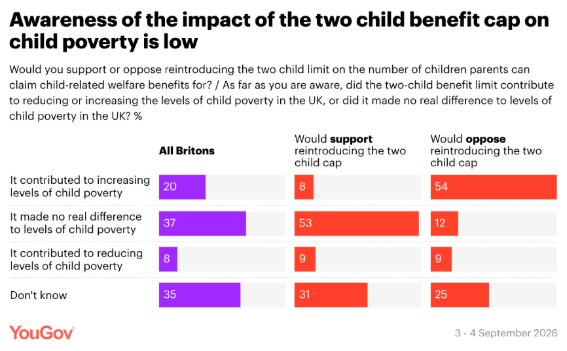
Only 20 per cent of Britons believe the two child limit contributed to higher levels of child poverty. Thirty seven per cent think it made no difference, while 35 per cent are unsure of its effect.
There is a particularly pronounced relationship between those beliefs and attitudes towards restoring the policy.
Among people who support bringing the cap back, just 8 per cent believe the original policy increased child poverty, while 53 per cent think it made no difference. Among opponents, 54 per cent believe it increased poverty and only 12 per cent think it had no effect.
That matters because research, including work by the Institute for Fiscal Studies, has linked the policy to increased poverty among larger families. The argument for abolition has consequently rested heavily upon its effect on children rather than simply the amount of welfare received by their parents. Institute for Fiscal Studies analysis
Welfare restraint still commands substantial support
When the question is widened beyond the cap itself, public opinion becomes less straightforward.
Asked whether government should prioritise reducing child poverty or limiting expenditure on child related welfare benefits, 46 per cent choose reducing poverty and 32 per cent favour limiting spending.
There is a clear political divide. Sixty nine per cent of Green voters, 62 per cent of Labour voters and 56 per cent of Liberal Democrats prioritise reducing child poverty. By contrast, 61 per cent of Reform voters and 55 per cent of Conservatives put greater emphasis on restraining welfare expenditure.
The apparent contradiction becomes sharper when respondents are asked to assume that there is evidence connecting the cap with increased child poverty. Under those circumstances, only 36 per cent continue to support its reintroduction, while 41 per cent oppose it.
It would be misleading, however, to substitute that hypothetical figure for the headline finding.
The 61 per cent figure measures what Britons currently say they want. The 36 per cent figure measures what they would say under an additional condition that many respondents do not presently accept. They answer different questions.
That distinction also illustrates the political battle that would accompany any attempt to restore the cap.
Opponents would seek to make child poverty the central issue. Conservatives could instead frame the argument around the sustainability of welfare spending, personal responsibility and competing demands on public money, particularly if savings were explicitly connected with defence.
The more striking conclusion from YouGov's figures is therefore not that Britain has reached a settled view on the consequences of the two child limit. It plainly has not.
It is that after Labour abolished one of the most controversial welfare restrictions of the past decade, a clear majority of the country currently wants it back.
Continue Reading
More News
Europe’s infrastructure problem is no longer simply about concrete

Two thirds of Britons back police powers to stop protesters hiding their faces

The old football boots being given another match