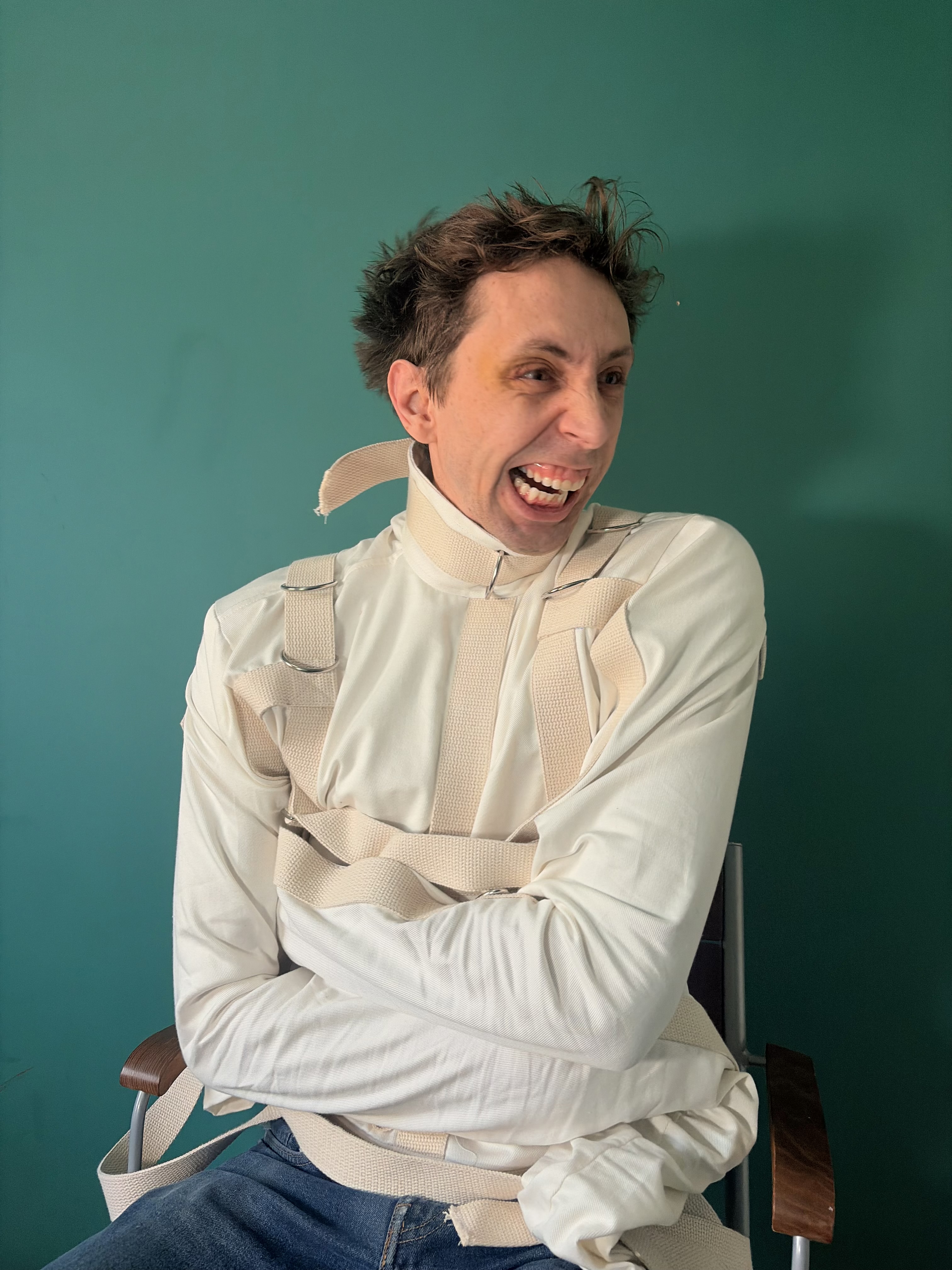
The premise of this show is incredibly personal, was there a point where you nearly decided it was too intimate to put onstage? On multiple occasions, I found myself questioning how much, if any, of this story needs to be said, and there were different reasons, as hurdles, that presented themselves; laying out the contents of my character for the public to judge, possibly tarnishing my future as the guy that lost his mind and scaped the hospital, or the fear of sharing the ingredients that lead to my mental breakdown, potentially accelerating the same crisis in my audience by accidental hypnosis, or even the mad revelations that surfaced in psychosis which if believed could have a major impact on society…
Thankfully…. It’s just a story. Even though it’s all based on a true event, after many iterations and diting to make the unbelievable palatable, I don’t even know if the audience will see it as anything other than a tall tale formed in imagination, and I’ve let go for the need to be believed. I know what I saw.
The audience know that Alice went to Wonderland, or Dorothy visited Oz, because we see their journey on screen, and at the end, they return home and that’s the end of the movie. But their story doesn’t end there… What kind of looks do you think their friends and family gave them when they tried to recount their story? As she raved about witches, flying monkeys and talking lions, do you think dear Dorothy was taken to the local Doctor and pumped full of valium so her family could handle her hysteria?
“Oh that’s just Alice, ignore her, she once had a nap and came back different. Poor Girl.”
It is indeed a personal story, but it’s also a construction of a past self that I no longer am, much like a dragonfly looking at its reflection in the pond and unable to recognise the larva it once was below the surface. I did my best to answer the question that everyone asked me, “how did it happen?” and I did so with a quote in mind, from Winston Churchill, something to help me take the leap of faith… “Truth is so precious that she should always be attended by a bodyguard of lies”.
You describe the show as rebuilding yourself from scratch, did comedy help with that process or complicate it? The character’s arc is about him (me) rediscovering his sense of humour in a world of pain; it’s incredibly difficult to laugh when carrying a body in the midst of PTSD, a body vacant of identity that absorbed the world around him, which at the time, was a fractured society shouting over one another about their individual tribes’ unheard voices; the Me Too movement, Black Lives Matter, Transgender rights, many other movements that begged to be heard as their community struggled with hurt, as well as their opposition who are somehow skewed reflections, also confused, each of us trapped in own subjective experience, minds that strive to be shared and connect, all this happening during a murderous pandemic… Which I happened to write about before my mental breakdown, so for a brief moment, I thought I wrote it into existence. Madness, I know, but that doesn’t negate the fact that I did believe it and my nervous system had to somehow deal with that farfetched burden.
I emerged out of the void wanting to care about humanity, I love us humans, weird, wonderful, complicated and messy, and this responsibility meant I didn’t see much to laugh at… Maybe because people who experience trauma project their pain into Reality.
This experience taught me a lot about the symbiotic relationship between King and court jester, or Batman and Joker, one carries the weight of the crown while the other realises it’s pointless to try and control chaos so you might as well enjoy your time with a smile on your face, but because they are dualities, one cannot live without the other, and if the other falls, it is the responsibility of the other to act, and thus, heavy is the head that wears the clown.
My notebooks very much look like a conversation between those dualities which I somehow had to make whole, two separate truths that must paradoxically co-exist. And I gave them both a voice for this one man show.
How do audiences react when they realise the story is rooted in something real? The Edinburgh Festival will be the real test of how people will receive the story, as I’ve not had many opportunities to preview the show, but based on how people react when they ask, friends, family members, anyone that asked, it became evident that none of us are truly in control of how something is perceived. When an artist creates something and finally displays it, they lose ownership of how it’s interpreted. An atheist and a believer in God will hear my story differently, a mathematician and a psychotherapist too will have their own opinion of what happened to me, some people looked at me with awe, some with fear, with doubt, laughter, ambivalence.
And I can’t blame the audience for their many ways of reacting, it is after all, what happens in the show; a character emerges from the void and experiences structural dissociation, a kind of splitting of the self to survive overwhelming stress, and the many characters argue about what happened, eventually finding a resolution to exist in one body. On occasions, I have moments where I doubt what happened, the past is a mirage, memories eventually become fiction because an event is slightly reshaped each time it is brought back to the present moment, much like a river rushing through cracks in rock to shape it into something else.
This thought of whether the event was real or not quickly fades as my scars are reminders of happened…
Were there moments where people around you noticed personality changes before you did? One of the catalysts to my self-destruction was going through hypnosis, an eight- week process where I resisted three memories which, with chronological and geographical distance, was safe enough to observe through a different perspective, and thus, change how it was carried in me, meaning I emerged out of the sessions slightly altered.
The hypnosis was done in London and a couple of friends pointed out changes, some positive and others with alarm, as they recognised the sudden transformation. It would, after all, be troubling to interact with a friend and realise there is a different driver behind their eyes.
Although I heard their concern, this was the first time in my life I finally felt free from the woes of the past, meaning I no longer feared the future, and therefore, I was incredibly present. It was an absolute joy and I ran with it, but much like Icarus flying too close to the sun, what goes up must come down, and nobody was able to contain the metamorphosis because I went back to Los Angeles during this euphoric swell, and was going through ha very lonely period over there, nobody but me to keep an eye on the morphing personality.
A year after the memory-loss, I lived with some local comedians, and one of them told me he trusted me at my core, but that interacting with me was much like a game of improv, he didn’t really know who was going to come out of my bedroom. Chaos is defined as a dynamic system whose sensitivity to the smallest of variables can give rise to large transformations, and in essence, that was what happened… The tiniest of elements could mutate my internal World and therefore how I would interact with the external, and the only way I could give myself peace during this phase was to acknowledge that reality has animals like the chameleon or mimic octopus who can transform at will, because it was scary to observe myself in what I described as quantum superposition, in multiple states at once. Our identities are shaped over time, but ultimately, it is a fabrication which we can some what deconstruct and rebuild, and this was made obvious to me when I gained control of a body without identity.
You only need to study geopolitics to see that suddenly removing troops from a location leaves behind a vacuum which gets filled by unpredictability, and since nature abhors a vacuum, “I” was replaced by the unknown, and had to subsequently weave the many parts into a coalescent unit.
Short answer made long, yes, people noticed the changes so much they kept themselves away from me, and I isolated myself to keep away from them.
What role does humour play when someone is psychologically struggling? I once did a stand up comedy show in some casino in the desert of New Mexico, he gig went by just fine, nothing to write home about, but the evening was memorable for one particular punchline, told by the waitress at the bar. We were chatting, and next to me, was a man, slumped on his chair, fatigued and probably down in the dumps from losses at the blackjack table, so I invite him to join our conversation, but his input was minimal to say the least, it was still mostly the waitress and I going back and forth with comedic quips.
At one moment, I don’t remember what was said, but she said something so funny, both me and the stranger burst out laughing, and that’s the moment I experienced the power of humour; the grey-haired gentleman appeared to lose ten to twenty years, he stood up taller, his eyes revived and peeped out from underneath a frown collapsed by its own gravity, his smile was ageless, I had never seen someone visibly rejuvenate so quickly, and it truly had me wonder whether laughter was the fountain of youth.
Eighteen months after my black swan event was when I, Eric, came back to me, a clear moment where I clutched my chest and said “there you are”, as if I had finally captured the essence of what it was to be me, and this happened after I cackled so hard it felt like I came back to life. I hadn’t laughed in so long I forgot how to, and nothing could muster even the semblance of a smile. My inner clown finally slipped a stage whisper in my ear, something so specific to me that the joke will never have the same strength, a unique moment just for me, as it was an inside joke with Myself.
“There you are”
During our much needed travel through cancel culture, we as a society chose what is and isn’t appropriate to laugh at, and although I know it necessary as a community to move as fast as our slowest members and revisit our beliefs so that we can create a better world for us all, I don’t think it’s healthy to criticise the emergence of comedians who push the boundaries of what we deem acceptable, for not only the trickster surveys our comfort zones to make sure we don’t become complacent in those beliefs, these agents of chaos offer solace to those who must dive deep in the dark recesses of the human experience; the surgeons who despite their best efforts sill have death lurking on their table, the detectives who lurk the shadows to keep monsters at bay, there is a reason for gallows and even inappropriate humour; it’s not just a fleeting moment of guffaw, but an ingredient for survival. Finding joy in the face of pain is not to turn a blind eye, it is to refuse to let suffering be the only story.
Eric Lampaert: Zero Minus One will be at the Edinburgh Fringe Festival from 6th – 30th August (not 18th). For more information visit: https://www.edfringe.com/tickets/whats-on/eric-lampaert-zero-minus-one
Continue Reading
More Culture
Lara Parmiani on Refugee Reimagining of Alice in Wonderland
Q&A with David Magidoff

Jenny Gorelick Q&A