Lara Parmiani on Refugee Reimagining of Alice in Wonderland
Director Lara Parmiani explains why Lewis Carroll's absurdist classic became the perfect lens for satirising UK immigration bureaucracy in 2026.
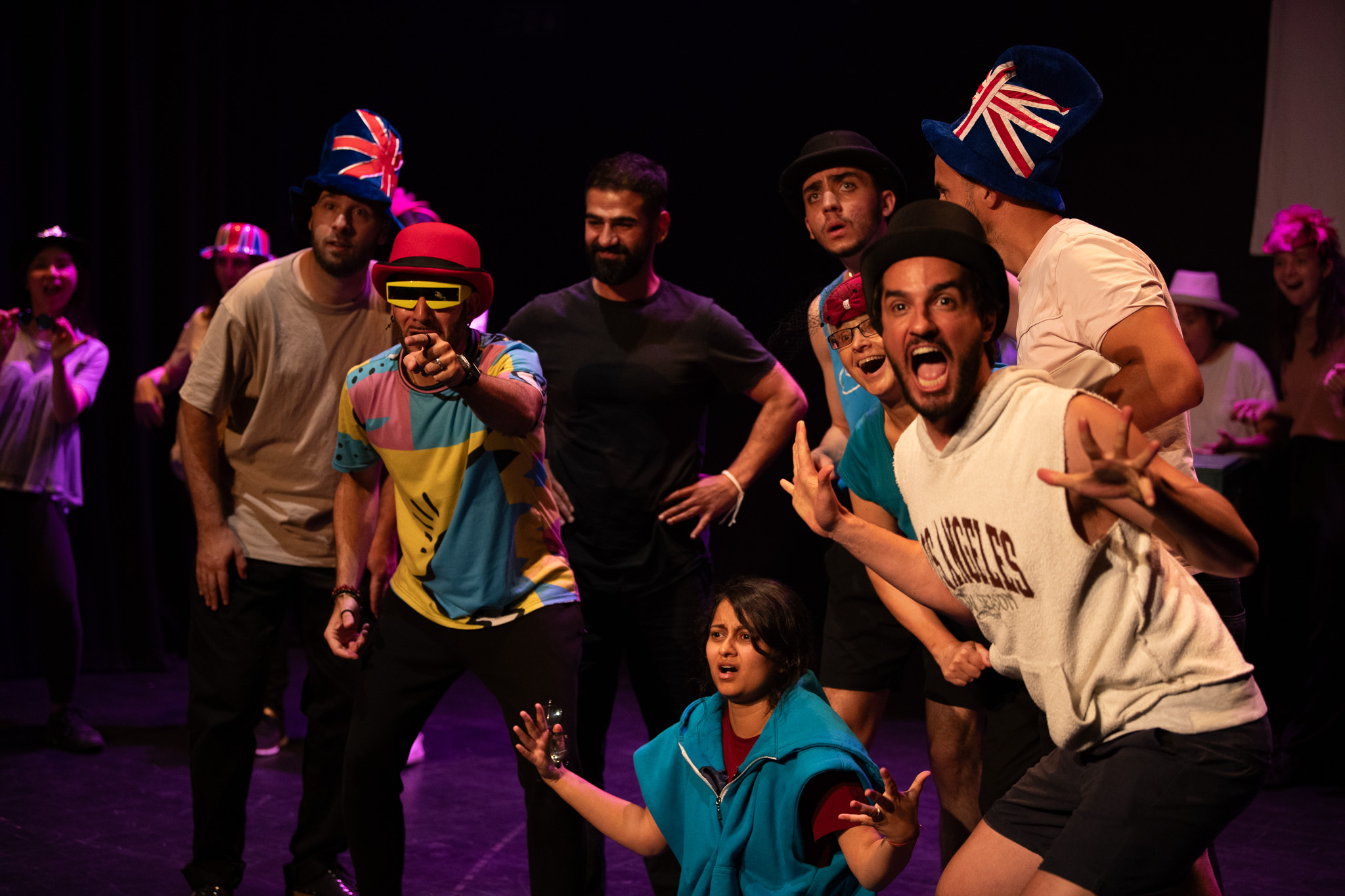
Ali in Wonder(Eng)land is a reimagining of Alice in Wonderland created by theatre company LegalAliens. Created with and performed entirely by an ensemble of 16 refugees and migrants, including two musicians, it sees an outsider coming to a strange new land only to be caught up in rules that make no sense. The politically sharp satire sees different participants taking on the title role, each bringing their own lived experience to Ali’s plight. Following a white rabbit’s promises of red buses, perfect queues and the sixth largest economy in the world, he comes to England only to encounter doors of the wrong size, interviews with no right answers, and helpful people that make everything worse. We spoke to director Lara Parmiani.
What made Lewis Carroll's Alice in Wonderland such a perfect framework for exploring the real-world experiences of refugees and migrants?
Almost everyone navigating the immigration system often describes it as surreal. Rules change overnight, language is deliberately confusing, it feels like falling down a rabbit hole. Which led us to Alice in Wonderland. People often remember the Disney version but the original is dark. It's the story of an outsider in a world that makes no sense. Where time is stuck and those in power look grotesque. Sadly we live at a time where perfomative evil towards certain minorities and grotesque politicians are a reality.
The show uses satire and an "absurdist lens" to look at immigration. Why do you feel comedy and absurdity can sometimes be more powerful than a straightforward drama when tackling such a heavy subject?
Because reality is often absurd. If you tried to invent some of the situations people have told us about, audiences would think they were exaggerated. Bureaucracy has an extraordinary ability to become unintentionally comic. Comedy also invites people in. It lowers defences. An audience laughing together is often more willing to question its assumptions than an audience being told what to think. We never laugh at individuals; we laugh at systems, and at prejudice. We hold up a mirror and ask, isn't this ridiculous? Well... it's actually going on for real. Minus the bunny ears.
With multiple participants playing the character of Ali, how do the different performers bring their own unique backgrounds and personalities to the single role?
They all come from different countries and life experiences, so naturally each version of Ali carries a different energy. Which is the point. Ali isn't one individual. Ali could be almost anyone who has crossed a border and found themselves trying to decode a new country. As the role passes from one performer to another, the audience starts to understand that this is a shared experience rather than a single biography.
This production originally ran in 2023. What has changed in this 2026 version to reflect how British society has shifted over the last few years?
First of all, the cast has changed, and the production evolves alongside the people making it. Public conversations around migration have changed too, becoming increasingly hostile. We've seen riots, attacks on hotels housing asylum seekers, and political language that would have been shocking just a few years ago become normalised. That inevitably shaped our approach. Reality has started competing with fantasy. Some politicians and commentators perform outrage so theatrically that it's difficult to make them any more grotesque on stage. How do you satirise something that's already absurd? As a result, the satire has become sharper, but we've also placed even more emphasis on solidarity. Ali doesn't win by defeating the system alone. They find another outsider, Peter Caterpillar, a local resident who recognises power for what it is: a machine that exists to protect itself. The ending is deliberately unresolved. Ali manages to regain some agency and, for a moment, outwit the system. But what kind of life awaits them in Wonder(Eng)land? We don't know. The Rabbit, who in our version represents the bureaucracy of the Home Office, is the one character who immediately recovers and carries on. People change. Governments change. Bureaucracy survives.
What does it mean to the performers to be able to reclaim their stories on stage?
We never ask participants to perform personal trauma. We transform experiences into theatre. We're reclaiming a shared story rather than asking people to tell their individual stories. Ali's journey is surreal. They meet talking rabbits, drink potions that make them smaller and bigger, and end up in a terrifying version of Who Wants to Be a Millionaire? Experiences of navigating bureaucracy, losing control, or facing interviews that make very little sense are transformed into one giant absurd adventure. Only five times is this crazy journey interrupted by performers stepping forward as themselves. But even then, the stories aren't the ones audiences often expect. One performer remembers the poster of England they had on their bedroom wall at fourteen and how it made them dream of this amazing country. Another talks about the neighbour who keeps explaining their own country back to them. Someone else remembers the excitement of being woken up by their mum saying, "We're going to Europe!" Those moments are ordinary and human. They remind us that migration isn't just about crisis. It's also about hope, dreams, and family.
Since the show features a mix of professional performers and emerging artists from your Tottenham Project, how do these two groups learn from and inspire each other?
Actually, none of the performers are professionals. They're all participants from the Tottenham Project. Some have been with us for years and are now part of our Advanced Strand, where they develop their skills further, while others joined much more recently. Some have been speaking English for years; others have only been learning the language for a few months. Rather than trying to hide those differences, we embrace them. I hope audiences embrace them too. The accents, the unevenness, the moments of discovery and the imperfections are not flaws. They're evidence that real life is happening on stage, and I think that's something theatre sometimes forgets. The professional artists are the creative team around them. As director, together with my associate directors Nada Sabet and Angela Poulima, and our brilliant designers Edalia Day, Issy Van Braeckel and Chris McDonnell, we create a professional environment where people who might never have imagined themselves on a London stage can experience making theatre to a high artistic standard.
What do you hope audiences who might not have any personal experience with migration take away or think about after leaving the theatre?
Migration has become something we debate endlessly, but very often without actually listening to migrants themselves. I'm not trying to persuade audiences to adopt a particular political position. I'm inviting them to spend ninety minutes seeing the world through somebody else's eyes. If people leave laughing, reflecting, and recognising a little more of themselves in people they previously thought of as "other", then I think we've achieved something worthwhile. Last time, a handful of audience members took offence on behalf of British people. I found that quite funny, because the show pokes fun at bureaucracy, power and how easily "crowds" can be swayed. If you see a bureaucrat with bunny ears, someone wearing fluorescent "Anti Foreigner Glasses", or a Queen who speaks almost entirely in one-line clichés and think, "That's me," well... maybe you need to come off social media?
Ali in Wonder(Eng)land runs at Jacksons Lane on 14 & 15 July. Tickets at jacksonslane.org.uk.
Continue Reading
More Culture
Elissa Gerrand and WVFRM presents: Act of God
Murder, Music and Mayhem: Inside The Pleasures of Fanny
What Would Jarvis Do? – Interview with Director Maiya Pascouche