Labour would lose 170 seats but remain largest party in a hung parliament
Labour would lose 170 seats but remain largest party on 241 MPs, according to YouGov's latest MRP model, leaving Britain with a hung parliament.
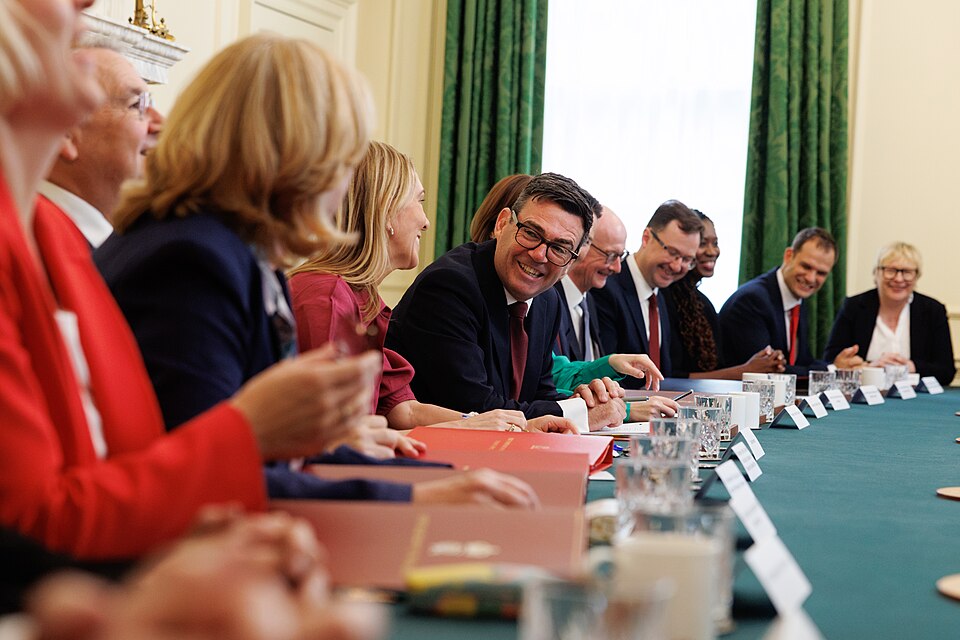
Image credit: Lauren Hurley / No 10 Downing Street, via Wikimedia Commons. Licensed under the Open Government Licence v3.0.
The Conservatives and Reform UK are separated by just seven seats in YouGov’s latest MRP, while Labour remains well short of a majority despite a substantial recovery under Andy Burnham.
Labour would lose 170 seats and its parliamentary majority if a general election were held now, but would still emerge comfortably as the largest party, according to a new YouGov model.
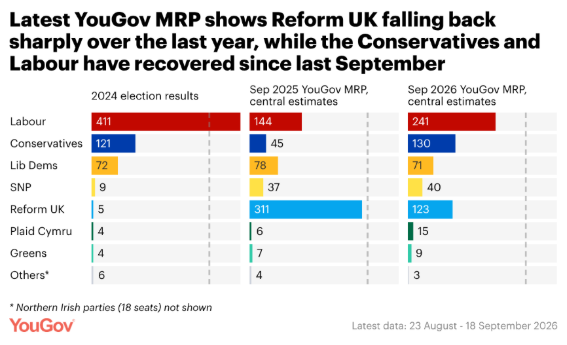
The first YouGov MRP since Andy Burnham became Prime Minister puts Labour on 241 seats, the Conservatives on 130 and Reform UK on 123. The Liberal Democrats are projected to take 71, with the SNP on 40, Plaid Cymru on 15 and the Greens on nine.
It would leave Britain with a deeply fragmented House of Commons. Labour would be 85 seats short of the 326 normally required for an overall majority and would need support from other parties to govern with a dependable Commons majority.
The figures nevertheless contain two quite different stories.
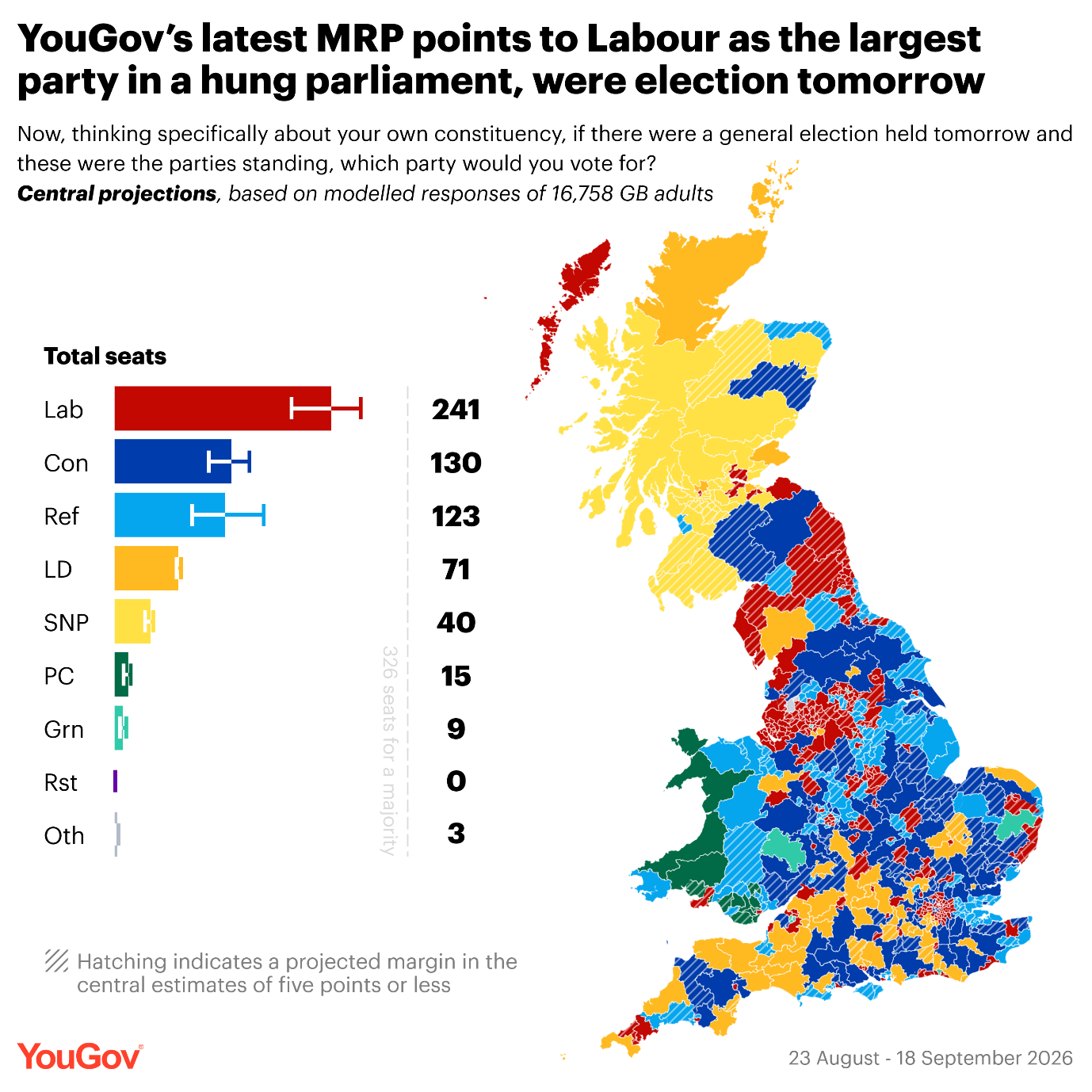
For Labour, 241 seats would represent a severe reversal from the 411 won at the 2024 general election. Yet it would also mark a considerable recovery from YouGov's MRP in September 2025, when Labour under Keir Starmer was projected to hold only 144 constituencies.
For the right, the contest is remarkably close. The Conservatives are projected to take 130 seats against Reform's 123, leaving Kemi Badenoch and Nigel Farage separated by only seven constituencies in the central estimate.
That represents a substantial Conservative recovery from YouGov's model a year ago, which put the party on only 45 seats. Reform, meanwhile, would still make enormous gains compared with the five MPs it returned in 2024, but has fallen sharply from the position it occupied in YouGov's September 2025 MRP.
Three parties, remarkably little between them
The seat totals disguise just how closely divided the electorate has become.
YouGov's central vote share estimate puts Labour on 24 per cent, Reform on 22 per cent and the Conservatives on 21 per cent. Both the Liberal Democrats and Greens stand at 12 per cent.
That broadly reflects the unsettled picture found in YouGov's conventional voting intention polling. Its September 20 and 21 survey put Labour on 23 per cent, with the Conservatives and Reform tied on 21 per cent.
Under Britain's first past the post electoral system, however, similar national vote shares can produce substantially different numbers of MPs.
Labour's support is currently distributed considerably more efficiently than that of its opponents in YouGov's model. The result is a projected 111 seat advantage over the Conservatives despite only three points separating the parties on national vote share.
The uncertainty is particularly pronounced because 234 constituencies, equivalent to 37 per cent of those modelled, are decided by five percentage points or fewer.
Reform is especially exposed. Two thirds of the seats it is projected to win have margins of five points or less, compared with 37 per cent of Conservative seats, 33 per cent of Labour seats and just seven per cent of Liberal Democrat seats.
That means relatively modest changes in voting behaviour could significantly alter the parliamentary arithmetic.
Reform's tactical voting problem
Tactical voting may prove particularly important.
YouGov's separate research this week found that where Labour and Reform were the only realistic contenders, voters would choose Labour by 41 per cent to 26 per cent. In a Conservative versus Reform contest, voters favoured the Conservatives by 35 per cent to 20 per cent.
That presents Farage with a problem not fully captured by headline voting intention.
Of Reform's 123 projected victories, 82 are won by margins of five points or less. Sixty eight of those are gains from Labour. YouGov calculates that Liberal Democrat and Green voters switching tactically to Labour could be sufficient to overturn Reform's advantage in many of those constituencies if the behaviour identified in its tactical voting research materialised at an election.
The Conservatives face tactical pressures of their own, but the model suggests their parliamentary position has strengthened substantially over the past year.
Thirteen existing Conservative seats are projected to fall to Reform, including the constituencies of shadow cabinet members Richard Holden, Julia Lopez and Victoria Atkins. Yet constituencies represented by former Conservative MPs who subsequently defected to Reform, including Suella Braverman, Robert Jenrick and Danny Kruger, are projected by the model to return to the Conservatives. YouGov cautions that individual constituency circumstances make such estimates particularly uncertain.
Labour's majority disappears
The scale of Labour's projected losses remains substantial.
Of the 411 seats won in 2024, the party is projected to lose 172. Reform would take 102 of them, the SNP 29, the Conservatives 25, Plaid Cymru 11 and the Greens five.
Scotland and Wales present particularly serious difficulties.
Labour is projected to retain just seven Scottish seats, down from 37 in 2024, while the SNP would recover to 40. In Wales, Labour falls from 27 seats to just two, which YouGov says would represent its worst Westminster result there since 1906. Plaid Cymru is projected to take 15 Welsh constituencies, Reform 14 and the Conservatives one.
England is markedly better for Burnham. Labour would retain 232 English constituencies and remain particularly resilient in London and Greater Manchester. The party is projected to win 51 of London's 75 seats and 24 of Greater Manchester's 27.
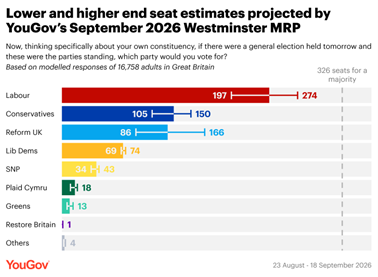
Even so, none of the plausible outcomes produced by YouGov gives Labour an overall majority. Its upper estimate is 274 seats, while its lower estimate is 197. The corresponding ranges are 86 to 166 for Reform and 105 to 150 for the Conservatives.
The model therefore points towards a Parliament in which no party comes close to governing alone.
Labour and the Liberal Democrats together would not necessarily be sufficient. YouGov says the two parties command a majority in only 33 per cent of its simulations. Labour, the Liberal Democrats and the SNP collectively reach a majority in 82 per cent.
That is the central tension in the new political landscape. Labour could lose more than 40 per cent of the MPs it returned in 2024 and still remain comfortably ahead in seats. The Conservatives could recover substantially without approaching a majority. Reform could gain more than 100 MPs while remaining extraordinarily vulnerable in many of the constituencies it takes.
YouGov's MRP is a model rather than an election forecast. It uses responses from nearly 17,000 Britons collected between August 23 and September 18 and estimates how current voting intentions could translate into individual constituencies.
With potentially years remaining before the next general election and more than a third of constituencies currently separated by five points or less, those estimates can change substantially.
For now, however, they describe a British electorate divided not simply between government and opposition, but among three major parties separated by only three percentage points of the national vote.
Continue Reading
More News
The British darts maker betting on Japan for its next phase of growth
Tactical voting is becoming a serious problem for Reform UK
Britons split over Macklemore removal as Ed Sheeran defends keeping politics off stage