Ed Davey’s biggest problem may be that much of Britain barely notices him
Ed Davey faces 42% of Britons who don't know what to make of him, new YouGov polling reveals as Liberal Democrats gather for their annual conference.
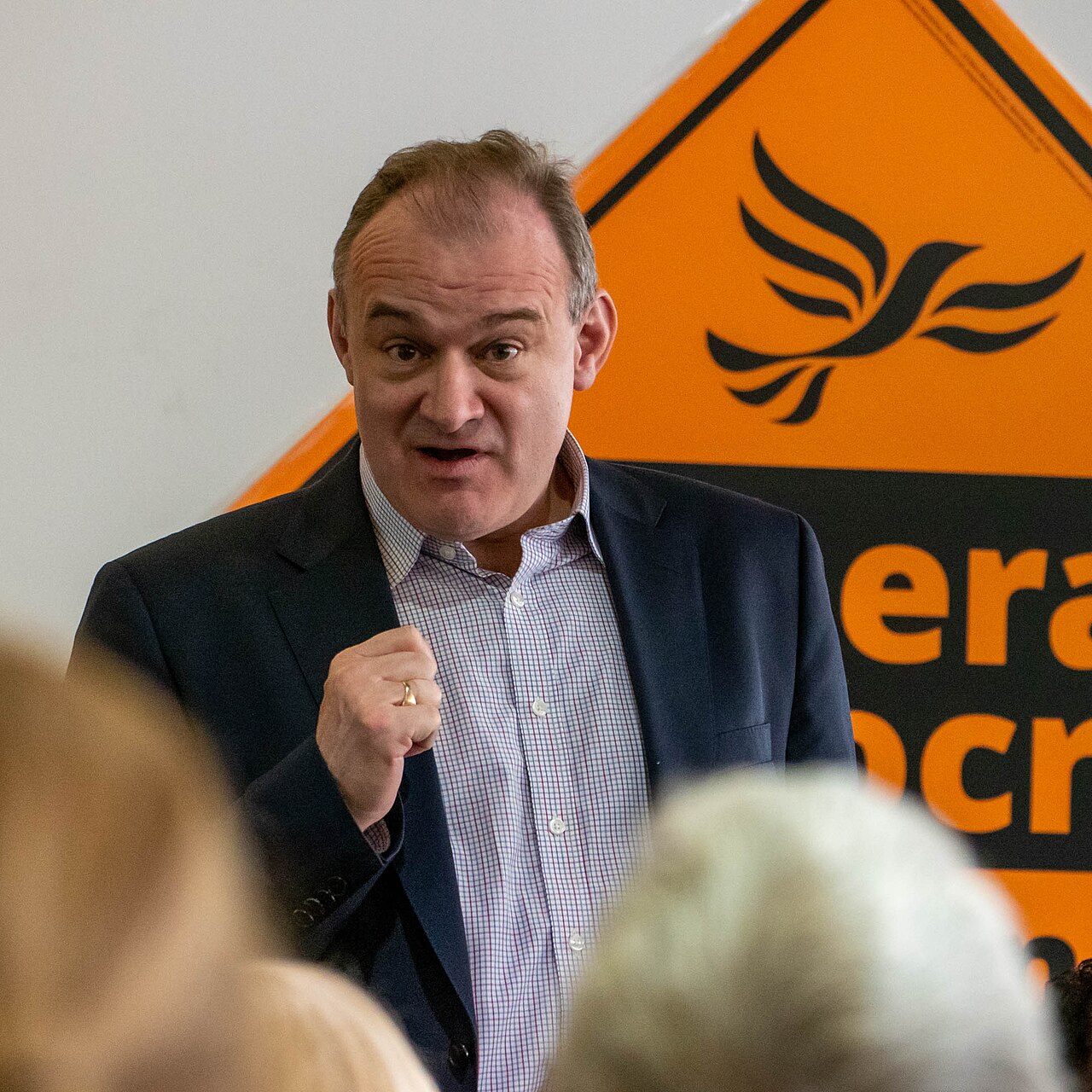
Ed Davey. Credit: House of Commons / Wikimedia Commons, CC BY 3.0.
As the Liberal Democrats gather for their annual conference, new polling suggests their leader has struggled to turn political stunts and parliamentary representation into a stronger national impression.
Ed Davey has rarely been short of ways to attract a camera. Yet as Liberal Democrats prepare to gather in Brighton for their annual conference, new polling points to a more fundamental difficulty for their leader: a sizeable proportion of the country still appears unsure what to make of him at all.
Asked by YouGov to describe Davey in three words, 28 per cent of Britons said they did not know or were unsure, while another 14 per cent responded, in effect, by asking “who?”. Together, those responses account for 42 per cent of the public.
For a politician who has made deliberately conspicuous campaigning part of his public identity, it is a striking finding. Davey’s election appearances have frequently involved unusual publicity stunts, but the polling suggests visibility in the moment has not necessarily translated into a clearly defined political identity.
Those who do have an opinion are more likely to reach for criticism than praise. Some 35 per cent of Britons used at least one negative term to describe Davey, compared with 25 per cent who used a positive one. “Clown” and “boring” were each mentioned by 4 per cent, while others described him as bland, invisible or irrelevant. Positive descriptions included fun, caring, friendly and sensible. These are respondents’ characterisations rather than objective descriptions of the Liberal Democrat leader.
The uncertainty is also visible in Davey’s broader ratings. YouGov puts his latest net favourability rating at minus eight, little changed from minus six a year earlier. Between 36 and 41 per cent answer “don’t know” when asked about him, a higher level of uncertainty than YouGov records for the leaders of the other four major parties.
That presents the Liberal Democrats with a curious problem. Davey is not experiencing a dramatic collapse in his personal ratings. Rather, the figures suggest stagnation.
A party struggling to convert consideration into votes
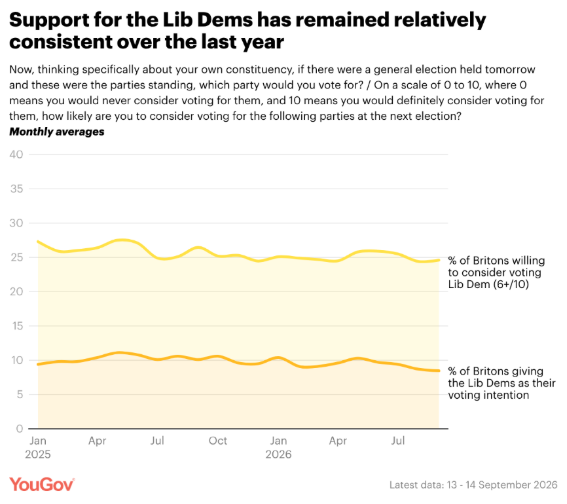
The difficulty extends beyond its leader. Liberal Democrat support has shown little sustained growth since the last general election, according to YouGov. The party’s voting intention figure slipped from 10 per cent in May to 8 per cent in the period covered by the release, although around a quarter of Britons consistently said they would consider voting Liberal Democrat.
That gap matters. YouGov calculates that current Liberal Democrat support represents only 34 per cent of those willing to consider the party. The equivalent figure is 46 per cent for the Greens, 51 per cent for the Conservatives, 57 per cent for Labour and 67 per cent for Reform UK.
In other words, the Liberal Democrats appear capable of entering voters’ consideration without persuading as many of them to make the final jump.
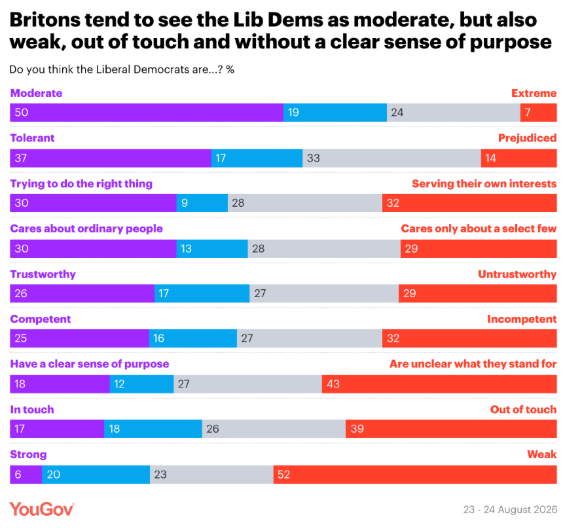
The public’s description of the party offers one possible explanation. Half of Britons regard the Liberal Democrats as moderate rather than extreme, and they are considerably more likely to see the party as tolerant than prejudiced. But 52 per cent describe it as weak, while 43 per cent say it is unclear what the party stands for, against 18 per cent who disagree. The public also tends to see the party as out of touch, by 39 per cent to 17 per cent.
Perhaps more awkwardly for Davey, some of those doubts exist inside his own electoral coalition. Among people who voted Liberal Democrat in 2024, 33 per cent describe the party as weak against 20 per cent who regard it as strong, while 29 per cent say it is unclear what the party stands for.
Even assessments of Davey among his own 2024 voters are not uniformly positive. Just over half, 52 per cent, use at least one positive term to describe him, while 30 per cent use at least one negative description.
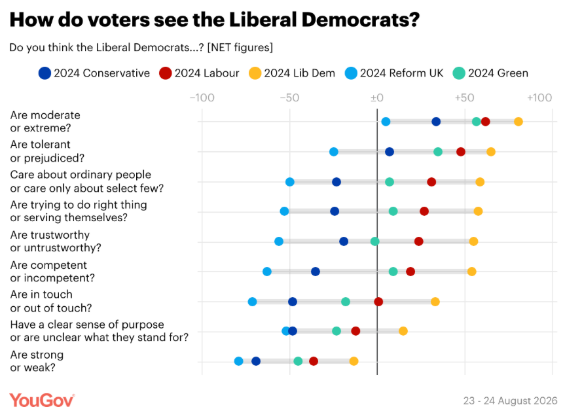
The polling does not suggest that Davey is universally disliked, nor that the Liberal Democrats lack attributes voters value. They are widely regarded as moderate, and opinion is much more evenly divided on whether the party is trustworthy or cares about ordinary people.
The more immediate challenge revealed by the numbers is definition. Davey has succeeded in becoming a familiar presence in British political coverage, but familiarity with the performance is not necessarily the same thing as understanding the politics behind it.
As his party meets in Brighton, the question is therefore less whether Davey can attract attention than whether the Liberal Democrats can turn that attention into a clearer reason to vote for them.
The YouGov survey was conducted among 2,128 adults in Great Britain between 22 and 23 August 2026.
Continue Reading
More News
Britons are split over tax and spending as the Budget choices tighten
The young Britons turning social media influence into millions in advertising value
Six in ten Britons want a cap on political donations after Reform’s £72 million windfall