Clare Woods turns flowers into meditations on time and mortality
Clare Woods
Flowers have long occupied a curious position in art. They are symbols of beauty and vitality, yet also reminders of decline, fragility and death. From Dutch still lifes to the late works of Édouard Manet, artists have repeatedly returned to flowers not simply for their colour or form, but for what they reveal about the passing of time.
This summer, the artist Clare Woods brings that tradition into the present with a major exhibition at Pitzhanger Manor & Gallery that explores nature, memory and mortality through a striking new body of work.
Garden Without Seasons, which opens in July, brings together 29 paintings, collages and prints created over the past four years. Installed throughout Sir John Soane's former country house in west London, the exhibition marks one of the most significant presentations of Woods' recent work and places her distinctive visual language within a setting preoccupied with history, architecture and the persistence of the past.
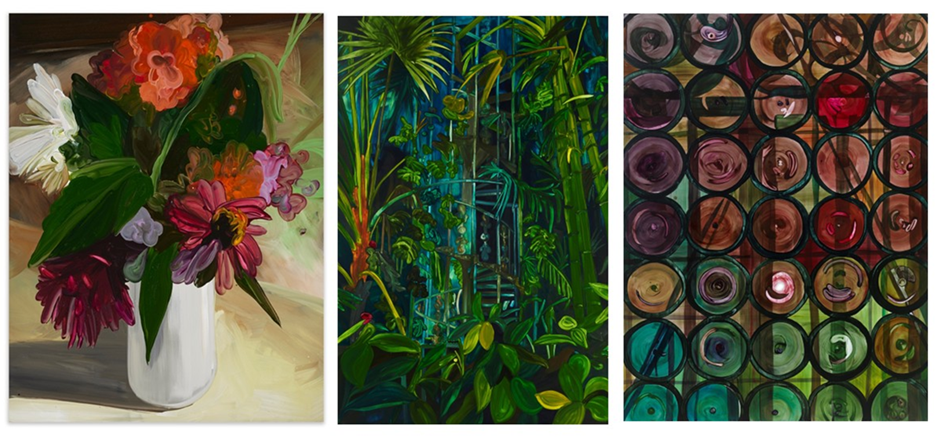
Woods has spent much of her career occupying a space between abstraction and representation. Her paintings often begin with photographs, yet the finished works transform familiar subjects into something less certain. Flowers dissolve into swirls of colour, architectural details become almost dreamlike and everyday objects take on an unsettling ambiguity.
The result is work that demands patience.
In an age saturated by digital imagery, Woods' paintings encourage a slower form of looking. Shapes emerge gradually. Meanings reveal themselves over time. Images that initially appear straightforward become more complex the longer they are observed.
Many of the works in the exhibition were developed during and after the pandemic, a period when ordinary surroundings acquired new significance. Windows, gardens and domestic interiors became central features of daily life as much of the world retreated indoors.
That experience runs throughout the exhibition.
Several paintings explore the act of looking through glass, whether into gardens, buildings or enclosed environments. Elsewhere, Woods examines the relationship between protection and vulnerability, life and decay. One of the exhibition's centrepieces, Under The Dome, depicts the rare plant collections housed within Kew Gardens' Temperate House. The glass structure that protects these species from extinction becomes a metaphor for the delicate boundary between survival and loss.
Such themes have become increasingly prominent in Woods' work.
Although visually rich and often exuberant in colour, her paintings frequently carry an undercurrent of melancholy. Flowers bloom, wilt and disappear. Shadows lengthen. Empty spaces suggest absence as much as presence. The beauty on display is never entirely separated from the knowledge that it is temporary.
That sensibility feels particularly suited to Pitzhanger Manor.
Designed by Sir John Soane, the house is itself a meditation on memory and legacy. More than 180 years after the architect's death, visitors continue to experience his presence through the buildings he created and the spaces he shaped. Woods responds to that atmosphere, drawing connections between the transience of human life and the enduring traces left behind.
The exhibition also highlights Woods' unusual artistic process. Trained originally as a sculptor, she approaches painting with a strong awareness of form and physicality. Her large-scale works are created in concentrated sessions, with oil paint manipulated directly on aluminium panels. Leftover paint is then repurposed into intricate collages, ensuring that nothing is discarded and each work becomes part of a broader creative cycle.
It is an approach that reflects many of the exhibition's central concerns.
Nothing remains fixed. Images evolve. Materials are transformed. Endings become beginnings.
At a time when contemporary art often seeks to provoke through spectacle or political confrontation, Woods offers something quieter and perhaps more enduring. Her paintings ask viewers to consider the relationship between beauty and impermanence, between the natural world and the passage of time.
The questions are ancient. The answers remain elusive.
That may be precisely why artists continue returning to flowers.
Continue Reading
More Art & Design
Josie Ryan paints the wildlife she refuses to let us forget
In the Tarn hills, Anne Briaud turns fragments into imagined worlds
Heinz Mack brings a lifetime’s study of light to Berlin