Britons remain divided over whether policing is applied equally
Britons remain divided over whether policing is applied equally, with 60% believing black people are treated differently by police, new YouGov polling reveals.
Oast House Archive / Geograph Britain and Ireland (CC BY-SA 2.0)
Few institutions rely more heavily on public confidence than the police. Every decision, whether at a protest, during a public demonstration or following civil disorder, is scrutinised not only for its legality but for its consistency. It is against that backdrop that accusations of "two tier policing" have become an increasingly prominent feature of Britain's political debate, with critics from across the political spectrum questioning whether different communities experience policing in different ways.
New polling from YouGov suggests there is little agreement on the answer. While a majority of Britons believe the police do treat some groups differently from others, there is no clear consensus over who receives tougher treatment and who is shown greater leniency. Instead, perceptions appear to be shaped as much by respondents' own backgrounds and political outlook as by the groups being assessed.
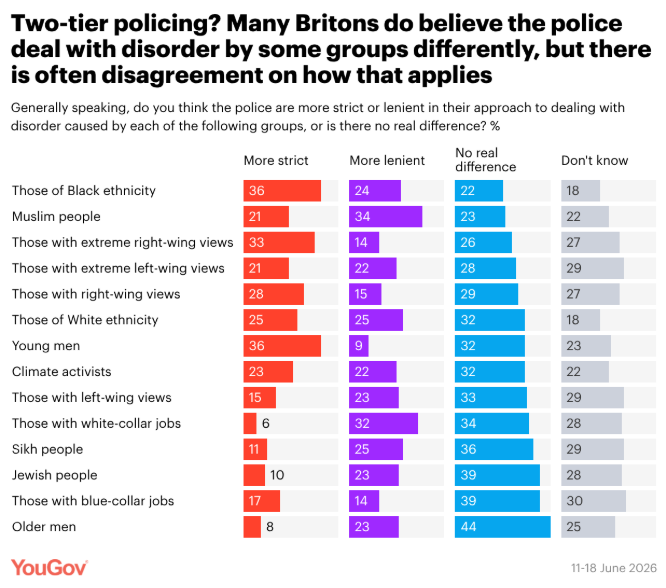
Among the clearest findings is public opinion surrounding the policing of black people. Around 60% of Britons believe black people are treated differently by police, although opinion is divided over what that means in practice. Thirty six per cent believe police are stricter with black people, while 24% believe they are treated more leniently, illustrating how the same question can produce sharply contrasting interpretations.
The survey also found that respondents tend to believe police take a firmer approach towards young men and those with extreme right wing views, while Muslims and people working in white collar professions are more likely to be perceived as receiving more lenient treatment.
Perhaps the most striking aspect of the findings, however, is the difference between white and ethnic minority respondents.
Among ethnic minority Britons, 53% believe police are stricter with black people, rising to 65% among black respondents themselves. White respondents also tend to believe black people receive stricter treatment, but by a smaller margin, with 33% holding that view.
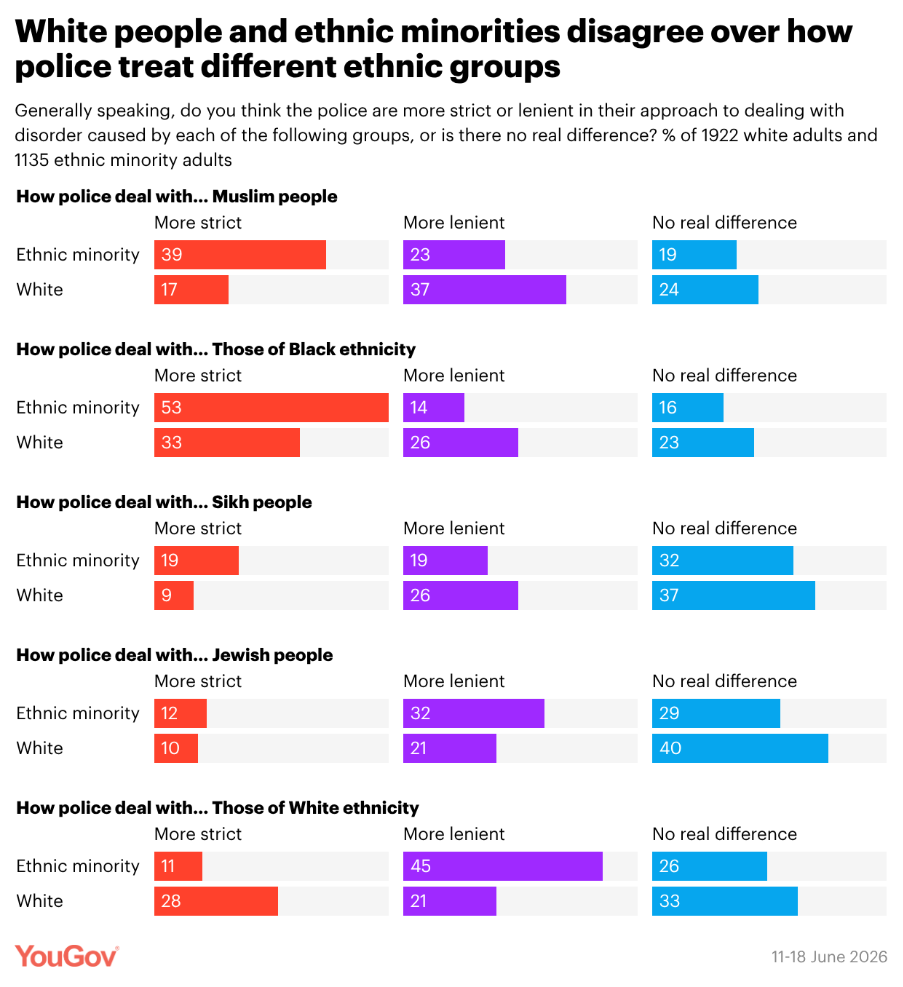
The sharpest divide emerges over perceptions of how police treat Muslims. Thirty nine per cent of ethnic minority respondents believe Muslims are treated more strictly, compared with 23% who believe they receive more lenient treatment. White respondents reach almost the opposite conclusion. Thirty seven per cent believe police are more lenient towards Muslims, while 17% think they are treated more strictly.
Views also differ significantly when respondents were asked about policing of white people. Ethnic minority Britons are considerably more likely to believe white people receive more lenient treatment, whereas a notable proportion of white respondents instead believe police are stricter towards white people than towards other groups.
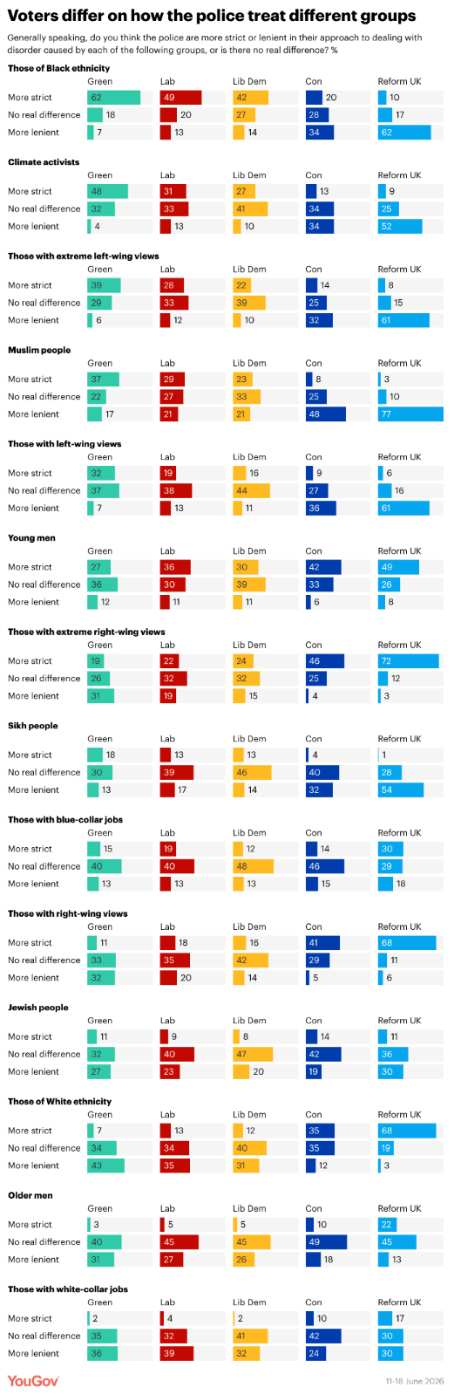
Political affiliation also plays an important role in shaping perceptions. Among Reform UK supporters, 68% believe police are stricter with white people, a view shared by 35% of Conservative voters but by only a small minority of Labour, Liberal Democrat and Green supporters. Conversely, voters on the political left are more likely to believe police apply greater scrutiny towards black people, Muslims and climate activists.
The findings underline the increasingly fragmented nature of public confidence in policing. Rather than pointing towards a shared national understanding of fairness, the survey suggests that different communities often arrive at entirely different conclusions when assessing the same institution. In many cases, perceptions of policing appear to reflect wider questions about identity, politics and trust as much as individual experiences.
Whether those differences are driven by lived experience, media coverage or broader political narratives remains open to debate. What is clear from the latest YouGov research is that Britain remains deeply divided over one fundamental question: not whether policing should be impartial, but whether it is perceived to be so.
Continue Reading
More News
The old football boots being given another match
Starmer leaves Parliament with public backing for his departure
Farage faces a test of credibility as Reform’s momentum begins to fade