When Photography Meets the Paintbrush: ICONIC Heads to Mallorca
Lorenzo Agius and Izzy Weissgerber bring ICONIC to Mallorca this August, transforming celebrity portraits of Madonna, Cate Blanchett and Jude Law through paint.
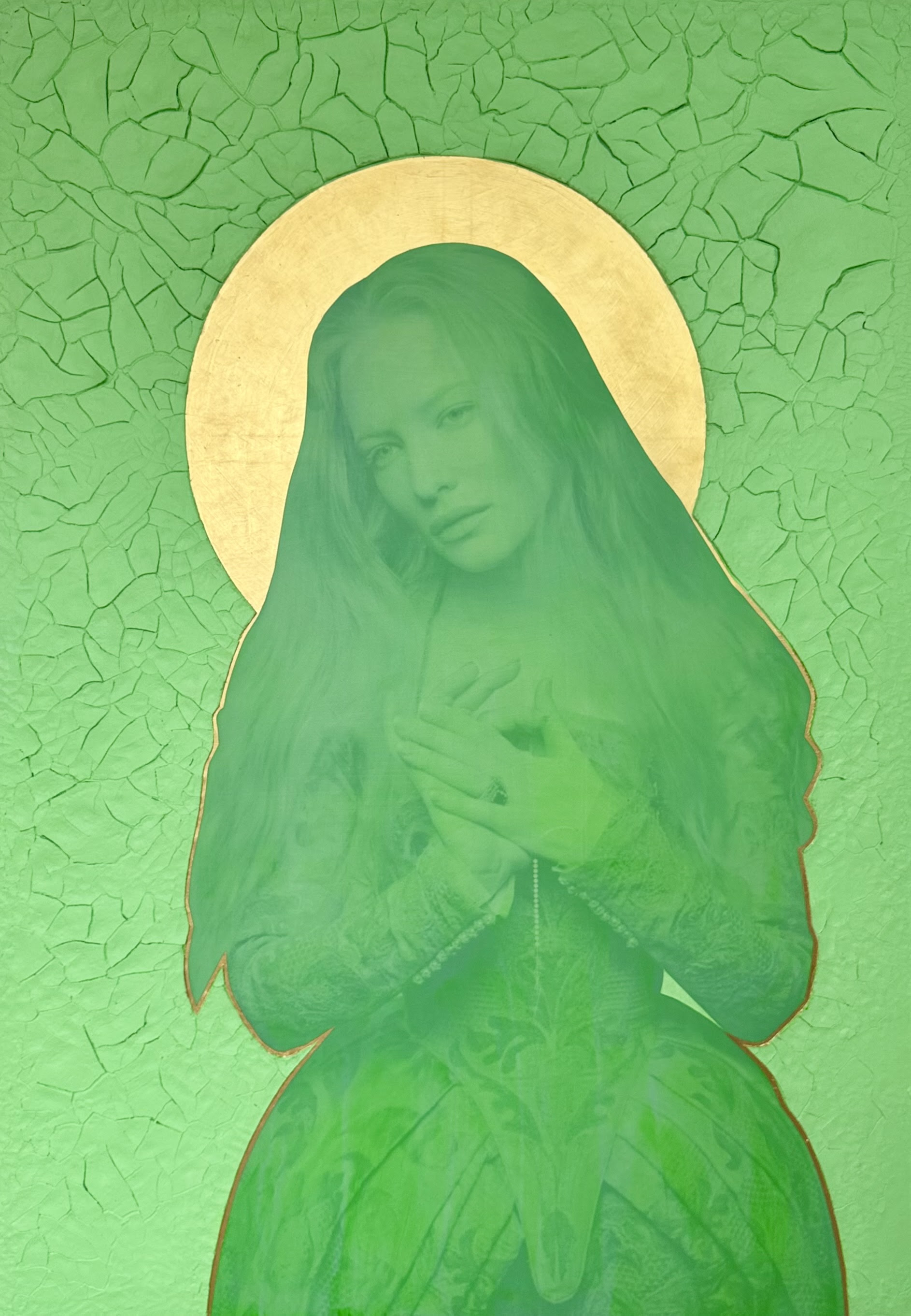
Cate Blanchett, 2026 © Izzy Weissgerbers
After drawing attention in Berlin, Lorenzo Agius and Izzy Weissgerber are taking their collaborative exhibition to Port Andratx, where some of the most recognisable faces in popular culture are transformed through paint, photography and a deliberate surrender of artistic control.
There is something inherently controlled about the celebrity portrait.
The lighting is considered, the composition deliberate and the subject, however famous, carefully contained within the frame. For decades, Lorenzo Agius has understood how to work within those boundaries while finding the moment when they begin to disappear.
His photographs of some of the world's most recognisable people have helped shape the visual language of celebrity culture. Cate Blanchett, Madonna, Jack Nicholson, Ewan McGregor and Valentino are among those who have appeared before his camera.
Yet his collaboration with German-American artist Izzy Weissgerber begins where the photograph might ordinarily end.
This month, their exhibition ICONIC arrives at HMH Galeria in Port Andratx, Mallorca, following its presentation during Gallery Weekend Berlin at St. Elisabeth-Kirche. Opening on 22 August, the exhibition will remain in Mallorca until 6 January 2027.
At its centre is a deceptively simple idea: what happens when one artist relinquishes control of a finished image and allows another to enter it?
Beyond the celebrity portrait
Agius has spent much of his career photographing people whose images are already deeply embedded in public consciousness.
That presents a peculiar challenge. Photographing a famous face is one thing; finding something within it that an audience has not already been shown countless times is another.
For Agius, portraiture is less about documenting celebrity than establishing sufficient trust for something less rehearsed to emerge. He has described the process as a dance between photographer and subject, built around intimacy, emotion and exchange.
The resulting photographs can carry all the polish expected of fashion and celebrity photography, but Agius is interested in the point at which that polish begins to fracture.
Weissgerber approaches those images from an entirely different direction.
Her practice is driven by instinct, gesture and intervention. Painting, mixed media and mark-making are used not simply to decorate an existing photograph, but to respond to it.
She treats the photographic image as something unfinished and alive.
And that changes the relationship between photographer and painter considerably.
Giving up control
The most interesting aspect of ICONIC may be that neither artist is allowed complete ownership of the final result.
Agius begins with a composed photograph. Weissgerber then intervenes.
Paint can disrupt the precision of the portrait, draw attention towards something previously secondary or introduce an entirely new emotional register. The photograph remains visible, but its authority is no longer absolute.
There is a risk inherent in that process.
Photography, particularly portrait photography, depends upon choices. The photographer determines the frame, the light and ultimately which fraction of a second survives.
Handing that finished work to another artist means accepting that those decisions can subsequently be challenged.
That tension gives ICONIC much of its character.
Agius brings control; Weissgerber brings interruption. One establishes the image and the other tests its boundaries.
The resulting works belong completely to neither photography nor painting.
Instead, the artists describe the collaboration as producing a third visual language, something that could not have been created independently by either of them.
Familiar faces, unfamiliar images
Among the works being shown in Andratx are portraits featuring Cate Blanchett, Jude Law, Madonna and Diana Ross.
These are faces audiences already know extraordinarily well.
That familiarity is important.
Celebrity imagery is consumed at such speed and volume that famous faces can become almost symbolic. We recognise the person before we properly look at the photograph.
ICONIC attempts to interrupt that instinct.
Weissgerber's interventions force the eye to reconsider images that might otherwise be processed almost immediately. Visibility and concealment begin to compete with one another. Beauty remains, but so too does vulnerability.
It is an approach particularly suited to a culture now saturated with images.
We see more photographs than perhaps any generation before us, while arguably spending less time actually looking at them.
Against that backdrop, Agius and Weissgerber are asking the viewer to linger.
The space between two artists
Collaborations can sometimes produce work in which one artist's contribution simply sits on top of another's.
ICONIC is more interesting when viewed as a negotiation.
Agius does not disappear beneath Weissgerber's painting, nor does her work behave as an accessory to his photography.
Instead, the original portrait and subsequent intervention remain in conversation.
Control meets surrender. Permanence meets erosion. The polished public image meets something more instinctive and uncertain.
It also raises a wider question about authorship.
A photograph traditionally carries the name of the photographer who made it. A painting belongs to the painter. Here, those boundaries become less useful.
The final work exists because one artist has been prepared to make something and another has been permitted to disturb it.
Perhaps that is why the collaboration feels appropriate for its subjects.
Celebrity itself exists somewhere between construction and reality, between the person and the image the rest of the world is allowed to see.
Agius has spent decades photographing that boundary.
With Weissgerber, he is now allowing somebody else to paint across it.
ICONIC – Izzy Weissgerber and Lorenzo Agius runs from 22 August 2026 to 6 January 2027 at HMH Galeria, Carrer de sa Fábrica 11, Port Andratx, Mallorca. The gallery is open Monday to Saturday, 9am to 6pm.
Continue Reading
More Art & Design
The wooden frame changing the view of one of Russia’s great architectural monuments
Christoph Schlingensief’s art was never meant to make its audience comfortable

Josie Ryan paints the wildlife she refuses to let us forget