The Shenzhen summit: three powers, one table and a start
Trump, Putin and Xi met for the first time as a trio in Shenzhen, agreeing to nuclear risk talks and UN reform. The 90-minute summit drew outrage, but rivals talking is what serious powers do.
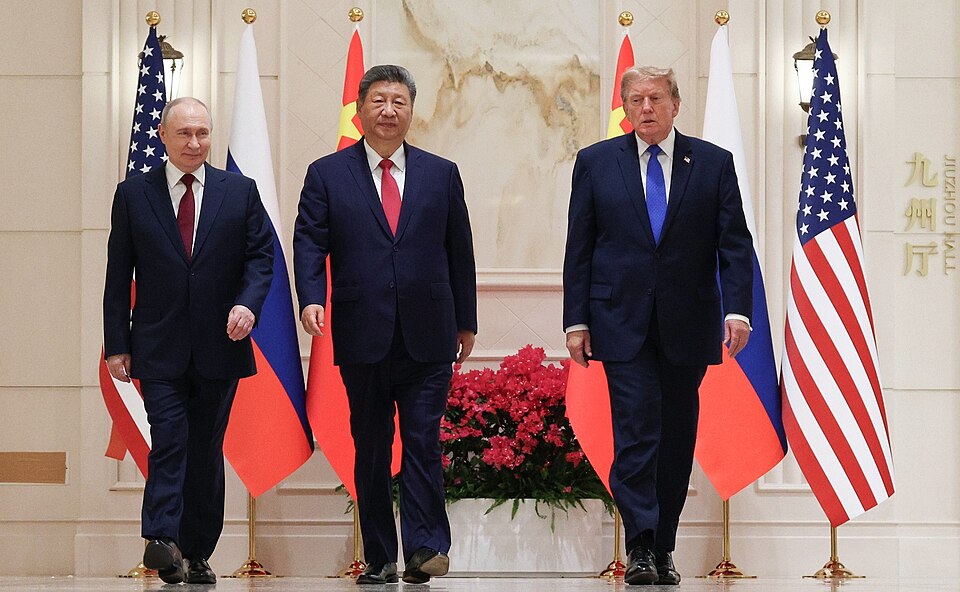
Photo: Kremlin.ru, CC BY 4.0, via Wikimedia Commons.
The first meeting of the American, Russian and Chinese presidents produced a modest text and a great deal of outrage. The outrage is misplaced. Talking to rivals is what serious powers do.
There is a government villa on a lake in Shenzhen, the Kylin, and on Thursday it hosted something that has never happened before. The presidents of the United States, Russia and China sat down together at a round table, with Xi Jinping in the chair, and talked for about an hour and a half. Donald Trump told the other two they were "really making history". Afterwards he scored the afternoon a 12 out of ten.
The marking is generous. The instinct is sound. Between them these three men command the overwhelming majority of the world's nuclear warheads and three of the five permanent seats on the Security Council. Until this week they had never met as a trio. Mr Trump said at the table that they bore "a special responsibility to maintain open, respectful and constructive dialogue". It is hard to see which part of that sentence a sensible person would wish to oppose.
What was actually agreed
The leaders issued a four-point text they called a Declaration Towards Peace. It commits them to reforming the United Nations, to raising the production and supply of refined fuel, to opening a dialogue on reducing nuclear risk, and to resisting what they regard as overreach by the International Criminal Court and bodies like it. That is a modest list. It is also more than Washington promised, since American officials had said beforehand that they did not expect any agreement at all.
The nuclear point is the one that matters. For years Beijing declined to join Washington and Moscow in arms talks, on the grounds that its arsenal was too small to count. That arsenal is now growing faster than any other on earth. In Shenzhen Xi put his name to a three-way dialogue on nuclear risk and repeated the old formula that a nuclear war cannot be won and must never be fought. Those are the words Ronald Reagan and Mikhail Gorbachev arrived at in Geneva in 1985. That summit produced no treaty either. Reykjavik, a year later, broke up without a deal and was written off as a failure. The treaty scrapping intermediate-range missiles was signed the following year.
The rest of the declaration is less grand and more useful than its critics allow. With a war in the Gulf and Ukrainian strikes on Russian refineries, the supply of fuel is a kitchen-table matter in every country that buys it. Mr Trump said Xi had agreed that the Strait of Hormuz must stay open and that Iran must not acquire a bomb. On the ICC, none of the three states is a member of the court, and America's objection to it long predates this President. One may dislike the company without pretending the position is new. As for reform of the United Nations, few readers of this magazine will need persuading that it is overdue.
The Ukraine objection
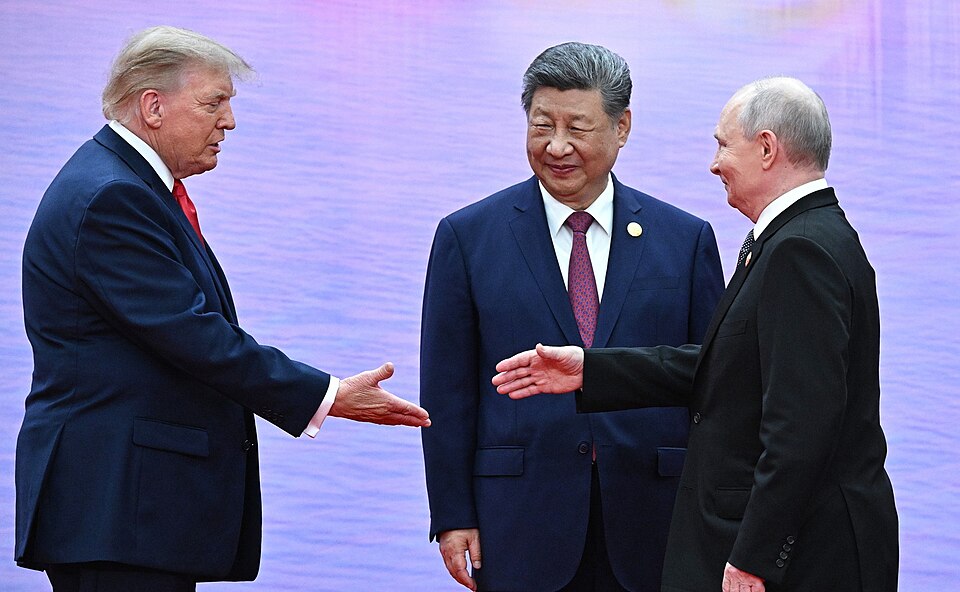
The serious complaint is about Ukraine, and it deserves a serious answer. The declaration does not mention the war. Volodymyr Zelensky, who was not invited, called his exclusion a "huge mistake". Donald Tusk, whose country borders the fighting, posted a one-line prayer after Mr Trump greeted Vladimir Putin as a friend: "God, protect us from such friends." Nobody should mock a Polish prime minister for being nervous about Russia.
But the three-way session was never billed as a Ukraine peace conference, and the White House said so in advance. The war was the main business of Mr Trump's separate meeting with Mr Putin earlier in the day, and he pressed Xi to help bring it to an end. On the same afternoon his envoy Jared Kushner was in Berlin, where more than 30 leaders had gathered for the Coalition of the Willing under German, French and British chairmanship. The President telephoned in. Andy Burnham said he had spoken with passion about the loss of life on both sides. A man who had abandoned Kyiv would not have troubled to do either.
There is also a plain fact that Europe's indignation tends to skip over. This war ends when Moscow decides to stop fighting it. The two capitals with real leverage over Moscow are Washington and Beijing. Both were in the room on Thursday. Years of refusing to speak to Mr Putin did not shorten the conflict by a day.
The critics at home
In Washington the Senate's Democratic leader, Chuck Schumer, called the summit a betrayal. His colleagues say that a President bruised by the midterms, and embarrassed by a spy scandal in Silicon Valley, went abroad in search of a flattering photograph. Much the same was said of Richard Nixon when he went to Peking in 1972, and of Reagan by his own side when he shook Gorbachev's hand. Both were accused of rewarding tyrants. Both are now remembered for having changed the weather.
None of this is an argument for credulity. Mr Putin went home with pictures that will play well in Moscow. Xi had the satisfaction of playing host. Neither conceded anything that can yet be measured, and a declaration is only words. Reagan's rule applies here as it did then: trust, but verify. The tests are simple enough. Does the nuclear dialogue actually convene, with Chinese officials at the table? Does fuel supply improve? Does Mr Putin move on Ukraine?
The first marker is close. Mr Trump hosts the G20 at Doral, in Miami, on 14 and 15 December and has repeated his invitation to the Russian leader. Mr Putin thanked him for it in Shenzhen and declined to commit himself. If he comes, he should be expected to bring something.
Britain was in Berlin this week, which is where it belonged. The lesson for London and for Europe is not that America has gone missing. It is that places at the top table go to those with the hard power to justify them, and that complaining about the seating plan is no substitute for paying for defence. Shenzhen settled nothing. It opened a conversation among the only three people who can settle a great deal. That was worth ninety minutes by a lake.
Continue Reading
More News
Men dominate finance conference stages as women secure just one third of speaking slots
British cancer drug developer Ellipses Pharma explores London Stock Exchange listing
Majority of Britons believe Brexit has failed, but public divided over whether rejoining EU should be a priority