Stina Otterström and Arttu Lahtinen answer our questions ahead of Soft Spot heading to the Edinburgh Festival Fringe
Stina Otterström and Arttu Lahtinen bring Soft Spot to Edinburgh Fringe 2026, a contemporary circus duet built around 300 wine glasses and precarious trust.
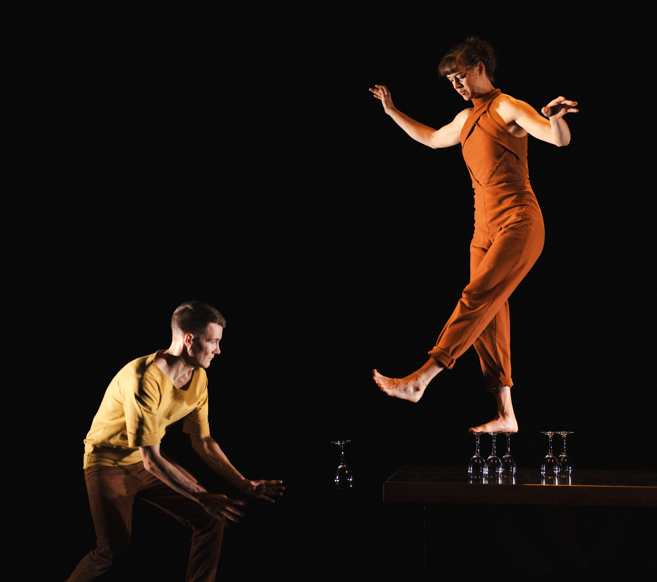
Soft Spot is a nerve-wracking contemporary circus duet combining object manipulation, physical theatre and 300 wine glasses. Using sliding wooden planks, juggling and handstands, real-life couple Stina Otterström and Arttu Lahtinen (OLO Company) perform human Jenga as they build increasingly precarious structures that wobble constantly on the edge of collapse. Full of suspense and play, the show explores trust, instability and how people support one another when things stop going to plan. We chat to Stina and Arttu about working with glass, each other and audience expactations.
Soft Spot is built around 300 wine glasses, sliding wooden planks and live circus skills. How did those particular elements come together to become the foundation of the show?
It was a very organic process that unfolded over quite a long period of time. We didn’t rush the creative process and allowed the different elements to naturally fall into place.
The wine glasses were the first idea. Stina already had a handstand act that incorporated wine glasses, and that became the starting point for our shared desire to create a full-length show together.
The wooden planks, on the other hand, were just an option among many. We also considered long transparent tubes, boxes, and water. However, through our research, we found the planks to be the most inspiring choice. Part of the reason was that they felt like a natural extension of the large table we had already decided to use.
The table was important for a very practical reason: we wanted some walking sequences to be more visible by elevating them and at the same time it felt safer to always work with the same surface and not depend on the variety of floors in theatres. While creating we also figured a specific treatment for the tabletop that allows the glasses to slide in a way that has now become essential to the piece.
Arttu is also a ring juggler, so deciding to leave the rings out of the show was a difficult choice. In the end, though, we felt they simply didn’t belong in the world we were creating with the wine glasses.
You perform the piece as a real-life couple. In a show where trust is constantly being tested, does your relationship offstage change the way you work together onstage?
Most likely yes, but it is hard to tell. We have always been on stage while being a couple in real life, so we don’t know if it would be any different if we weren’t. However, we do have a routine dynamic while working together which we haven’t experienced in any other collaboration. We definitely believe that the trust we have on stage comes from our private relationship, since we have never had to build it through an actual duo practice such as pair acrobatics, dance, improvisation or similar disciplines.
A funny fact is that we actually only have a couple of moments of physical contact during the show while our interactions share the deep trust that is often part of close contact disciplines.
The performance embraces near-misses rather than trying to hide them. What have you discovered about audiences when they know that things could genuinely go wrong?
We keep on discovering the incredible difference between a live experience and screen culture. Audiences have an endless catalogue of spectacular sights they can watch online, but when they come and see us taking controlled risks live, it touches them on a much deeper level.
The show is very honest, and we feel that audiences respond with the same honesty. They don’t hide their gasps, just like we can’t hide if something goes wrong. It genuinely feels like we are all very much in the moment, where whatever happens, happens. At the same time the public trusts us, it is the precious mission of our profession, the unspoken contract with the audience that we are responsible for making them live extreme and unique experiences but without crossing the fine line that would turn those moments into uncontrolled risks.
The soundtrack is made entirely from recordings of wine glasses being struck, shaken and shattered. How did that idea develop, and what did it add to the atmosphere of the piece?
It is not entirely made of glass sounds; there are other sounds as well. However, all of the glass sounds that are part of the music were created from recordings of our own wine glasses, made by the composer together with us in our studio.
Since the glasses are at the centre of the piece, both physically and thematically, the idea came very naturally. It felt obvious that they should be part of the auditory experience as much as they are part of the visual experience.
The glass sounds feel very natural within the piece. Often, the audience may not consciously think about them during the show, but there are moments when the sounds make the viewer question whether they are coming from the glasses present on stage or from the soundtrack.
The show asks audiences to sit with moments of instability for longer than feels comfortable. What is it about that feeling of suspense that interests you as performers?
We have been interested in the suspense that instability creates because it is a way of having the audience deeply invested in the action on stage, but in an unusual way compared to a quick and short “wow effect” trick. As a handstander and a juggler, our disciplines are generally much less dangerous than aerial or acrobatic disciplines, especially because they happen at floor level. It has been incredibly interesting for us to shape scenes in the show that reach that same level of intensity and audience involvement through disciplines where mistakes usually do not carry the same consequences.
On the other hand, one of the goals of our work with the fragility of the wine glasses is to push it far enough that it moves beyond the first scary reaction and becomes about the choreography and complicity that emerges from the instability itself.
Wine glasses are such familiar objects that most people instinctively know how fragile they are. What made them a more interesting choice than specialist circus equipment?
It is exactly because of their familiarity that we find them interesting. As a handstander and a juggler, we are used to performing with objects that, for the audience, have no direct connection to their everyday surroundings.
For example, juggling rings or clubs can feel a little strange, even if they can be related to more familiar objects. But handstand canes - those metal sticks stuck in a platform with squared blocks on top to hold onto when upside down - are completely alien to most audiences.
We wanted the audience to recognize, understand, and connect with the objects on stage in order to bring them closer to us and to the concept of fragility that we want to share with them. It is also great to think that next time they hold a glass, they might look at it from a radically different angle and think of us.
OLO Company describe their work as being rooted in genuine live interaction. How does Soft Spot leave room for the unexpected, even after so much rehearsal?
For us this is inherent to live arts. The presence of the people in the audience, which will always vary, allows us as artists to let the moment unfold and experience it fully and partly for the first time, since, for most of us present that night, it is actually the first time. So even when a show goes exactly as planned, it will always be a unique experience for the audience and for us. We always end up having all kinds of things to talk about after the show, from unexpected audience reactions to a funny drop of sweat hanging from an ear. On the other hand, even though we feel comfortable with the material we present, things can still very easily go wrong if we lose our concentration or if we simply accidentally fumble. At times, it also feels like the glasses have a say in it when they unexpectedly fall. We will probably have to do a few more hundred shows before they stop surprising us!
Soft Spot will be performed at 8:30pm at Zoo Southside from 7th – 30th August. Booking link: https://zoofestival.co.uk/programme/soft-spot/
Continue Reading
More Ed Fringe 2026
Lorna-Rose Treen ‘Now That’s What I Call Characters’ Interview
Q&A: Talking all things Edinburgh Fringe with Only Bones creator and performer Daniel Nodder
Tom Neenan answers our questions ahead of Tom Neenan: Portrait of a Tom as a Young Neenan heading to the Edinburgh Festival Fringe