Caitlin McEwan answers our questions ahead of Two Little Pigs heading to the Edinburgh Festival Fringe
Caitlin McEwan brings Two Little Pigs to Edinburgh Fringe 2026—a dark comedy where a lonely man's feminist pig dismantles his alpha-male worldview.
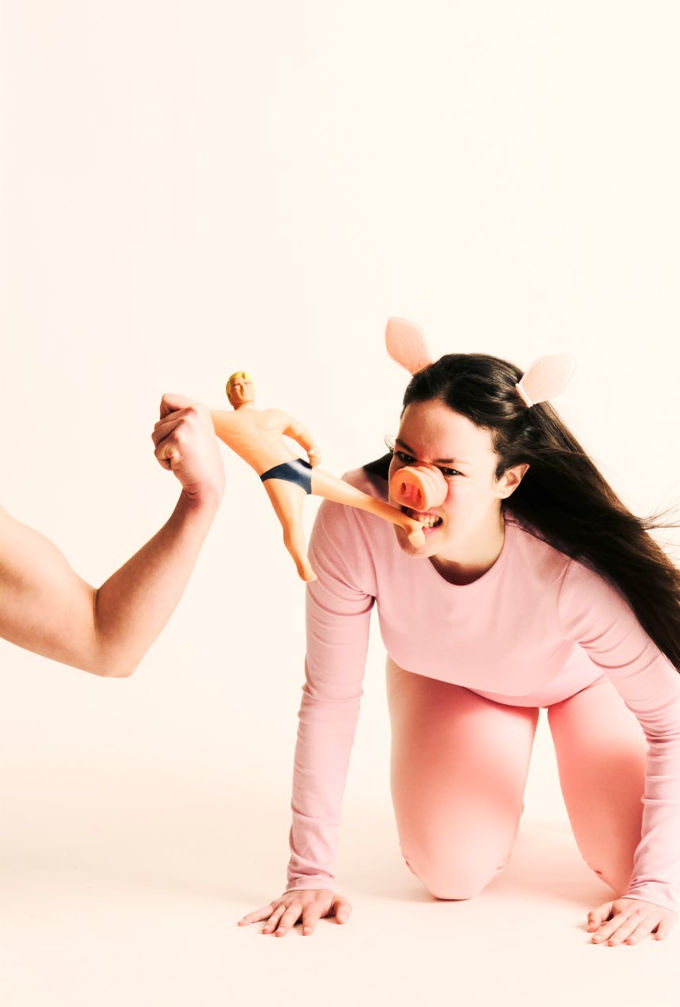
Two Little Pigs is a wickedly dark and absurdist play about masculinity, loneliness and the online spaces shaping modern male identity. After his girlfriend leaves him following his descent into alpha-male internet culture, Mark adopts a pig for companionship only to discover she is a feminist determined to dismantle his worldview. Funny and timely, the show explores the collision between online ideology and emotional reality. We chat to writer and actor Caitlin McEwan about lab grown meat, literal vs metaphorical pigs, and including laughs while serving the story
The central relationship in the show is between a man pulled into alpha male culture and a talking pig with a passion for feminist literature. Where did that idea come from, and what made you think it could sustain a full play?
The initial idea came from an article I read years ago about, of all things, lab-grown meat. There’s a company in Japan called the Shojinmeat Project who are developing technologies that would allow ordinary people to harvest an animal’s cells to create what’s called cultured meat. The article discussed a theory that if a pig was both a family’s pet and its food source, it could completely change the relationship between humans and animals. There’s definitely a cultural disconnect between the animals we keep as pets and the ones many of us choose to eat, and I thought there might be an interesting play in what happens when those two categories collide. I pitched it (very half-formed) to a couple of people and was met with total confusion, so put it to the back of my mind for a few years! It wasn’t until I started thinking about who might need the companionship of an animal who was also a food source - a lonely man who was obsessed with hitting his protein goal but felt guilty about eating animals - that the play began to take shape. I think theatre is at its best when there’s a strong dialogue between two opposed points of view, and that’s when the feminist literature-obsessed pig started to take shape. My idea was that Mark, the owner, would help the Pig become less of a literal pig, and she would help him become less of a metaphorical pig, and it all developed from there. I knew they’d never agree easily, that they would start as adversaries and become something like friends, and that there were some big themes hanging over it all (masculinity, communication, the pitfalls of black-and-white thinking), so I thought all those things combined might make a play that would keep people entertained and hopefully intrigued!
Pig is played by the same actor as Mark’s ex-girlfriend. What did that casting choice allow you to explore that wouldn’t have been possible otherwise?
I’m playing Pig, so selfishly it gave me more to do! But I think as a writer it gave me the opportunity to draw parallels between Pig and Martha, Mark’s ex-girlfriend. Throughout the play, I wanted the audience to feel unsure whether Pig genuinely can talk, or whether Mark is projecting a feminised personality onto her. Pig is definitely not Martha in a costume, but at times Pig is a stand-in for Martha, and other female characters in the play, who Mark can speak to without fear of judgment or being shut down. There’s also a nice echo for me in the same actor playing Pig and Martha that maybe speaks to how Mark views women in an almost animalistic or proprietary sense. Pig has never met Martha, so has to build a picture of her through the mostly negative things Mark tells her (which she knows must be exaggerated). But she also has a deep affinity with human women, which encourages her to try and find some empathy for Martha, and her reason for leaving. That becomes increasingly complicated as Pig gets to know Mark, and understands how hurt and broken he is. Martha is a sort of a ghost for both characters throughout the play, whilst also being visible onstage, in the body of Pig.
Mark is looking for something he can control when he adopts Pig, but she immediately starts dismantling his worldview. Was it important that the power dynamic shifts so quickly?
Yes, definitely - I think when the audience meets Mark, he’s very calcified in his worldview. He’s angry, and he feels backed into a corner in many aspects of his life. He’s clinging on to these very strict beliefs about the world - that women are trying to take his power away from him, and should be subjects under his control. Pig is fascinated by the human world, but she operates outside of it, with her own ways of thinking and behaving, so she has absolutely no respect for Mark, and is brutally honest about what she thinks of him and his lifestyle. It takes a force of nature like Pig to shake Mark up, and it prompts a power struggle that gives the play a bit of an engine.
The play takes on subjects like the manosphere and male loneliness through surreal comedy rather than straightforward realism. Why did that feel like the right approach?
Instinctively as a writer I always gravitate towards comedy - I think I’m probably incapable of writing something without a few jokes thrown in, because it doesn’t feel real otherwise. But for this play in particular, I think the set-up is so absurd and surreal that it would feel strange for it to be played extremely seriously. There’s a pig on stage talking about Simone de Beauvoir - it’s not exactly Death of a Salesman! But also, I thought there was room to explore masculinity with a bit of lightness. A lot of the recent on-screen depictions of similar stories are amazing, but very serious. I wanted to make something really entertaining and amusing that would still pack a punch and hopefully be all the more impactful for an audience because there had been laughs along the way.
The play suggests that rigid ideas about masculinity can be damaging to everyone. How did you avoid turning Mark into a simple villain?
I think if Mark was an irredeemable villain, the play would be painful to watch. What I hope will keep the audience engaged is their hope that he might change. He’s got some awful views, and does some terrible things in the course of the play, but at his core I think he’s not a bad guy, he’s just been influenced by extreme content online and has internalised the core beliefs of that content until he can’t differentiate between his own opinions and the ones his algorithm has fed him. Over the course of the play, with Pig’s help, he starts to untangle everything, but the ultimate question is whether he can completely free himself, and what his life would look like if he did.
There are plenty of jokes in the idea of a feminist talking pig, but the play also takes the relationship between Mark and Pig seriously. How did you find the right balance?
To be honest, a lot of redrafting! Because Pig is such an outrageous character, I had a lot of fun coming up with lots of withering put-downs or quippy one-liners for her, but at some point, I had to start cutting them back, because the more I added, the less effective they became. The guiding principle I used was that the jokes had to serve the story. It’s not a straight-up comic play, it’s more of a dramatic comedy, and it’s got a clear theme, so anything that wasn’t in service of that had to go. It was still important that it felt funny though, so I did leave a fair few jokes in.
Two Little Pigs will be performed at 7:45pm at Pleasance Courtyard from 5th – 30th August. Booking link:https://www.pleasance.co.uk/event/two-little-pigs
Continue Reading
More Ed Fringe 2026
Lorna-Rose Treen ‘Now That’s What I Call Characters’ Interview

Q&A: Talking all things Edinburgh Fringe with Only Bones creator and performer Daniel Nodder

Tom Neenan answers our questions ahead of Tom Neenan: Portrait of a Tom as a Young Neenan heading to the Edinburgh Festival Fringe