Love Island was built on making unknowns famous. The numbers suggest viewers still want it that way
Love Island contestants who entered with under 1,000 followers now boast millions, generating more commercial value than established influencers like Joey Essex.

Love Island did not become a cultural phenomenon by giving famous people another television appearance. At its peak, part of the attraction was discovery: a group of largely unknown twenty somethings entered a villa and, over the course of a summer, viewers decided who deserved their attention. Some disappeared almost immediately afterwards. Others emerged with careers, businesses and audiences that would have been almost unimaginable when they walked through the villa doors.
That formula has changed. Contestants increasingly arrive with established social media audiences, existing relationships with brands and, in some cases, considerable public profiles. It makes commercial sense in an entertainment industry increasingly intertwined with the creator economy, but new analysis suggests that Love Island may still be at its most powerful when viewers are introduced to somebody they have never heard of.
Research from influencer marketing platform Kolsquare, examining selected current and former Love Island contestants, found that some of the programme's most dramatic social media success stories came from those who entered with remarkably small audiences. Rather than simply amplifying existing influencers, the programme has historically demonstrated an extraordinary ability to create them.
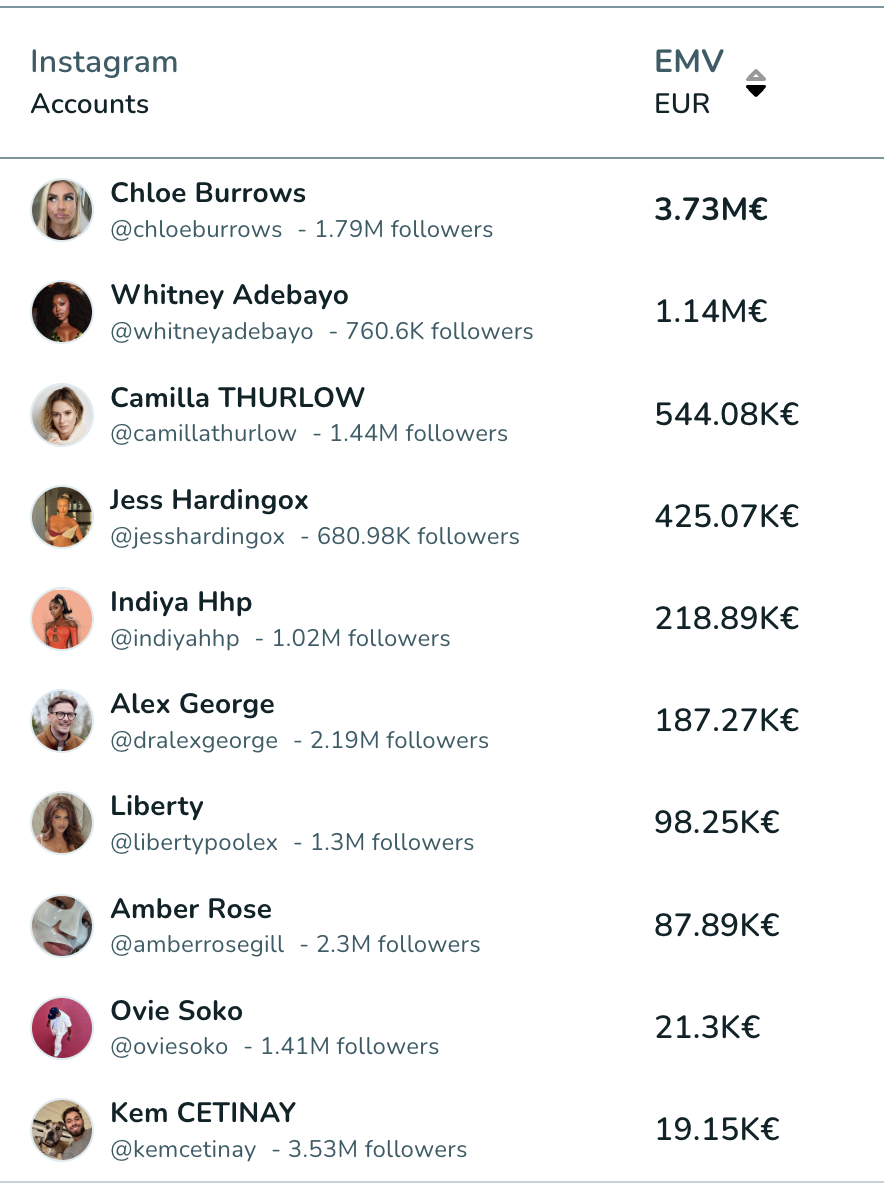
Few examples illustrate this better than Camilla Thurlow. When she entered the villa in 2017, Kolsquare estimates that she had only 200 to 300 Instagram followers. Today, that audience stands at more than 1.4 million, representing growth of well over 450,000 per cent.
Dr Alex George arrived as an NHS doctor with approximately 6,000 Instagram followers and has subsequently built an audience exceeding 2.2 million. Whitney Adebayo, who entered in 2023 with around 1,700 followers, now has more than 760,000 on Instagram and 556,000 on TikTok.
Then there is Chloe Burrows. She entered Love Island with approximately 11,500 Instagram followers. Her audience now stands at 1.79 million on Instagram and 1.4 million on TikTok, turning her into one of the programme's most significant creator success stories.
The contrast with contestants who were already well known is striking. Joey Essex entered the 2024 series with around 1.8 million Instagram followers and now has approximately 1.89 million, according to the analysis, an increase of roughly 5 per cent and the smallest percentage growth among the contestants examined.
That does not mean an existing following prevents contestants from benefiting enormously from the programme. Ekin Su Cülcüloğlu, Tommy Fury, Gemma Owen and Molly Marsh all arrived with substantial audiences and subsequently recorded considerable growth. What the figures do challenge is the assumption that bringing an established creator into the villa necessarily produces greater influence afterwards.
Perhaps more interesting for the industry is what happens once follower counts are converted into commercial value.
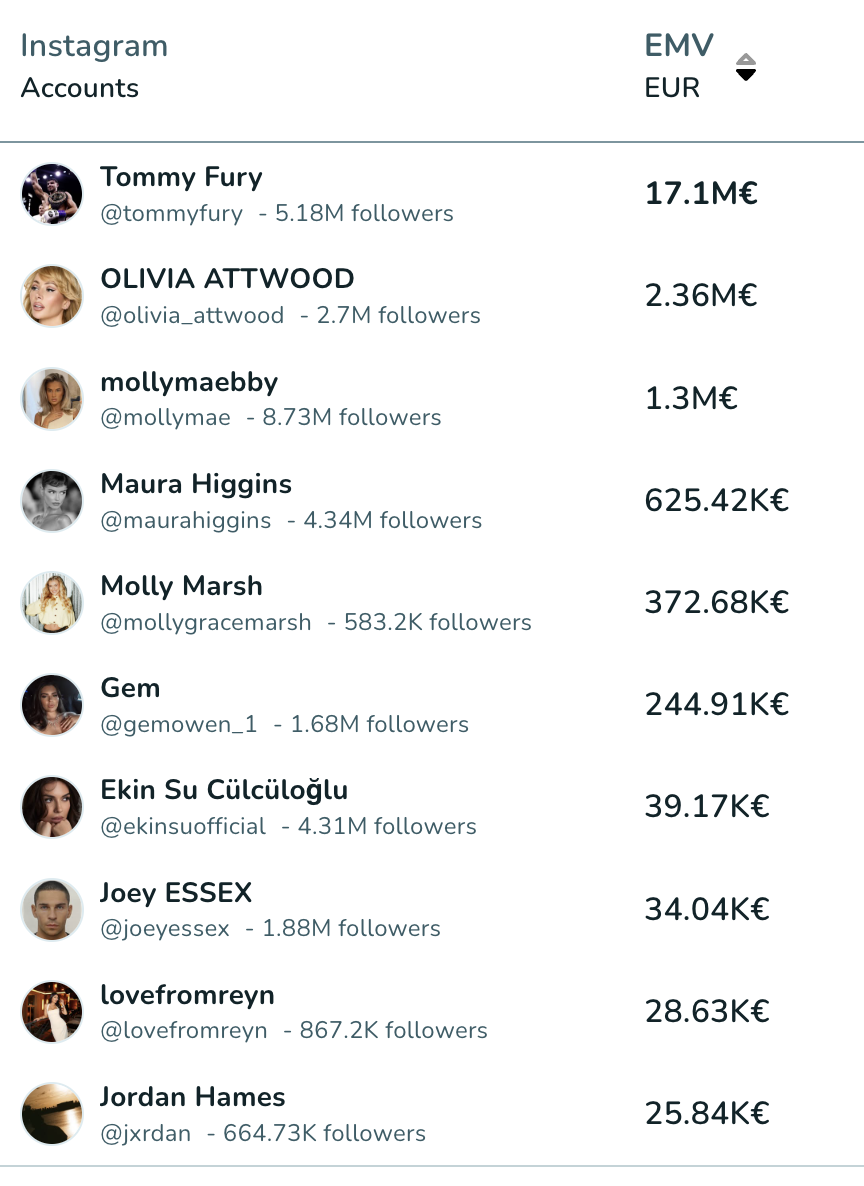
Kolsquare examined Earned Media Value, or EMV, generated between 1 June and 30 July 2026, an estimate of the media value created through a person's content and audience engagement. On that measure, several former contestants who entered Love Island as relative unknowns are now formidable commercial propositions.
Burrows generated approximately £3.23 million in Instagram EMV during the period examined, alongside about £176,000 on TikTok. Adebayo generated almost £1 million on Instagram and approximately £370,000 on TikTok.
The standout was Tommy Fury, whose Instagram activity generated an estimated £14.8 million in EMV, alongside £126,000 on TikTok. Yet Joey Essex, despite having the largest pre existing audience of those examined, recorded Instagram EMV of approximately £21,200. Kolsquare says eight contestants from its group of previously unknown islanders currently generate higher EMV than Essex.
The findings arrive at an interesting moment for Love Island itself. The programme's 2019 final attracted a peak audience of around 3.7 million viewers, according to figures supplied by Kolsquare, compared with around 700,000 for this year's final. The analysis does not establish that influencer casting caused that decline, and Kolsquare is careful not to make that claim. Streaming habits, competition for attention and the fragmentation of television audiences have transformed considerably since Love Island's cultural peak.
But the figures raise a more interesting question about what viewers actually want from reality television.
Part of the genre's appeal has always been transformation. Audiences encounter somebody without an established public persona, form an opinion over several weeks and feel some ownership over what happens next. Casting somebody who already understands content strategy, brand partnerships and audience building inevitably changes that relationship. The contestant may be new to the programme, but they are not necessarily new to being watched.
As Alicia Van Der Meer, UK Marketing Lead at Kolsquare, puts it: “Some of Love Island's biggest creator success stories started with just a few hundred followers before entering the villa. Audiences don't just want to follow already famous people; they enjoy being part of someone's journey and helping create the next big star.”
There is a lesson here for brands as much as broadcasters. Follower numbers remain an easy shorthand for influence, but they do not necessarily reveal the strength of the relationship between a creator and their audience. Somebody with a smaller but highly engaged following can prove considerably more valuable than a familiar face followed by millions.
Love Island has become one of Britain's most effective accidental talent factories. Its alumni have launched fashion labels, podcasts, television careers, fitness businesses and lucrative partnerships, while some have become considerably more famous than the programme that introduced them.
The irony is that as reality television becomes increasingly professionalised, its greatest commercial asset may still be the thing that made it compelling in the first place: finding somebody before everybody else does.
Continue Reading
More Lifestyle
Polestar broadens the appeal of the 4 with a new SUV

Josie Ryan paints the wildlife she refuses to let us forget

The Art of Staying In: A Weekend at The Pelham, South Kensington