Godfried Donkor Is Not Rewriting History. He Is Showing You How It Was Built
Explore Godfried Donkor's revolutionary exhibition at Firstsite. Discover how Godfried Donkor builds history through art, not rewriting it.
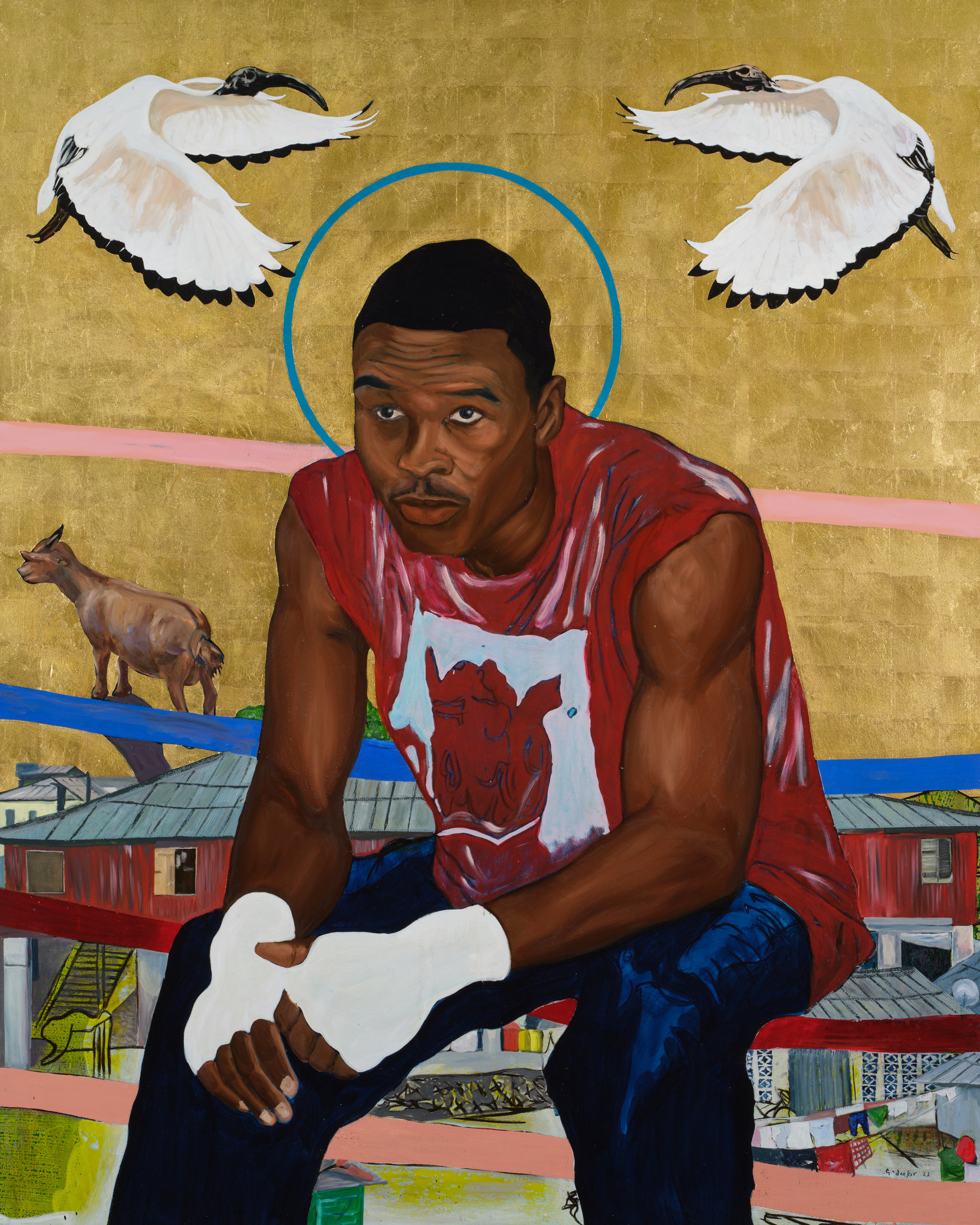
History likes to present itself as fixed. Clean lines, clear narratives, a sense that everything sits exactly where it should. Godfried Donkor has never really accepted that.
His exhibition It’s a Numbers Game at Firstsite does not attempt to correct history in the traditional sense. It does something more unsettling. It pulls it apart, layers it back together, and lets the seams show.
This is his first major institutional exhibition in the UK, which feels overdue once you see the scale of what he is doing. Collage, painting, embroidery, installation. None of it sits in isolation. Each piece feeds into the next, building a visual language that feels less like a single narrative and more like multiple conversations happening at once.
The materials do a lot of the work. Financial Times pages cut into fragments. Archival photographs sitting next to contemporary imagery. European heraldry woven into Ghanaian Adinkra symbols. Nothing is treated as separate. Everything overlaps. The idea is simple enough. Culture is not pure. It never was. It is built through exchange, conflict, influence, and repetition.
What Donkor does is make that visible.
There is a rhythm to it. A call and response between mediums, references, and histories that mirrors something closer to music than traditional exhibition design. You move through it and start to see the same themes return in different forms. Power. Commerce. Identity. Not presented as abstract ideas, but as systems that have shaped real lives and continue to do so.
The triangle he refers to, Britain, West Africa, the Caribbean, sits at the centre of that. Trade, migration, resistance. Histories that are often taught separately are placed side by side until it becomes difficult to see them as anything but connected. That is where the work becomes sharper. It does not tell you something new. It shows you something that was always there, just not always acknowledged.
There is also a local edge to it. Colchester is not used as a backdrop but as part of the argument. The resistance of Boudicca is set against that of Yaa Asantewaa, not as a comparison, but as a continuation. Different places, different moments, same underlying tension. The past does not sit still. It repeats, shifts, and reappears in different forms.
Visually, it holds. Large scale collages pull figures out of dense fields of text, forcing you to look at both at once. Embroidery becomes something more than decoration, carrying symbols of power across cultures. A boxing ring appears as both object and metaphor, tying back to Donkor’s long standing interest in the sport as a way of understanding movement, struggle, and exchange.
What makes it land is the control. There is a lot happening, but it never feels chaotic. Each layer is deliberate. Each reference placed with purpose. The complexity is the point, but it is handled in a way that keeps it readable.
There is also timing. The exhibition arrives alongside Donkor’s presence at the Venice Biennale, which places him more firmly on an international stage. That matters, not just for visibility, but for context. His work has been shaping conversations around history and power for years. This feels like a moment where that is being recognised more clearly.
What It’s a Numbers Game does, ultimately, is remove the idea that history is something you inherit passively. It shows it as something constructed, something shaped, something that can be read differently depending on where you stand.
Once you see it like that, it becomes harder to take it at face value.
Continue Reading
More Art & Design
Josie Ryan paints the wildlife she refuses to let us forget
In the Tarn hills, Anne Briaud turns fragments into imagined worlds
Heinz Mack brings a lifetime’s study of light to Berlin