David Lutken answers our questions ahead of Woody Sez: The Life & Music of Woody Guthrie heading to the Edinburgh Festival Fringe
David Lutken brings Woody Sez back to Edinburgh Fringe after 18 years. The musical uses Guthrie's own letters and columns to trace the folk icon's life.
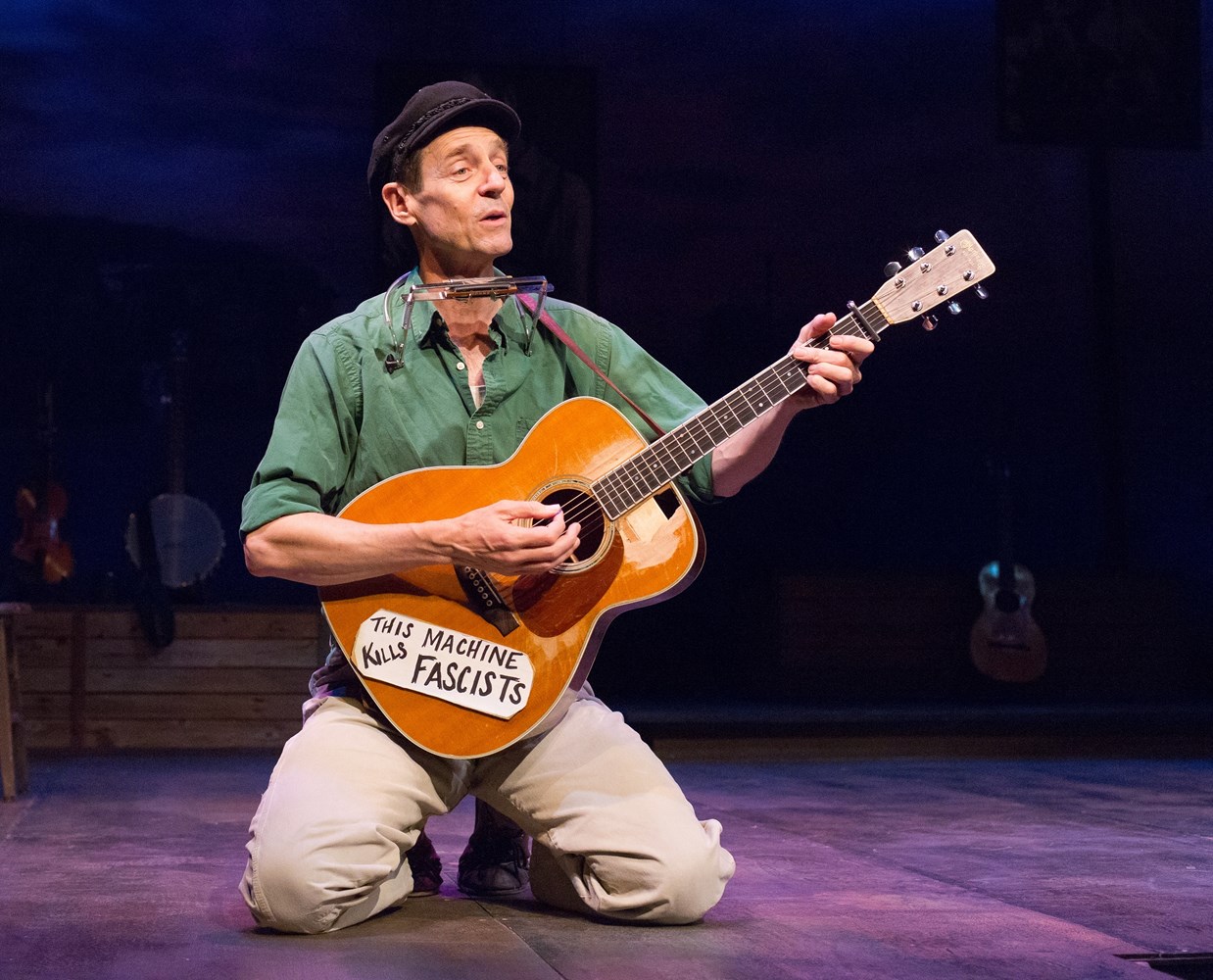
Woody Sez: The Life & Music of Woody Guthrie is a critically acclaimed musical that returns to the Edinburgh Fringe for the first time in nearly two decades, following acclaimed productions across the UK, the West End and Off-Broadway. The show draws directly from Guthrie’s own words, letters and songs to trace the life of the American folk icon through the Dust Bowl, the Great Depression and the political movements that shaped twentieth-century America. We chat to co-creator and performer by David Lutken about whether it’s possible to separate Guthrie’s songs from his activism, the changing relationship between art and politics, and Woody’s timeless words.
Take us back to the very beginning. What first drew you to Woody Guthrie, and when did you realise there was a show in him?
The very beginning, for me, would have been in 1960 or ’61, when I was in nursery school in Dallas, Texas. My teachers there loved Folk music, and, in particular, “Texas (or Southwestern) Folk music” - I learned many of Woody’s songs along with “Cowboy” songs, tunes from Leadbelly and Blind Lemon Jefferson (both Dallasites during their lives) , songs from Indigenous Peoples’ traditions, Spanish & ‘Tejano’ ballads and Christmas songs, folk songs of early German immigrants. I suppose what drew me to Woody’s songs was that when I was learning to play the guitar, eight or ten years later, they kept turning up - from Bob Dylan, The Kingston Trio, Peter, Paul & Mary, and one of my oldest brother’s favorites: Lonnie Donegan.
You built the show from Guthrie's diaries, letters and his 'Woody Sez' newspaper columns. How did you gain access to that material, and what did it reveal about him that you could never have learned from the songs alone?
There have been (and still are) great tributes, musicals and movies about Woody and about his songs, starting with California to the New York Island which was put together by Millard Lampell (one of the Almanac Singers) - a tribute concert in New York City in 1956 - that Woody’s manager, the late Harold Leventhal, published as a “Community Sing”. In 2001, Mr. Leventhal encouraged me to take that formula, along with the newspaper columns (Woody Sez) and lots of other materials - using Woody’s own words along with his songs - to devise a new “biography for the stage”. The research and years of performing the role have shown me that my grasp of every song deepens with each new bit of knowledge and understanding about the course of his tumultuous and often tragic life. He was a fascinating, difficult, brilliant, natural poet, part Joe Hill, part Homer, with flashes of John Brown - or perhaps Frederick Douglass - and the Buddha!
Guthrie left behind a huge archive and thousands of songs. How did you choose what made it into the show, and was there anything you loved that you had to leave out?
The choices of songs were quite difficult. Our group started with those two or three dozen that have defined his career for many listeners for many years, and a dozen more obscure ones that one or another of us loved, and a couple that Mr. Leventhal pointed to, and over many iterations, whittled it down to about 24, with bits and pieces of a 5 or 6 more. There were many favorites that, for one reason or another, didn’t fit the narrative and biographical/chronological ‘book’ of the show - among them, my favorite Woody Guthrie song: Pretty Boy Floyd.
Guthrie painted "This Machine Kills Fascists" on his guitar, wrote a newspaper column and served with the Merchant Marines during the Second World War. How much of the political activist, rather than simply the folk singer, did you want audiences to encounter? Or were those sides of Woody impossible to separate?
With Woody Sez: The Life & Music of Woody Guthrie, Andy, Helen, Nick, Darcie, and I wanted to find a way to tell the story - both public and personal - of one of the 20th century’s greatest singer/activists. The activism in many of his most famous songs stands on its own - but the narrative of his life adds a sort of high-definition illumination to each song’s origin, and the songs in turn help to illuminate Woody’s own well-documented orneriness, as well as some of his own hopes, struggles and dreams. The musician and the activist are separable to some degree; we’ve done our best to put them together.
Guthrie believed music could be a force for social change. Today, artists from Bruce Springsteen to Tom Morello continue that tradition. Do you think audiences still expect musicians to take a stand, or do you feel the relationship between art and politics has changed?
I believe the relationship of Art and Politics is always changing, and audiences’ expectations change as well - I can tell you that we’ve had many wonderful and varied experiences with Woody Sez and our audiences over the last almost-twenty years.
Nearly sixty years after his death, Guthrie's songs continue to resurface at protests, while new generations keep discovering his work. Has performing the show changed in moments when Woody himself feels newly relevant?
The most interesting and amazing ‘happenings’ around Woody Sez have been the changing moments audiences have reacted to over the years: mentions of “walls”, or “bankers”, “immigrants”, “dust storms”, “The Internationale”, “The Blitz”, “integration”, “deportees”, “fascism” - all relevant issues in the 1930s and ‘40s - have each had their ‘stop-the-show’ runs during different years or in different countries.
You've worked closely with Woody's family for decades and the show is made with the support of the Guthrie estate. What does that relationship look like in practice, and what has it meant to the show?
I got to know Harold Leventhal, Woody’s former manager, in the 1980s. I met his sister, Mary Jo Guthrie Edgmon, in 1990 and she became a close friend along with his daughter, Nora. I also met Woody’s first wife, Mary, and Maxine Crissman, a.k.a. “Lefty Lou”, in the early 2000s. The whole family and its many music and activism extensions have been invaluable to Woody Sez’s progress, as well as with our involvement with the Huntington’s Disease Association, a fantastic world-wide organization, launched by his widow, Marjorie, not long after his death.
The show premiered at the Edinburgh Fringe in 2007 and has since had more than 80 productions around the world. Why do you think it has endured, and does bringing it back to Edinburgh feel like coming full circle?
Woody’s words are timeless, and this show, with its historical content - and context - seems, for lots of folks, to “hold the mirror up to Nature” and all that is currently going on in the world. Mr. Leventhal and I met while Ronald Reagan was president. Woody Sez first came to Edinburgh during the George W. Bush era, and last toured the UK in 2016. We hope bringing it back to The Fringe now can be at least a drop in what appears to be a rising ocean, one that that we’re hoping might help make a few waves.
Woody Sez: The Life & Music of Woody Guthrie will be performed at 5:30pm at Underbelly Bristo Square from 5th – 30th August. Booking link: https://underbellyedinburgh.co.uk/event/woody-sez
Continue Reading
More Ed Fringe 2026
Lorna-Rose Treen ‘Now That’s What I Call Characters’ Interview

Q&A: Talking all things Edinburgh Fringe with Only Bones creator and performer Daniel Nodder

Tom Neenan answers our questions ahead of Tom Neenan: Portrait of a Tom as a Young Neenan heading to the Edinburgh Festival Fringe