Beyond Borders: Peregrinations director on migration, identity and belonging
Blake Habermann's Peregrinations uses wordless movement and Swiss Larval masks to explore migrant experiences at Edinburgh Fringe this August.
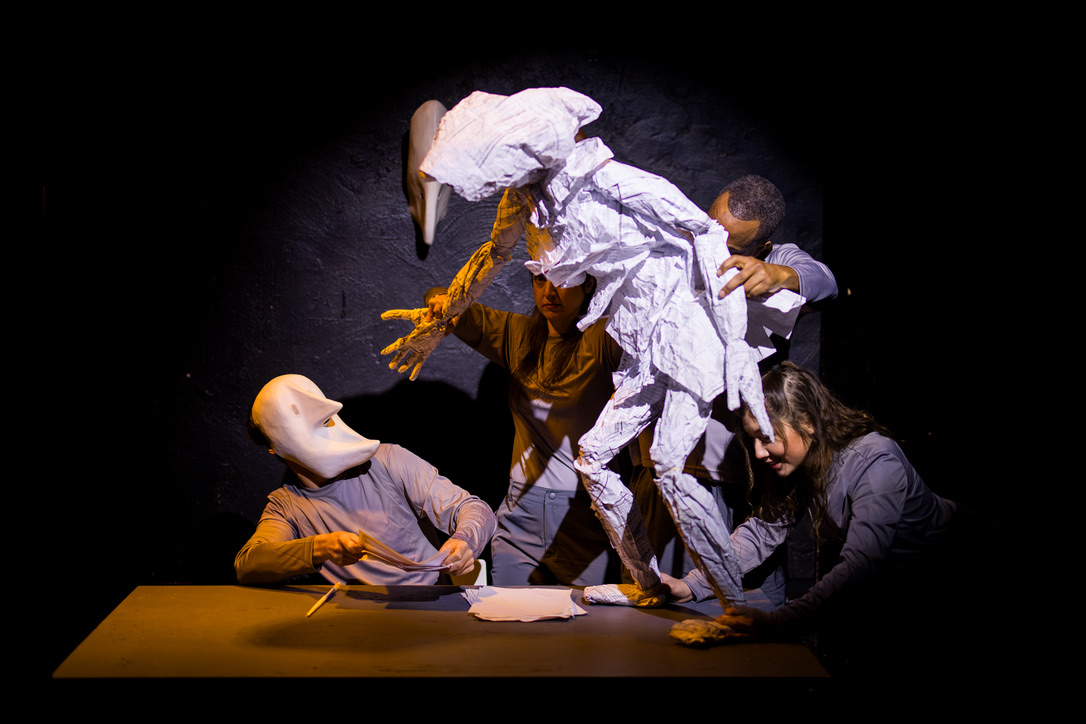
Ahead of the world premiere of Peregrinations at the Edinburgh Fringe, we caught up with Blake Habermann, the director behind this powerful new production. Inspired by the real-life experiences of migrants from around the world, the show uses movement, music and mask work to explore identity, belonging and the universal experience of crossing borders.
Peregrinations is inspired by interviews with migrants from around the world, including members of the cast. What stories or conversations had the greatest impact on the development of the production?
Our conversations with cast members and other immigrants focused on what it is like to cross borders and the fear, hope and loss that come with the experience. Several spoke of a cleaved identity, of feeling torn between two worlds, while others recounted the challenges of navigating institutional caprice and unending bureaucracy. The common threads were the determination, ingenuity and imagination it took to keep going, which inspired the dynamics of our three principal characters.
The show explores migration without using any spoken dialogue. Why did you choose a wordless form of storytelling for a subject that is often debated through language, politics and rhetoric?
Every day, we consume news stories about immigration. However, wordless storytelling like our play–in which the story comes through movement, behaviour, sound, music, and silence–tends to land differently. It hits us in the heart and gut, rather than the head. In a wordless show, meaning isn’t confined to the specific words and syntax of just one language and culture; it uses a wider-reaching vocabulary.
The only thing we have in common with every human is a physical body. While our experiences in those bodies differ greatly, some are shared: the feeling of an exhale, the pull of the earth, the tensions and bonds that exist in the space between people. We feel non-verbal performance leaves space for this universality.
The production draws inspiration from animal migrations as well as human journeys. What parallels did you see between the two, and how are those ideas reflected in the choreography?
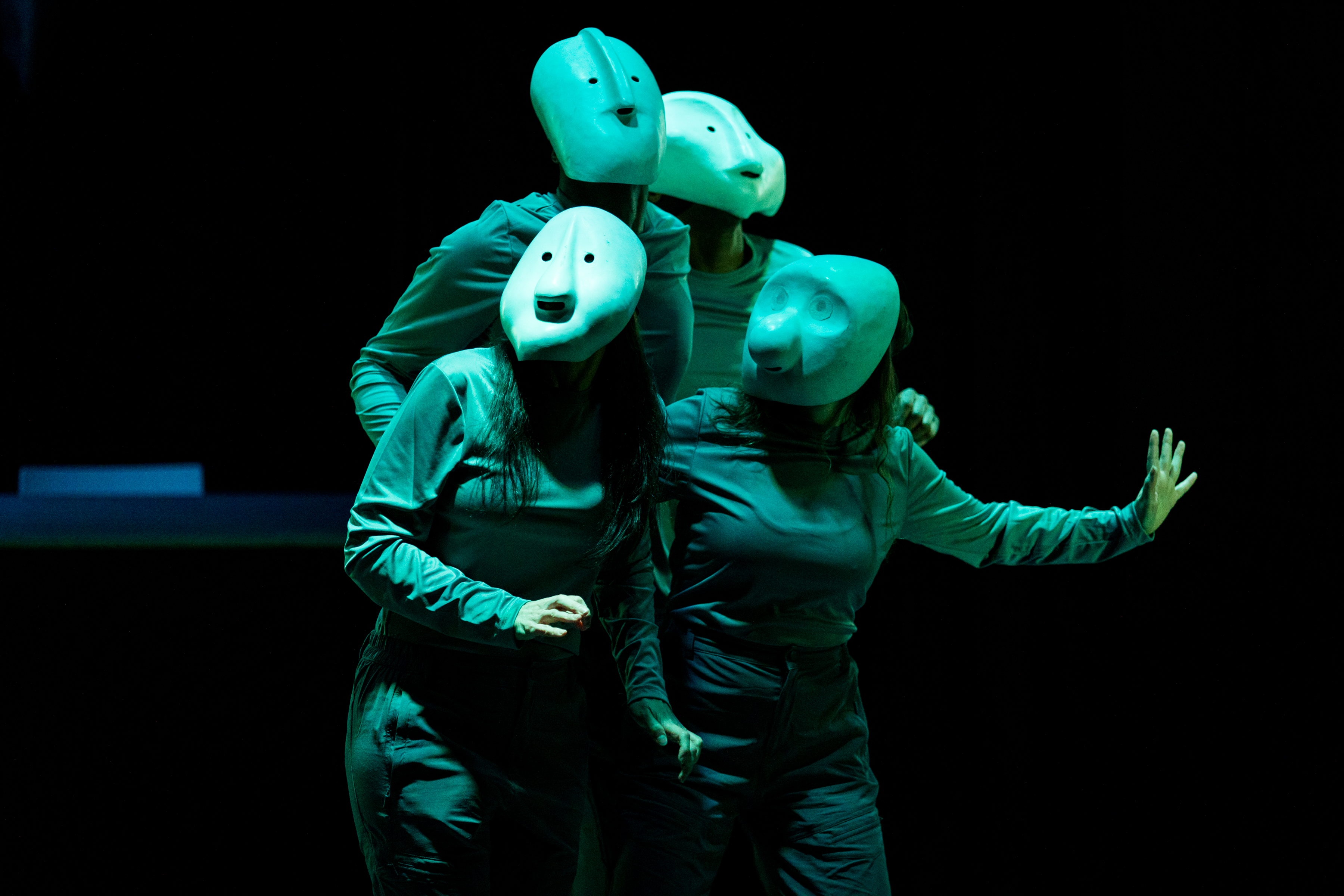
Look above a detention centre, and you might see a flock of birds freely murmuring. We wanted to explore the contrast between the fluidity of natural borders traversed in animal migrations and the rigidity of human-constructed, socio-political borders. The Larval Masks we use are often described as characters in “the state of becoming.” Like their namesake “larvae,” they represent humans that are not yet fully formed, bridging a simplistic, almost animalistic sensibility and the complexities of our contemporary reality.
All of the performers wear Larval masks from the Swiss Basel Carnival. What do the masks allow you to express about identity, belonging and the immigrant experience?
The masks function as a metaphor for how the immigrant is viewed in their new country, how the migrant identity can reduce and mask someone’s inner humanity, and the dehumanising nature of enforcement, which only perceives these bodies through the filter of their “otherness”. These simplified, deconstructed white masks are in tension with the visceral, emotional reality of a human body, creating a compelling visual metaphor for how borders impact those bodies.
Migration is often discussed through statistics and headlines. How important was it for you to focus on individual experiences and the emotional realities behind those stories?
In the age of mass migration and mass information, it is tempting to allow statistics to function as a distancing mechanism. While the wider perspective is important in assessing global impacts, we wanted to narrow our focus and find the common, vital threads connecting disparate migrant experiences and distil them into poetic, dynamic and evocative images that can subvert assumptions and inspire a more empathetic, compassionate perspective in our audiences.
This is a subject that can be politically divisive. How did you approach creating a piece that engages with migration while keeping the focus on shared human experiences?
We had the intention of approaching the research and creation with an honest appraisal of the power differentials inherent in the politics of displacement, aiming to devise a poetic piece of documentary theatre that highlights the parallels and shared experiences of everyone on the planet while putting the forces that drive migration into stark relief. We all yearn for a better life, for a home and for a sense of community, and all struggle against the institutional obstacles and entrenched interests that prevent the realisation of these goals. We believe that security and stability can only be achieved through a genuine solidarity with the dignity of all people that acknowledges the systemic oppression of the global majority.
Peregrinations is at the Edinburgh Fringe at Assembly Roxy, Central, 6 – 30 Aug 2026 (not 17 & 25), 11.25 - 12.25. Ticket information here: Peregrinations | Edinburgh Festival Fringe
Continue Reading
More Culture
The masons are disappearing faster than the monuments
A Stage for Every Story: Meet the Directors Behind London’s Voila! Theatre Festival
Thirty years of paper stars: the Ford Sierra start-up that now lights Blenheim Palace