Thirty years of paper stars: the Ford Sierra start-up that now lights Blenheim Palace
Paper Starlights marks 30 years bringing Indian Diwali lanterns to UK Christmases, from a Ford Sierra boot to Blenheim Palace and Bath Abbey installations.
A couple who once slept in their car between sales are marking three decades of Paper Starlights, the business that brought India’s Diwali lanterns to the British Christmas.
Some Christmas traditions are centuries old. Others are younger than you’d think. One of them started in 1996 in the back of a Ford Sierra estate.
That was the year Andy Jupp and Jules Cooper started driving round Britain with a car full of paper star lanterns. They sold them to independent shops and festival-goers, slept in the car between stops, and depended on customers liking them enough to order again. Enough of them did. Thirty years later Paper Starlights has stalls at some of the country’s best-known Christmas markets, and its lanterns have hung in Bath Abbey and at King’s Cross.
The idea came from India, not from a Christmas card. During Diwali, Jupp and Cooper saw paper lanterns glowing in doorways and community spaces. They tracked down the family who made them and agreed to trade with them. That partnership is still going. The first shipment came to Britain in a single aluminium trunk, which sounds less like a supply chain and more like the opening of an adventure novel.

From festival stall to cathedral nave
The business is now based in Chesterfield, Derbyshire. It sells through independent retailers, online, and at the big seasonal markets, including Winchester and Blenheim Palace. Regulars are said to come back each year to add another star to the collection. A good stall-holder knows that habit well, and a marketing department can’t easily manufacture it.
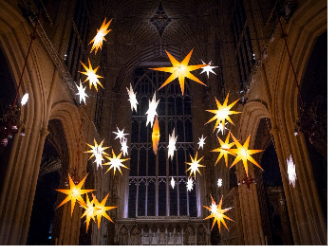
The bigger change has been in scale. Paper Starlights now designs large installations as well as selling one lantern to hang in a hallway. Its “Light of Stars” display filled Bath Abbey with lit paper stars, and a project at King’s Cross brought the same idea to one of London’s busiest public spaces. Next comes Leicester Cathedral, where a new installation goes up at the end of October.
The cathedral setting suits it. English churches have always had some understanding of theatre, and a high Gothic nave hung with coloured lights shows a building at its best. The lanterns’ origins in a Hindu festival of light also give the project a quiet sense of shared ground. There’s no slogan attached, and it doesn’t need one.
Made by hand, still
What has kept Paper Starlights distinctive is that the product hasn’t been cheapened as the business grew. The stars are still made by hand. The patterns are screen printed and punched, and tissue inserts behind the paper give the colour and the soft, dappled light. Each lantern folds flat and is meant to be put away in January and brought out again the following December.
It’s an unfashionable approach in an age of disposable decorations, when so much of what goes on the tree is plastic and lands in the bin by Twelfth Night. A paper star that comes out of the loft year after year, eventually passing from parents to children, works on a different idea of value. You buy it once and keep it.
The company still trades directly with its makers and is a member of BAFTS, the British Association for Fair Trade Shops and Suppliers. That direct relationship, unchanged for three decades, may be the most impressive part of the story. Plenty of firms talk about ethical sourcing in their annual reports. Few can point to one family workshop they have dealt with since the mid-1990s.
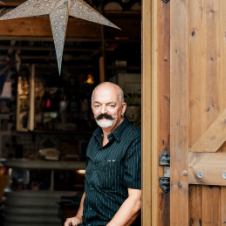
A small business, done properly
There’s a broader point here, and it shouldn’t be lost in the tinsel. Paper Starlights was not built on venture capital, a government scheme or a viral moment. It was built the old way: two people, a car, a product they believed in, and the slow work of earning repeat customers. Its growth from motorway service stations to palace courtyards happened because people kept buying what it sold.
Britain talks a great deal about backing small enterprise and rather less about what that enterprise actually looks like. It often looks like this. It’s patient, a little eccentric, rooted in a provincial town rather than a capital city, and dependent on independent shops that are under more pressure than ever. A thriving Christmas market is a reminder that the high street isn’t finished. It’s waiting for things worth leaving the house for.
Thirty years on, the lanterns that arrived in one trunk now hang in homes and historic buildings across the country. The Sierra is presumably long gone, but the business it carried is still going strong.
Find out more at paperstarlights.com.
Continue Reading
More Culture
The masons are disappearing faster than the monuments

A Stage for Every Story: Meet the Directors Behind London’s Voila! Theatre Festival

Ben Foster returns to Wrexham to support young footballers with M&S Food