After a decade of Sadiq Khan, most Londoners say the capital has got worse
55% of Londoners say the capital has worsened under Sadiq Khan's decade as Mayor, with housing affordability the sharpest failure. 56% want Labour to choose a new candidate in 2028.
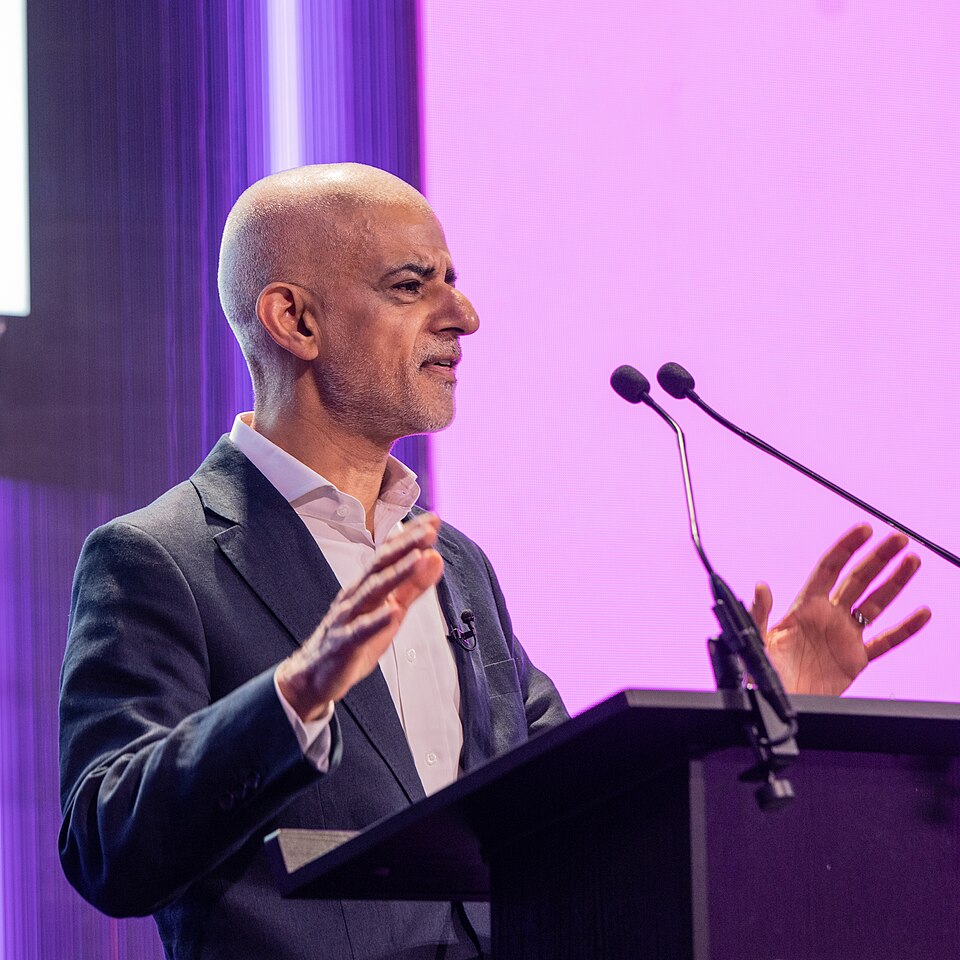
Sadiq Khan at SXSW London, 2026. Credit: Wikimedia Commons
Ten years after the Mayor entered City Hall promising to make housing his defining priority, a YouGovsurvey finds deep dissatisfaction with housing, crime and the direction of the capital. More than half of Londoners now think Labour should choose somebody else in 2028
Ten years is long enough to leave a mark on a city.
For Sadiq Khan, who passed a decade as Mayor of London in May, the judgement of the people he governs is becoming difficult to ignore.
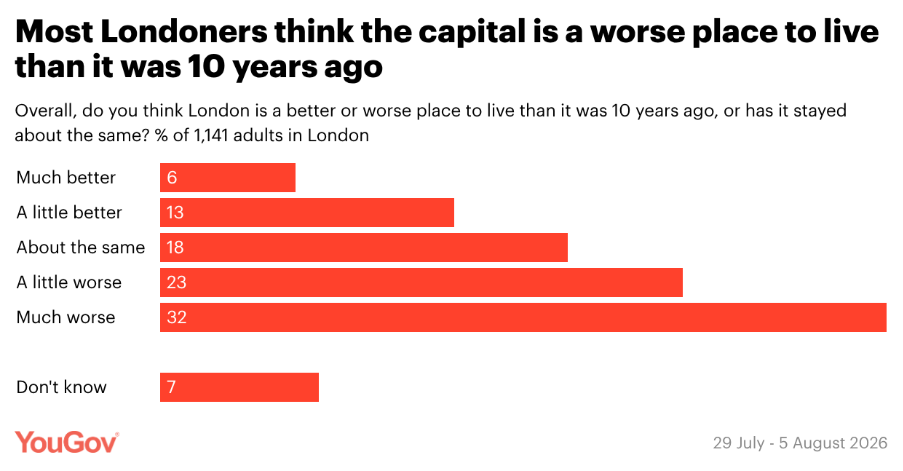
A new YouGov survey finds that 55 per cent of Londoners believe the capital is a worse place to live than it was ten years ago. Just 19 per cent believe it has improved.
The verdict is particularly striking among those best placed to make the comparison. Of Londoners who have lived in the capital for more than a decade, 60 per cent say it has become worse. Only 17 per cent think it has become better.
It would be unreasonable to attribute every change in one of the world's largest cities to the man occupying City Hall. London has endured Brexit, a pandemic, inflation, an acute cost of living squeeze and considerable demographic change during Khan's mayoralty.
Yet voters do judge politicians on what happens while they are in charge. And after ten years, the latest polling presents an uncomfortable account of Khan's record.
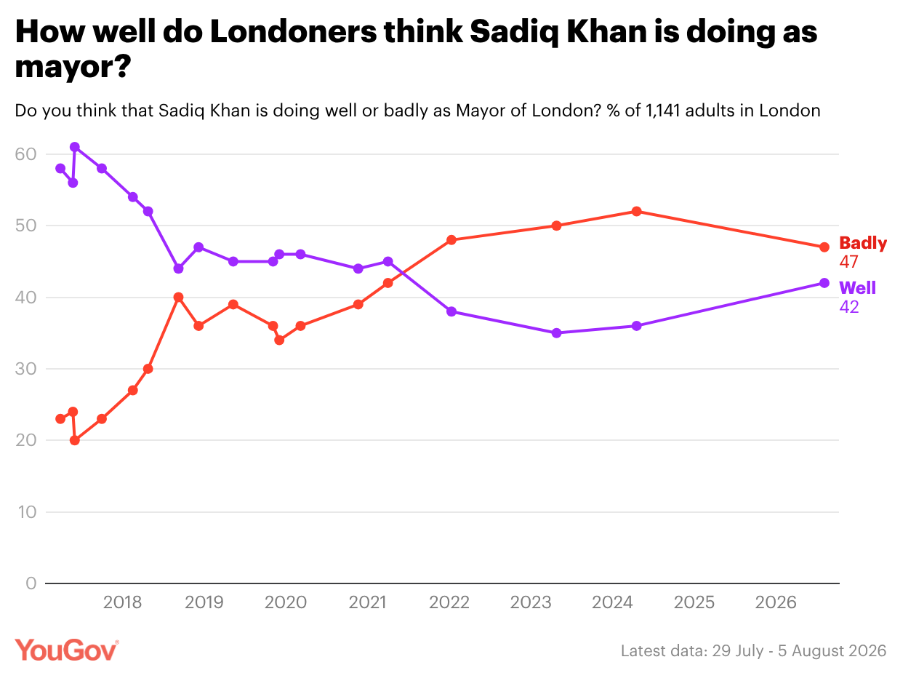
His personal rating remains underwater. Some 39 per cent of Londoners have a favourable opinion of the Mayor, against 48 per cent who view him unfavourably.
Asked directly about his decade in office, 47 per cent say he has done a bad job. Forty per cent say he has done a good one.
Perhaps most consequentially, 56 per cent believe Khan should step aside and allow another Labour candidate to fight the mayoral election scheduled for May 2028. That view is shared by 31 per cent of people who voted for him in 2024.
The housing promise that has come back to haunt City Hall
No part of the polling is more damaging than housing.
When Khan first stood for mayor in 2016, he described housebuilding as his "single biggest priority". Housing remained prominent in his subsequent election campaigns.
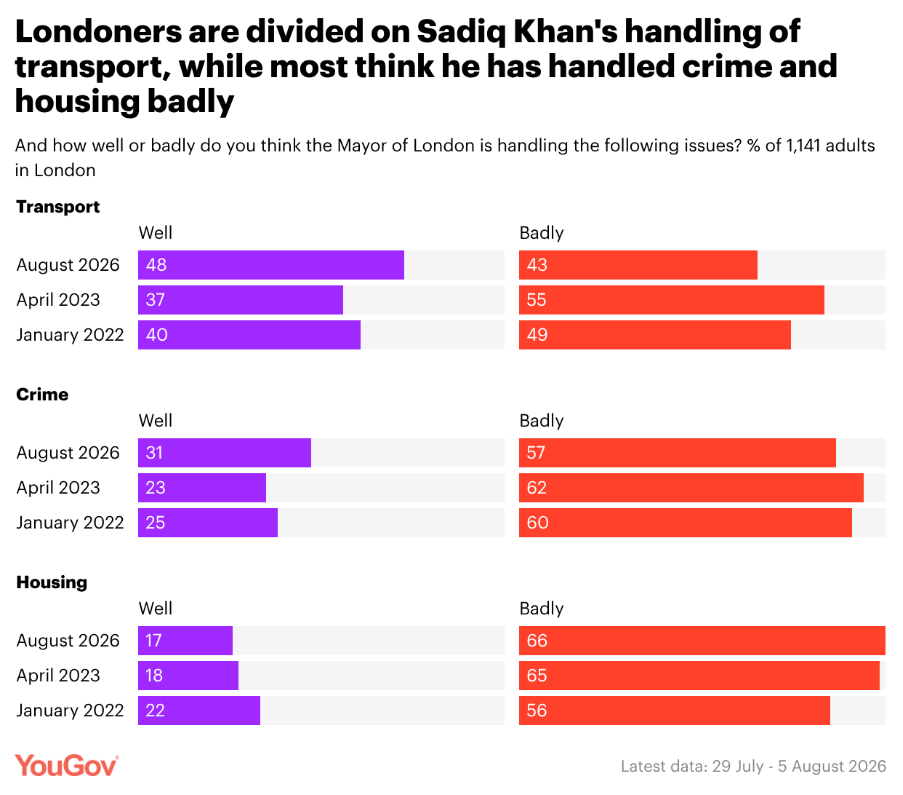
A decade later, only 17 per cent of Londoners believe he is handling housing well. Two thirds, 66 per cent, say he is handling it badly.
Even Khan's own electoral coalition is dissatisfied. Among those who voted for him at the 2024 election, 46 per cent say he is handling housing badly, against 37 per cent who think he is doing well.
The broader judgement on affordability is more severe still.
Only 5 per cent of Londoners believe the availability of affordable housing has improved during the past decade. Three quarters, 76 per cent, say it has deteriorated, with 54 per cent saying it has become "much worse".
Among Khan's 2024 voters, 74 per cent believe housing affordability has worsened.
For a mayor who placed housing near the centre of his political project, those figures amount to more than dissatisfaction with a difficult national problem. They suggest that a defining promise of the Khan era has failed to persuade the people it was intended to help.
Crime remains a weakness
Crime provides another difficult set of numbers for City Hall.
Khan and his administration have pointed to more encouraging recent statistics, including falling neighbourhood crime and a lower homicide rate.
The public mood has not followed to the same extent.
Only 31 per cent of Londoners say Khan is handling crime well. A majority of 57 per cent say he is handling it badly.
Asked more broadly about how London has changed over the decade, 58 per cent believe crime has worsened.
Half say women's safety has deteriorated. Some 62 per cent think rough sleeping and homelessness have become worse, while the same proportion say the condition of London's high streets and public spaces has declined.
Forty nine per cent believe community cohesion has worsened and 47 per cent say inequality has deteriorated.
These are not marginal concerns. Together they go to the question of whether people feel that the city in which they live is becoming safer, more prosperous and easier to navigate.
On that test, the polling is distinctly pessimistic.
The economy troubles Londoners too
The discontent extends beyond the Mayor's most obvious responsibilities.
Sixty nine per cent of Londoners believe the economy and jobs have become worse over the past decade, according to the survey.
Some 46 per cent believe London's international reputation has deteriorated.
Again, City Hall cannot reasonably be assigned sole responsibility for either. Economic policy is overwhelmingly shaped at Westminster, while Britain's departure from the European Union, Covid and international economic conditions have all affected the capital.
But the numbers matter politically because they reveal something broader than dissatisfaction with an individual policy.
They describe a city whose inhabitants increasingly believe it is moving in the wrong direction.
ULEZ has not produced an obvious political dividend
Few policies have defined Khan's mayoralty as clearly as the expansion of the Ultra Low Emission Zone.
The policy consumed considerable political capital and produced fierce opposition, particularly in outer London. If the argument was that such measures were necessary to deliver noticeably cleaner air, public opinion remains decidedly unconvinced.
Twenty nine per cent believe London's air quality has improved over the past decade.
Thirty four per cent think it has become worse.
A further 24 per cent believe it is broadly unchanged.
That does not measure the scientific effect of ULEZ. It measures something politically different: whether Londoners themselves believe the air has improved. After years of controversy over the policy, there is no clear public consensus that it has.
Transport offers Khan some respite
There is one important area in which the Mayor performs considerably better.
Transport is the strongest of the three principal mayoral responsibilities tested by YouGov. Forty eight per cent say Khan is handling it well, against 43 per cent who say badly.
Looking across the decade, 37 per cent believe London's public transport has improved. Thirty per cent think it has worsened and 27 per cent believe it is broadly unchanged.
The geographical divide is also worth noting.
Inner London remains considerably more sympathetic towards Khan. There, 52 per cent say he is doing well as mayor and 39 per cent badly.
Outer London gives almost the reverse verdict: 51 per cent say he is performing badly and 37 per cent well.
It is a divide that has repeatedly surfaced during arguments over transport, road charging and the balance between the priorities of central and suburban London.
Khan still beats Boris Johnson in one comparison
There are qualifications to what otherwise looks like a bleak anniversary poll.
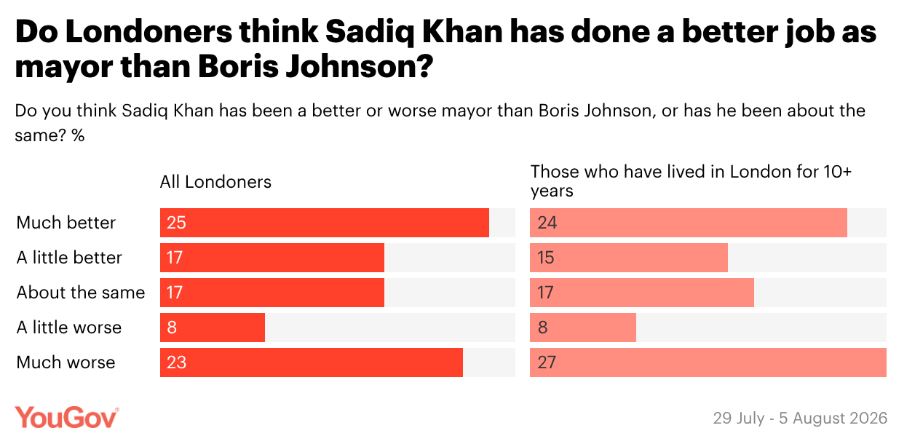
Asked to compare Khan with his predecessor, Boris Johnson, 42 per cent say Khan has been the better mayor. Thirty one per cent say he has been worse and 17 per cent see little difference.
Among people who have actually lived in London for longer than ten years, however, the gap is considerably narrower. Thirty nine per cent prefer Khan's record and 35 per cent Johnson's.
Khan's overall job rating has also improved since before the 2024 election. Forty two per cent now say he is doing well, six points higher than in 2024, although 47 per cent continue to say he is doing badly.
Those figures prevent the survey from being interpreted as wholesale rejection.
But they do not remove its central finding.
After ten years of the Khan mayoralty, most Londoners believe their city has become a worse place to live.
Housing, the issue Khan once promised to make his greatest priority, produces some of his poorest numbers. A majority remains dissatisfied with his handling of crime. His personal favourability is negative. And most Londoners now say that when Labour next asks the capital for its vote, it should do so with somebody else.
Khan has not yet said whether he intends to seek a fourth term in 2028.
If he does, the argument for another four years will have to contend with a simple question that this polling places at the centre of London's politics: after a decade under the same mayor, why do so many of the people living there believe their city has gone backwards?
Continue Reading
More News
AI is changing banking. The skills that matter most are proving harder to automate

Molly Mae Hague’s Maebe overtakes PrettyLittleThing, Nike and Adidas in UK fashion rankings

Ride 6.5km and Malaysia Airlines could fly you to Melbourne to cycle with an Olympic medallist