The defence spending dilemma: voters want more security but fewer trade-offs
56% of Britons want higher defence spending, but most reject NHS cuts, tax rises or borrowing to fund it, new YouGov polling reveals.
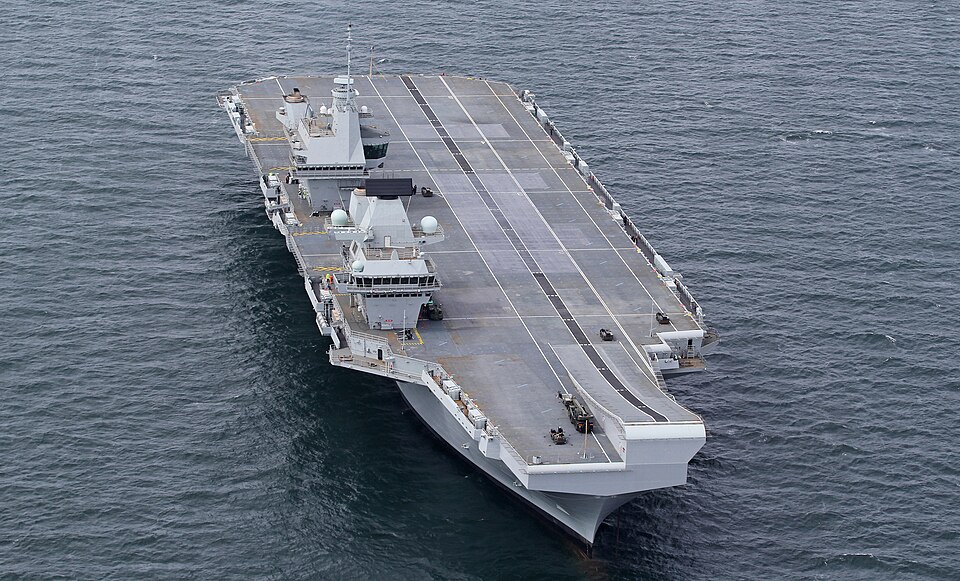
Photo: Aircrew / MOD (via Wikimedia Commons)
Britons increasingly believe the country should spend more on defence. The difficulty for ministers is that while public support for greater military investment is growing, enthusiasm quickly fades when voters are asked how that investment should be funded.
New polling by YouGov reveals a growing contradiction at the heart of public opinion on national security. A majority of Britons support increasing defence spending, yet most reject almost every practical measure that would be required to fund a significant expansion of Britain's military capabilities.
The findings arrive at a time when defence has returned to the forefront of political debate. Russia's continued aggression in Europe, instability across parts of the Middle East and growing concerns over the international order have prompted renewed scrutiny of Britain's military readiness. Senior political and military figures have repeatedly argued that the country must prepare for a more dangerous and uncertain world.
The public appears to agree with that assessment. According to the YouGov survey, 56% of Britons believe defence spending should increase. Just 6% believe it should be reduced, while 23% say spending should remain broadly where it is today.
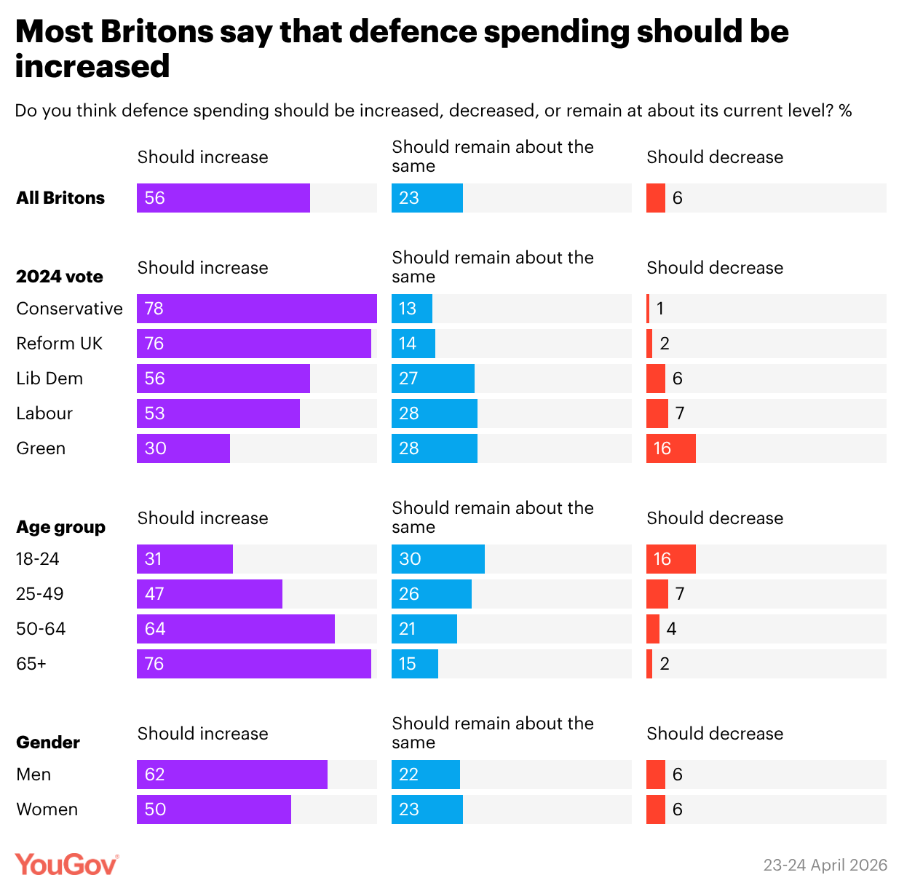
Support for higher defence spending extends across much of the political spectrum. Conservative voters are the most supportive, with 78% favouring an increase, closely followed by Reform UK voters on 76%. Majorities of Labour and Liberal Democrat supporters also back directing more resources towards the armed forces. Support is particularly strong among older voters, rising to 76% among those aged over 65. Men are also notably more likely than women to support higher defence spending, by a margin of 62% to 50%.
Yet the consensus begins to break down the moment the conversation turns to funding.
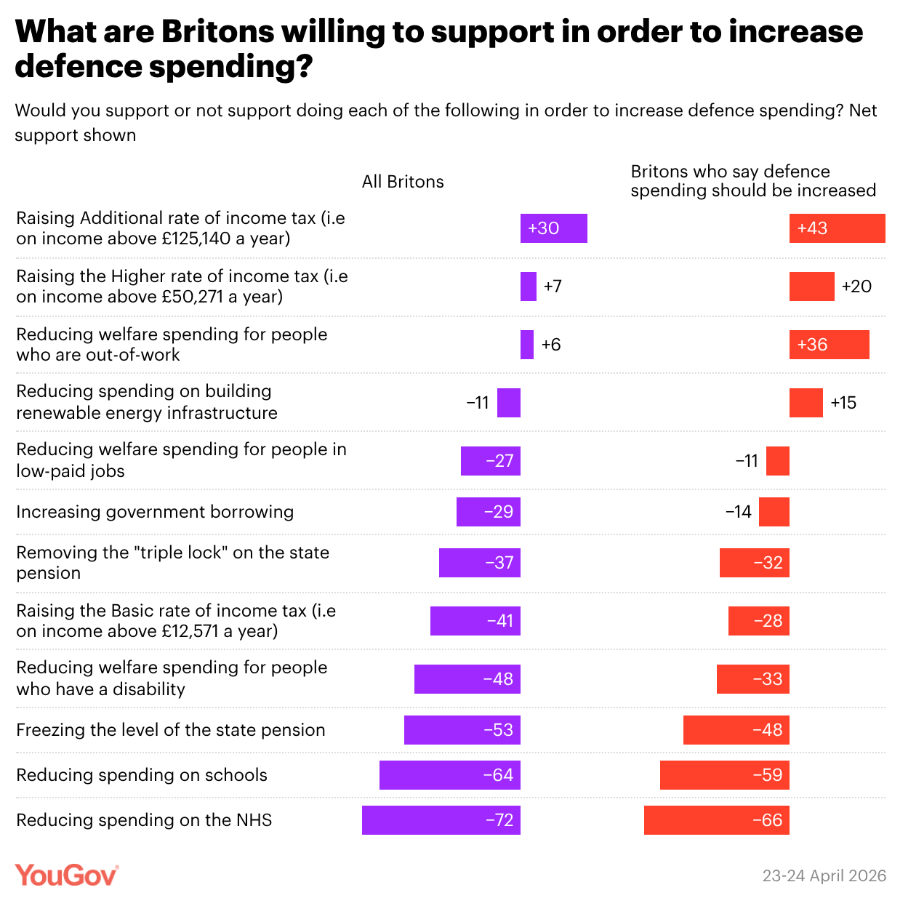
Of the twelve options tested by YouGov, only one attracted clear and substantial public support. A majority of Britons back increasing the additional rate of income tax paid by the highest earners in order to provide more money for the military. Beyond that, voters become considerably more cautious.
There is modest support for increasing the higher rate of income tax and for reducing benefits paid to those who are out of work, although both measures attract only narrow margins of support. Neither comes close to commanding the broad consensus that would be required for a significant shift in public spending priorities.
Most other proposals are rejected outright.
The public remains overwhelmingly opposed to reducing NHS funding in order to strengthen the armed forces, with more than eight in ten voters rejecting such a move. Similar opposition exists towards cutting school budgets, reducing support for disabled people, freezing state pensions or weakening the triple lock. There is also little appetite for increasing the basic rate of income tax, despite repeated warnings that higher defence spending will ultimately require difficult fiscal decisions.
Perhaps most strikingly, there is little enthusiasm for using government borrowing to finance a larger military budget. More than half of Britons oppose taking on additional debt to fund defence, suggesting voters remain wary of passing the cost onto future generations.
What makes the findings particularly significant is that these views change surprisingly little among those who explicitly support higher defence spending. Even voters who believe the armed forces deserve more funding continue to oppose cuts to the NHS, education and pensions by substantial margins. They support the principle of stronger defence, but remain reluctant to endorse many of the measures necessary to achieve it.
This presents a challenge not only for the government but for politicians across Westminster. For much of the post-Cold War era, defence spending occupied a relatively modest place in domestic politics. Successive governments benefited from a peace dividend that allowed resources to be directed elsewhere while military investment became a less pressing concern.
That era now appears to be ending.
Across Europe, governments are confronting the reality that deterrence, military readiness and national resilience come with a financial cost. Calls for Britain to increase defence spending towards 3% of GDP and beyond are becoming increasingly common as policymakers respond to a rapidly changing geopolitical landscape.
The YouGov findings suggest that voters recognise the need for a stronger military. What they have not yet accepted is the scale of the sacrifice that may be required to deliver it.
The debate is therefore shifting. The question is no longer whether Britain should spend more on defence. Increasingly, there is broad agreement that it should.
The more difficult question is where the money will come from.
And on that issue, public opinion remains far less certain.
Source: YouGov survey of 2,076 adults in Great Britain, conducted between 23 and 24 April 2026.
Continue Reading
More News
One in three Britons believe the Green Party has a significant antisemitism problem

Justin Timberlake and Jessica Biel join protein soda brand PRODA as co-founders

More than half of Britons want inheritance tax cut or abolished