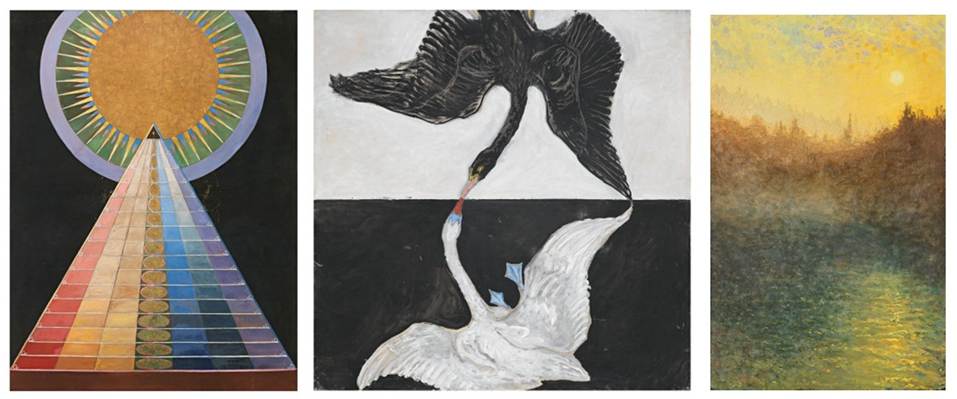
Hilma af Klimt: Artist and Visionary'
Art history tends to favour clear narratives. Movements are assigned founders, revolutions are given dates and pioneering figures are elevated into positions of certainty. Yet every so often an artist emerges who forces those stories to be rewritten.
Few have done so more dramatically than Hilma af Klint.
This autumn, the National Gallery of Ireland will stage the first major Irish exhibition dedicated to the Swedish artist, bringing together 79 works that span a career increasingly recognised as one of the most remarkable in modern art. Hilma af Klint: Artist and Visionary will explore not only the abstract paintings that have transformed her reputation, but also the landscapes, botanical studies, portraits and notebooks that reveal the breadth of her intellectual and artistic ambitions.
For decades, af Klint occupied a curious position within art history. Although she created some of the earliest abstract paintings in the Western tradition, her work remained largely unknown beyond specialist circles. While figures such as Wassily Kandinsky, Kazimir Malevich and Piet Mondrian became synonymous with the birth of abstraction, af Klint's contribution was overlooked for much of the twentieth century.
The reasons were complex. Working in Sweden at a time when opportunities for female artists remained limited, she developed her ideas largely outside the dominant artistic institutions of Europe. Much of her work was also deeply intertwined with spiritualism, mysticism and esoteric philosophies, subjects that sat uneasily within the more rational narratives favoured by many art historians.
Today, however, her reputation has undergone a remarkable transformation.
Major exhibitions across Europe and North America have introduced audiences to paintings that appear startlingly modern despite being created more than a century ago. Spirals, geometric forms, symbols and vivid colour combinations fill canvases that often seem closer to contemporary abstraction than the artistic conventions of the early twentieth century.
The Dublin exhibition arrives at a moment when interest in af Klint continues to grow. Yet one of its strengths lies in moving beyond the familiar story of a forgotten pioneer.
Visitors will encounter not only the abstract works for which she has become known, but also the influences that shaped them. Early landscapes, detailed botanical studies and observational drawings reveal an artist deeply engaged with the natural world long before she embarked on her more experimental projects. Science, mathematics, religion and philosophy all informed her thinking, creating a body of work that sought to understand humanity's place within a rapidly changing world.
That world was one of extraordinary upheaval. Af Klint lived through a period marked by technological innovation, scientific discovery and profound social change. Traditional certainties were being challenged, while new theories about the universe, evolution and human consciousness captured public imagination across Europe.
Her response was unlike that of almost any contemporary artist.
Rather than treating science and spirituality as opposing forces, she sought to explore the relationship between them. Her paintings drew on both disciplines, combining geometric structures with symbolic imagery in an attempt to visualise realities beyond ordinary perception.
The exhibition's centrepiece will be works from her celebrated Paintings for the Temple series, a project that occupied much of her life and remains one of the most ambitious undertakings in modern art. Created following what af Klint described as a spiritual revelation, the series explores themes of evolution, duality, creation and transcendence through an entirely original visual language.
Seen today, the works retain much of their mystery.
Unlike many modern artists who accompanied their work with manifestos and theoretical explanations, af Klint often left questions unanswered. The result is art that continues to invite interpretation rather than dictate it.
That ambiguity may help explain her enduring appeal. In an age often characterised by certainty and instant opinion, af Klint's paintings remain resistant to easy conclusions. They challenge viewers to engage with ideas that sit somewhere between art, science, philosophy and faith.
The National Gallery of Ireland's exhibition offers an opportunity to encounter those ideas at scale. More importantly, it allows visitors to see an artist whose work increasingly appears not as a footnote to modernism, but as one of its most original achievements.
The story of abstract art is no longer quite as straightforward as it once seemed. Hilma af Klint is one of the reasons why.
Hilma af Klint: Artist and Visionary runs at the National Gallery of Ireland from 15 October 2026 to 7 February 2027.
Continue Reading
More Art & Design
Josie Ryan paints the wildlife she refuses to let us forget
In the Tarn hills, Anne Briaud turns fragments into imagined worlds
Heinz Mack brings a lifetime’s study of light to Berlin