Can technology teach us to see nature again?
Timur Si-Qin's Mariposita recreates an Amazon ecosystem using digital scans and steel at Art Basel, questioning if technology is now our only path to nature.
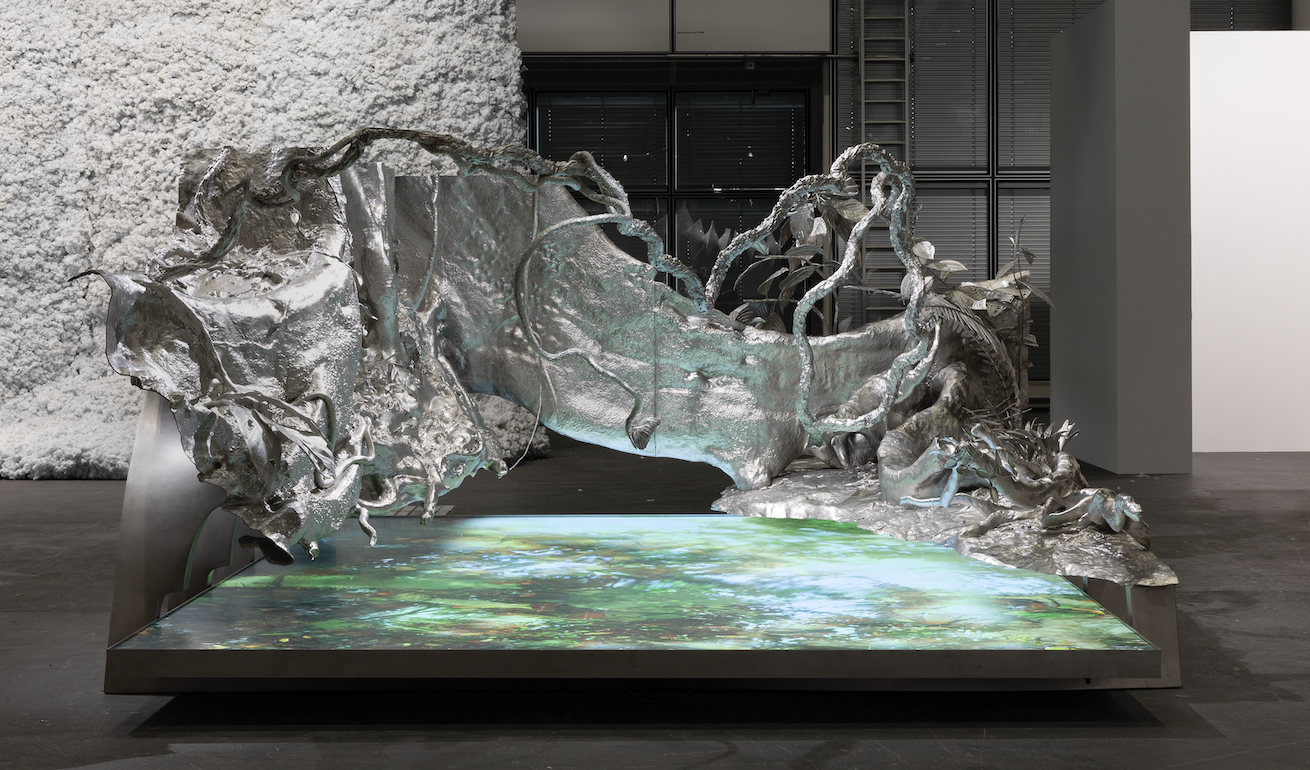
At first glance, the latest installation by Timur Si-Qin appears to embody a familiar contradiction of contemporary art. A pristine fragment of the Amazon rainforest has been recreated using advanced digital scanning, industrial fabrication and polished stainless steel, bringing one of the world's most remote ecosystems into the highly controlled environment of Art Basel.
Yet for Si-Qin, one of the most closely watched artists of his generation, the apparent contradiction is precisely the point.
Unveiled this week at Art Basel Unlimited, Mariposita is an immersive sculptural installation inspired by a period the artist spent in relative isolation within Peru's Ucayali region. Based on detailed scans of a Renaco tree and the pond ecosystem surrounding it, the work recreates roots, insects, water and plant life at full scale, translating a living environment into a highly refined sculptural form.
The result is striking not because it attempts to improve upon nature, but because it asks whether modern societies have become so detached from it that technological mediation is increasingly the only way many people encounter truly wild places.
That question sits at the centre of Si-Qin's practice.
Born in Germany to Mongolian and Chinese heritage, the artist has spent much of the past decade exploring the relationship between spirituality, technology and ecology. While his work is often discussed through the lens of digital culture, Si-Qin has consistently resisted the suggestion that technology is his primary subject.
Instead, he sees technology as merely another tool through which humanity interprets the natural world.
That distinction feels increasingly relevant. The modern environmental debate is often framed as a conflict between technological progress and ecological preservation. Si-Qin's work proposes a more complicated relationship. Human beings have always used technology to understand, represent and engage with nature, from cave paintings to photography and beyond. The tools may have changed, but the impulse remains remarkably consistent.
Mariposita arrives at a moment when questions surrounding biodiversity loss, deforestation and climate change are becoming increasingly urgent. The Amazon rainforest, often described as one of the planet's most important ecological systems, continues to face significant pressure from development, extraction and land-use change.
Rather than confronting viewers with statistics or political slogans, Si-Qin adopts a different approach. The installation functions almost as an act of preservation, capturing a single ecosystem in extraordinary detail and presenting it as an object worthy of contemplation.
There is a distinctly spiritual quality to that gesture.
Throughout history, religious traditions have often encouraged reverence for landscapes, forests and natural phenomena. Modern societies, by contrast, tend to value nature primarily through economic, scientific or recreational frameworks. Si-Qin belongs to a growing group of artists questioning whether something important has been lost in that transition.
His previous large-scale projects explored similar themes, including Sacred Footprint, a monumental installation commissioned for Meta's New York headquarters. Yet Mariposita feels more intimate. Rather than constructing a universal symbol, it focuses on a specific place, a specific tree and a specific encounter.
That specificity gives the work much of its power.
Art Basel is hardly lacking in spectacle. The world's most influential art fair has built its reputation on ambitious installations and headline-grabbing works. Yet some of the most memorable pieces are often those that encourage reflection rather than demand attention.
In an era increasingly dominated by screens, algorithms and virtual experiences, Mariposita poses a surprisingly simple question: what happens when direct encounters with nature become the exception rather than the norm?
For Si-Qin, the answer appears to begin with looking more carefully.
Whether through sculpture, digital technology or simple observation, his work suggests that preserving the natural world may first require learning how to see it again.
Mariposita is on view at Art Basel Unlimited from 15–21 June 2026.
Continue Reading
More Art & Design
Josie Ryan paints the wildlife she refuses to let us forget
In the Tarn hills, Anne Briaud turns fragments into imagined worlds
Heinz Mack brings a lifetime’s study of light to Berlin